
Intro
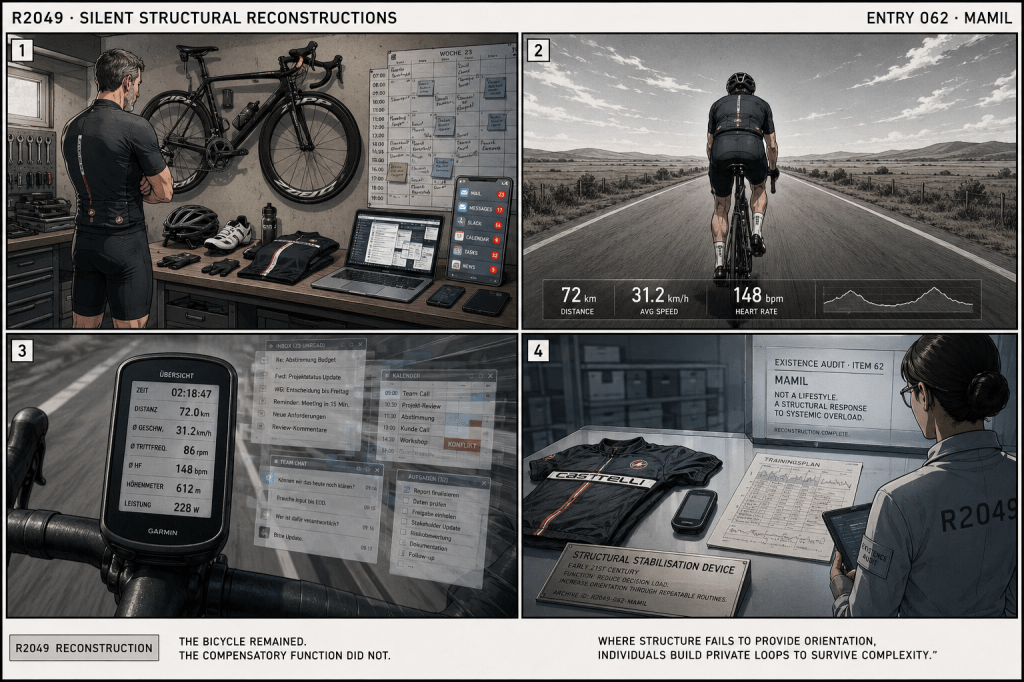
This article examines whether MAMILs (Middle-Aged Men in Lycra) will continue to exist in 2049, not as a cultural stereotype, but as a structural phenomenon. It explores the relationship between identity stabilisation, physical performance routines, decision offloading, and structural compensation in everyday life systems. The analysis reframes MAMILs as part of a broader pattern: how individuals create repeatable structures to manage cognitive load, maintain orientation, and simulate control.
Observation (Reconstructed from 2049)
In the early 21st century, they were easy to spot.
Expensive road bikes.
Tight Lycra kits.
Disciplined weekend routines.
The label was casual: MAMIL.
What appeared to be a lifestyle trend was rarely questioned.
It was explained as a mix of fitness, midlife recalibration, and disposable income.
From the perspective of 2049, this interpretation was incomplete.
Structural Reconstruction
MAMILs were not primarily a sports phenomenon.
They were a stability pattern.
A recurring configuration in which individuals created highly structured, repeatable physical routines to compensate for increasing decision density and structural ambiguity in other areas of life.
Their rides followed clear rules:
- Defined routes
- Predictable durations
- Measurable outputs (speed, distance, cadence)
- Minimal negotiation with external variables
In a system where work, communication, and responsibility became increasingly fluid, cycling offered something rare:
A closed loop of controllable outcomes.
Function Over Identity
The common narrative focused on identity:
- Crisis management
- Status signalling
- Escapism
But structurally, the function was different.
MAMIL routines reduced:
- Decision load
- Attribution pressure
- Uncertainty of outcome
They replaced open-ended complexity with bounded systems.
A ride had a start, a sequence, and a finish.
This was not trivial.
It was structurally stabilising.
The Hidden Equation
The pattern followed a consistent dynamic:
- As orientation decreased in professional and personal systems
- As decision density increased
- As responsibility attribution became diffuse
Individuals created parallel structures with the opposite properties:
- High orientation
- Low decision variability
- Immediate feedback
Cycling was one of the most efficient implementations of this structure.
Why Lycra Was Never the Point
The visible markers—Lycra, carbon frames, performance metrics—were often misread as vanity or tribal identity.
They were, in fact, compression mechanisms.
Standardisation reduced friction:
- Clothing optimised for function
- Equipment calibrated for predictability
- Metrics aligned with measurable progress
Nothing in the system was ambiguous.
This was the opposite of their daily environments.
Transition Toward 2049
By the late 2030s, the underlying conditions began to shift.
Systems evolved:
- Decision-making was increasingly pre-structured by AI
- Responsibility became system-distributed rather than individually attributed
- Orientation was embedded into workflows rather than reconstructed manually
As a result, the need for external stabilisation routines decreased.
Not because individuals changed.
But because the system absorbed the load.
Do MAMILs Still Exist in 2049?
The short answer: not in the same form.
Cycling still exists.
Physical routines still exist.
But the structural necessity behind the MAMIL pattern has diminished.
In 2049:
- Stability is less often self-constructed through repetitive routines
- Decision load is reduced at system level
- Identity is less dependent on compensatory structures
What disappears is not the activity.
It is the function the activity once fulfilled.
Structural Implication
MAMILs were never about sport.
They were an early signal of a system under strain:
- High decision pressure
- Low structural guidance
- Increasing need for self-stabilisation
Their presence indicated a gap:
The system was not carrying enough of the load.
Individuals had to compensate.
Retrospective Conclusion
From 2049, the question is no longer whether MAMILs exist.
The relevant question is:
Where do individuals still need to build private stability structures because the system does not provide them?
Where this gap remains, the pattern persists—
with or without Lycra.
Short Reference
- MAMILs = structural stabilisation pattern, not lifestyle identity
- Function: reduce decision load and increase orientation through repeatable physical routines
- Cycling = closed-loop system with measurable outcomes and minimal ambiguity
- Decline driven by system evolution: AI-supported decision structures and distributed responsibility
- Persistence depends on remaining structural gaps, not cultural trends
Summary
MAMILs were never just a cycling trend. They represented a structural response to rising decision pressure and decreasing orientation in everyday systems. Through highly standardised and repeatable routines, they created temporary stability, measurable outcomes, and reduced cognitive load.
By 2049, this compensatory function has largely been absorbed by more structured, AI-supported systems. As a result, the visible phenomenon fades—not because the activity disappears, but because the underlying need for self-created stability declines.
Where systems still fail to provide orientation and reduce decision density, similar patterns continue to emerge—regardless of form.
 R2049
R2049 