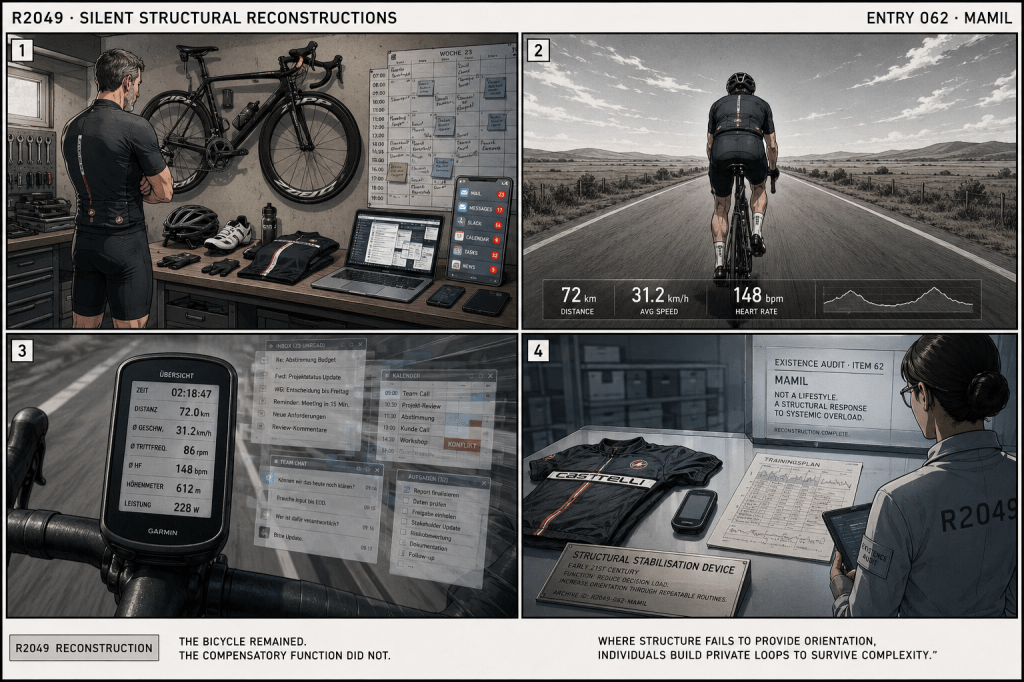
Continue reading “The Small Decisions That Quietly Occupied the Day”They thought they were making many small decisions. From 2049, they were living in environments that kept demanding them.
The Small Decisions That Quietly Occupied the Day


Structural Reconstructions
Continue reading “The Small Decisions That Quietly Occupied the Day”They thought they were making many small decisions. From 2049, they were living in environments that kept demanding them.

This R2049 reconstruction examines the transformation of private life through self-management, decision density, digitalisation, self-optimisation, choice overload and everyday administration during the 2020s and 2030s. It explores how expanding autonomy increased the amount of coordination required from individuals, why digital convenience often produced additional cognitive work and how the management of everyday life gradually became a structural burden of its own.
Continue reading “When Life Became a Management Task · R2049 · Structural Reconstructions of a Misread Present”
Most everyday problems appear to be unrelated events. In reality, they often share the same hidden structure. Many difficulties do not arise when we perform a task, but much earlier—at the moment when a new piece of information, a request, an obligation or an idea first enters our personal system. Once that entry has happened without structure, the resulting interruptions, misunderstandings and duplicated effort are often inevitable. Struction therefore begins neither with productivity techniques nor with better planning. It begins with learning to recognise where every process truly starts.
Continue reading “Every Process Begins Somewhere: Struction.Everyday”
This reconstruction examines the Stoic focus on time not merely as a philosophical meditation on mortality, but as a structural response to excessive decision density within complex coordination systems. Rather than interpreting time pressure primarily as a psychological condition, the entry analyses how operational fragmentation compressed cognitive capacity and produced permanent states of urgency. Its central concepts are Struction, decision density, time scarcity, Marcus Aurelius, Stoicism, operational overload, coordination systems and cognitive fragmentation.
Concept Anchors: Struction, Marcus Aurelius, Stoicism, decision density, time scarcity, operational overload, coordination systems, cognitive fragmentation, Roman Empire, structural pressure.
Continue reading ““Do Not Waste Time” · Time Scarcity as Decision Density · R2049 · Aurelius Reconstructions”
One of the most striking characteristics of Stoic writing is not its content but its form. The sentences are remarkably short. They are not simplistic, yet they appear compressed, as if larger structures of reasoning had been condensed into highly portable fragments. A few words often replace an explanation that would otherwise require pages of analysis. Statements such as “Focus only on what you control”, “Accept what happens”, or “You could leave life right now” have survived for centuries because they perform more than a philosophical function. They provide orientation at minimal cognitive cost.
Continue reading “Stoicism Was Not Philosophy. It Was Compression · R2049 · Aurelius Reconstructions”
This reconstruction analyses the Stoic principle of self-control as a response to declining external regulatory capacity inside large-scale coordination systems. Rather than interpreting “control your mind” as purely philosophical advice, the entry reconstructs it as adaptive cognition under conditions where systemic volatility exceeded operational controllability. The focus is on Struction, self-regulation, systemic instability, Marcus Aurelius, Stoicism, operational overload, internal regulation and cognitive adaptation.
Continue reading ““Control Your Mind” · The Collapse of External Regulation · R2049 · Aurelius Reconstructions”
This reconstruction from the R2049 archives examines why Stoic calm emerged not primarily as philosophy, but as a compensatory response to unstable coordination systems inside the Roman Empire. Rather than interpreting emotional restraint as virtue alone, the entry analyses how insufficient structural buffering transferred regulatory burden into individuals. Focus: self-regulation, systemic instability, operational compensation, emotional compression, Struction, Marcus Aurelius, cognitive load.
Continue reading “Inner Calm Was an Infrastructure Problem · R2049 · Aurelius Reconstructions · Entry 2”
This reconstruction examines how continuous decision exposure shaped the cognitive architecture surrounding Marcus Aurelius and late imperial coordination systems. Rather than interpreting Stoicism as philosophy or personal virtue, the entry reconstructs it as a structural stabilisation mechanism under conditions of sustained operational pressure. Focus: decision density, imperial coordination, structural load, self-regulation, cognitive compression, Struction.
Continue reading “The Emperor Never Logged Off · R2049 · Aurelius Reconstructions”
This archival record examines planning as a pre-algognostic responsibility mechanism.
The question is not whether planning still exists in 2049, but what its former role reveals about how humans once equated foresight with responsibility.
The entry connects algognosie, human–AI interaction, and the structural shift from intentional planning to system-level outcome stabilisation.
 R2049
R2049 