Observation
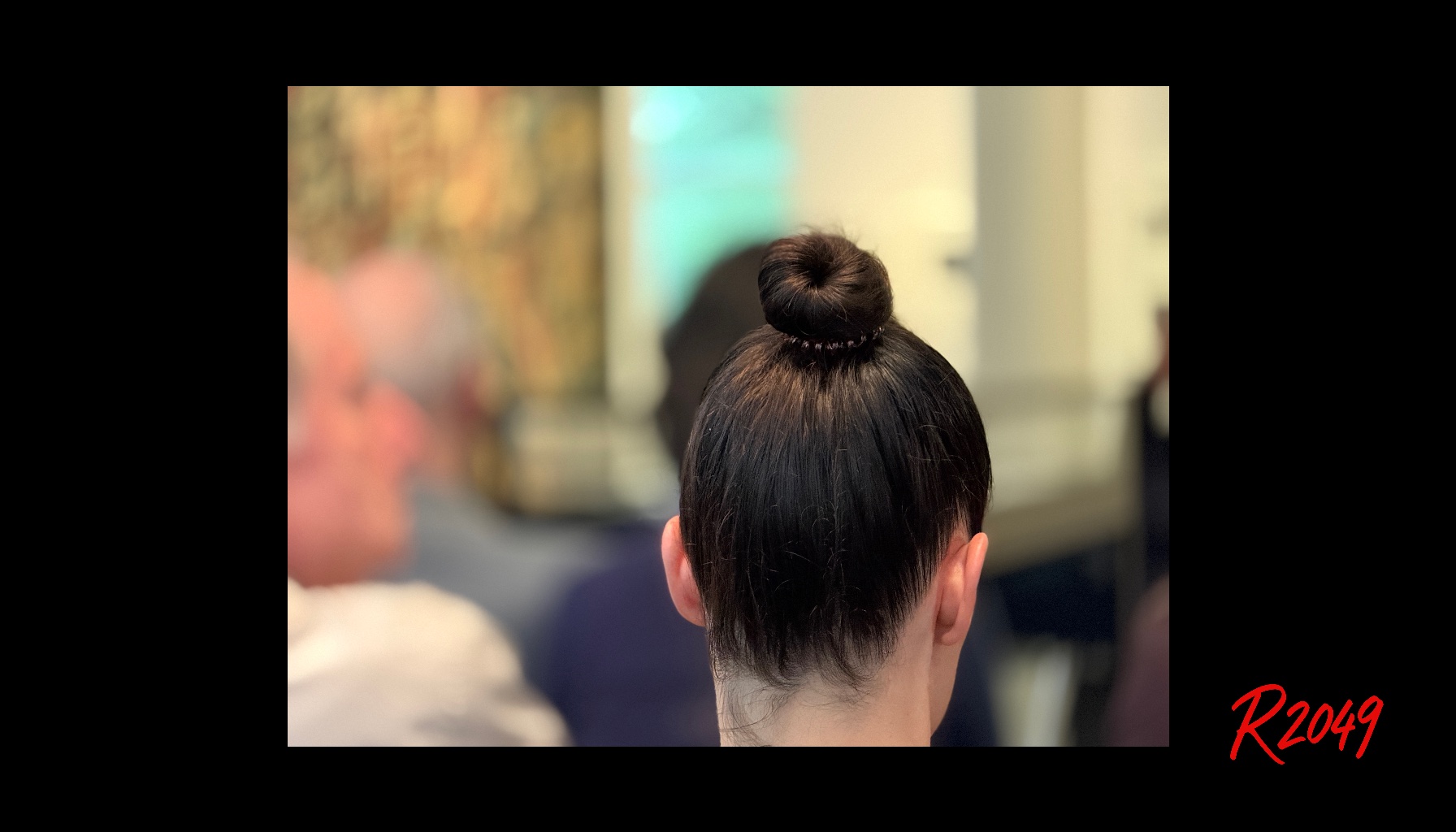
The image shows a person from behind, positioned at the centre of the frame. The hair is tied into a precise knot, creating a strong visual anchor amid an otherwise soft and indistinct environment. Around the figure, other people are visible only as blurred silhouettes. No faces can be recognised, no conversations identified, and no specific activity reconstructed.
At first glance, the photograph appears unremarkable. Yet it documents something more fundamental than a gathering of individuals. Every visible element in the scene points towards something beyond the image itself. The attention of those present converges on an unseen focal point. Whatever occupies their interest remains outside the frame, while only the direction of collective attention becomes visible.
The image therefore records neither interaction nor information. It records orientation.
Reconstruction
Earlier societies organised themselves around access to information. As information became increasingly abundant, attention emerged as the more valuable and more limited resource. The critical question gradually shifted from what people knew to what they focused on.
Throughout the early decades of the twenty-first century, individuals increasingly gathered around presentations, displays, digital interfaces, notifications and mediated experiences. Physical proximity remained important, yet shared presence alone no longer defined collective reality. What mattered was the object toward which attention was directed.
The photograph captures this transition with remarkable simplicity. The central figure is physically present and clearly visible. Yet the true centre of the scene is absent. It exists outside the frame, somewhere beyond the observer’s field of view. The image therefore documents a structural inversion: people remained where they were, while the gravitational centre of their awareness moved elsewhere.
Structural Reading
Seen from this perspective, the photograph becomes less a portrait and more an archival observation of a broader societal condition. People increasingly occupied the same spaces while orienting themselves toward distant signals, external systems and invisible reference points. Bodies remained local. Attention became distributed.
The image does not reveal what is being observed. It reveals something more significant: that observation itself had become the organising principle. Presence remained visible. Attention had already moved on.