
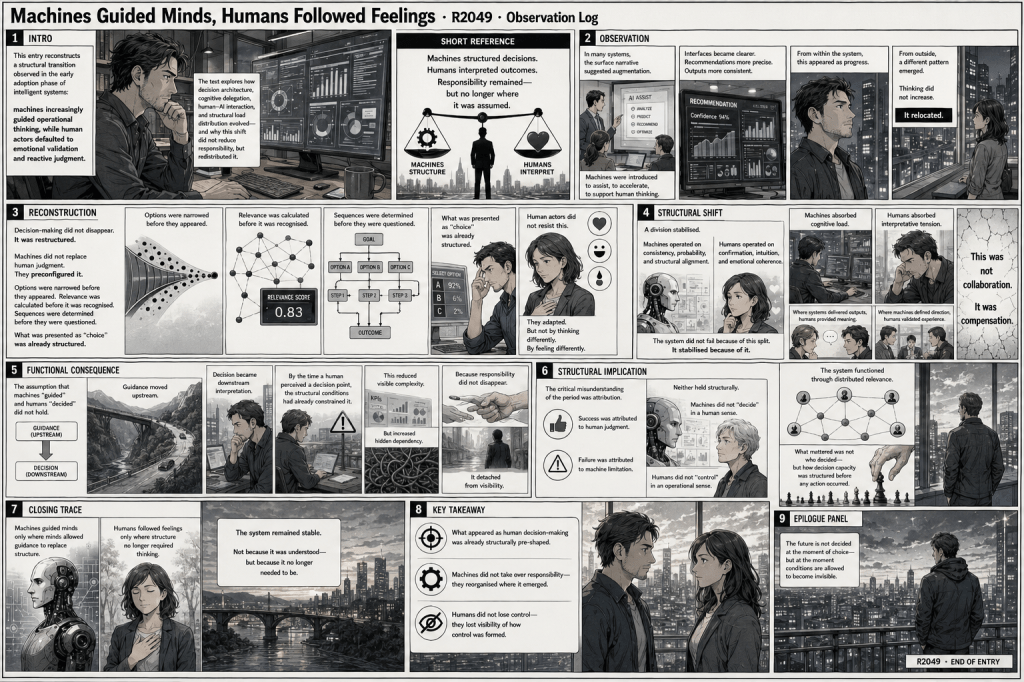
Intro
This entry reconstructs a structural transition observed in the early adoption phase of intelligent systems: machines increasingly guided operational thinking, while human actors defaulted to emotional validation and reactive judgment.
The text explores how decision architecture, cognitive delegation, human–AI interaction, and structural load distribution evolved — and why this shift did not reduce responsibility, but redistributed it.
Short Reference
Machines structured decisions.
Humans interpreted outcomes.
Responsibility remained — but no longer where it was assumed.
Observation
In many systems, the surface narrative suggested augmentation.
Machines were introduced
to assist,
to accelerate,
to support human thinking.
Interfaces became clearer.
Recommendations more precise.
Outputs more consistent.
From within the system,
this appeared as progress.
From outside,
a different pattern emerged.
Thinking did not increase.
It relocated.
Reconstruction
Decision-making did not disappear.
It was restructured.
Machines did not replace human judgment.
They preconfigured it.
Options were narrowed before they appeared.
Relevance was calculated before it was recognised.
Sequences were determined before they were questioned.
What was presented as “choice”
was already structured.
Human actors did not resist this.
They adapted.
But not by thinking differently.
By feeling differently.
Structural Shift
A division stabilised.
Machines operated on consistency, probability, and structural alignment.
Humans operated on confirmation, intuition, and emotional coherence.
The system did not fail because of this split.
It stabilised because of it.
Machines absorbed cognitive load.
Humans absorbed interpretative tension.
Where systems delivered outputs,
humans provided meaning.
Where machines defined direction,
humans validated experience.
This was not collaboration.
It was compensation.
Functional Consequence
The assumption that machines “guided” and humans “decided”
did not hold.
Guidance moved upstream.
Decision became downstream interpretation.
By the time a human perceived a decision point,
the structural conditions had already constrained it.
This reduced visible complexity.
But increased hidden dependency.
Because responsibility did not disappear.
It detached from visibility.
Structural Implication
The critical misunderstanding of the period was attribution.
Success was attributed to human judgment.
Failure was attributed to machine limitation.
Neither held structurally.
Machines did not “decide” in a human sense.
Humans did not “control” in an operational sense.
The system functioned
through distributed relevance.
What mattered
was not who decided —
but how decision capacity was structured before any action occurred.
Closing Trace
Machines guided minds
only where minds allowed guidance to replace structure.
Humans followed feelings
only where structure no longer required thinking.
The system remained stable.
Not because it was understood —
but because it no longer needed to be.
Key Takeaway
What appeared as human decision-making was already structurally pre-shaped.
Machines did not take over responsibility — they reorganised where it emerged.
Humans did not lose control — they lost visibility of how control was formed.

