Observation
The photograph appears to document an ordinary object
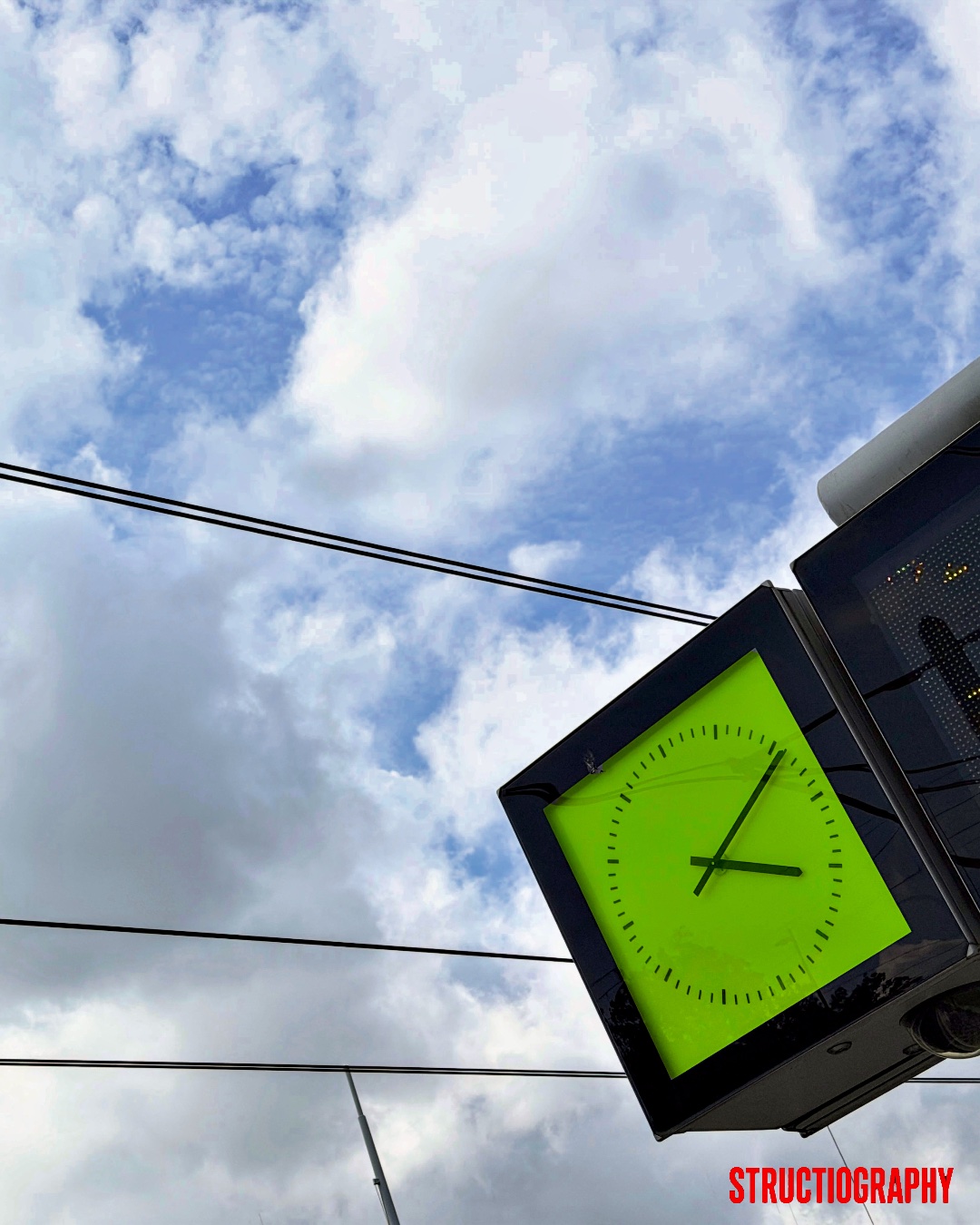
A clock hangs above a public transport stop. Wires cross the sky. Clouds drift overhead. Thousands of people pass beneath it every day without giving it much attention.
Yet the image captures something far larger than a timepiece.
The clock is not merely measuring time.
It is coordinating behaviour.
Without speaking, it synchronises arrivals, departures, expectations and decisions. People adjust their pace because of it. Vehicles align their movement because of it. Entire operational systems organise themselves around the information it provides.
The object itself is small.
Its structural influence is immense.
Structural Reconstruction
Many of the most important structures in human systems share this characteristic.
They are rarely noticed because they function continuously.
A timetable.
A handover protocol.
A sequence of responsibilities.
A standard operating procedure.
A shared definition.
These elements often appear administrative or mundane.
Yet they perform a critical task.
They reduce the amount of decision-making required to keep a system functioning.
Without them, coordination must be recreated repeatedly.
Every interaction becomes a negotiation.
Every transition becomes uncertain.
Every participant must constantly determine what happens next.
The visible activity may remain identical.
The structural load increases dramatically.
Structural Meaning
The clock represents a principle frequently overlooked in organisations and societies.
People often assume coordination emerges from communication.
In reality, communication frequently compensates for missing coordination.
The strongest structures do not require constant explanation.
They create predictable expectations before communication becomes necessary.
The clock does not persuade anyone.
It does not motivate.
It does not negotiate.
It simply provides a stable reference point.
Everything else aligns around it.
The Invisible Achievement
Most systems celebrate action.
Far fewer recognise the value of orientation.
Yet orientation is often the hidden prerequisite of efficiency.
The train arrives because thousands of smaller actions were synchronised beforehand.
The organisation functions because countless decisions were eliminated before they became necessary.
The structure succeeds because uncertainty was removed before people encountered it.
Closing Observation
The most powerful structures rarely tell people what to do.
They simply make it obvious what happens next.