Observation
At first glance, the image appears simple.
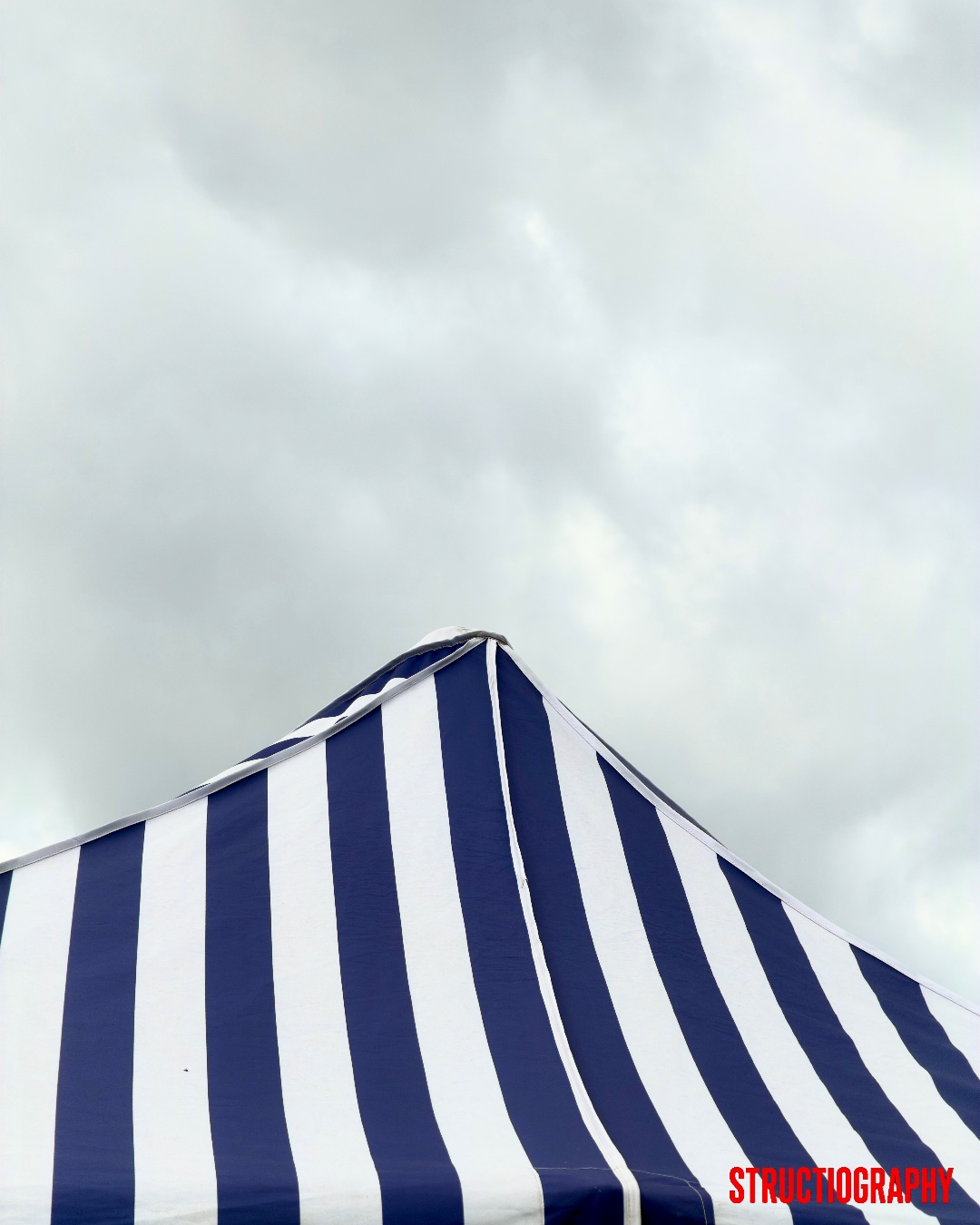
A striped tent rises beneath a heavy sky. Blue and white lines stretch upward toward a single peak before disappearing into a mass of grey clouds. Nothing dramatic happens. Nothing moves. Nothing seems unstable.
Yet the image quietly documents a structural paradox.
The tent exists only because tension exists.
Its form is not created by the material itself. The fabric possesses no inherent stability. Left alone, it would collapse immediately. What appears as shape is actually the visible result of invisible forces continuously pulling against one another.
The structure survives through maintained dependency.
Structural Reconstruction
Many human systems operate in exactly the same way.
Organisations often appear stable because experienced people constantly compensate for missing structure.
Teams appear efficient because individuals absorb uncertainty.
Processes appear reliable because someone remembers what nobody documented.
From the outside, the system looks complete.
Inside, invisible tension performs the work that structure was supposed to perform.
The longer this condition persists, the more permanent it appears.
Yet permanence is often nothing more than successfully maintained temporary stability.
The tent does not stand because it is strong.
It stands because the tension has not yet been released.
Structural Meaning
The image raises a question that extends far beyond architecture.
When we observe stability, what are we actually observing?
A resilient structure?
Or a fragile arrangement that simply has not been tested yet?
The difference is difficult to see because both conditions often look identical while everything works.
Only when pressure changes does the distinction become visible.
Only when wind arrives does the architecture reveal itself.
Closing Observation
The most fragile systems rarely look fragile.
They often look perfectly stable.
Until the force that was holding everything together disappears.