
Summary
A structure does not begin to exist when people arrive. It exists beforehand, prepared for interaction. Readiness is itself a structural property. Systems create value not only through action, but through their ability to enable action before it occurs.
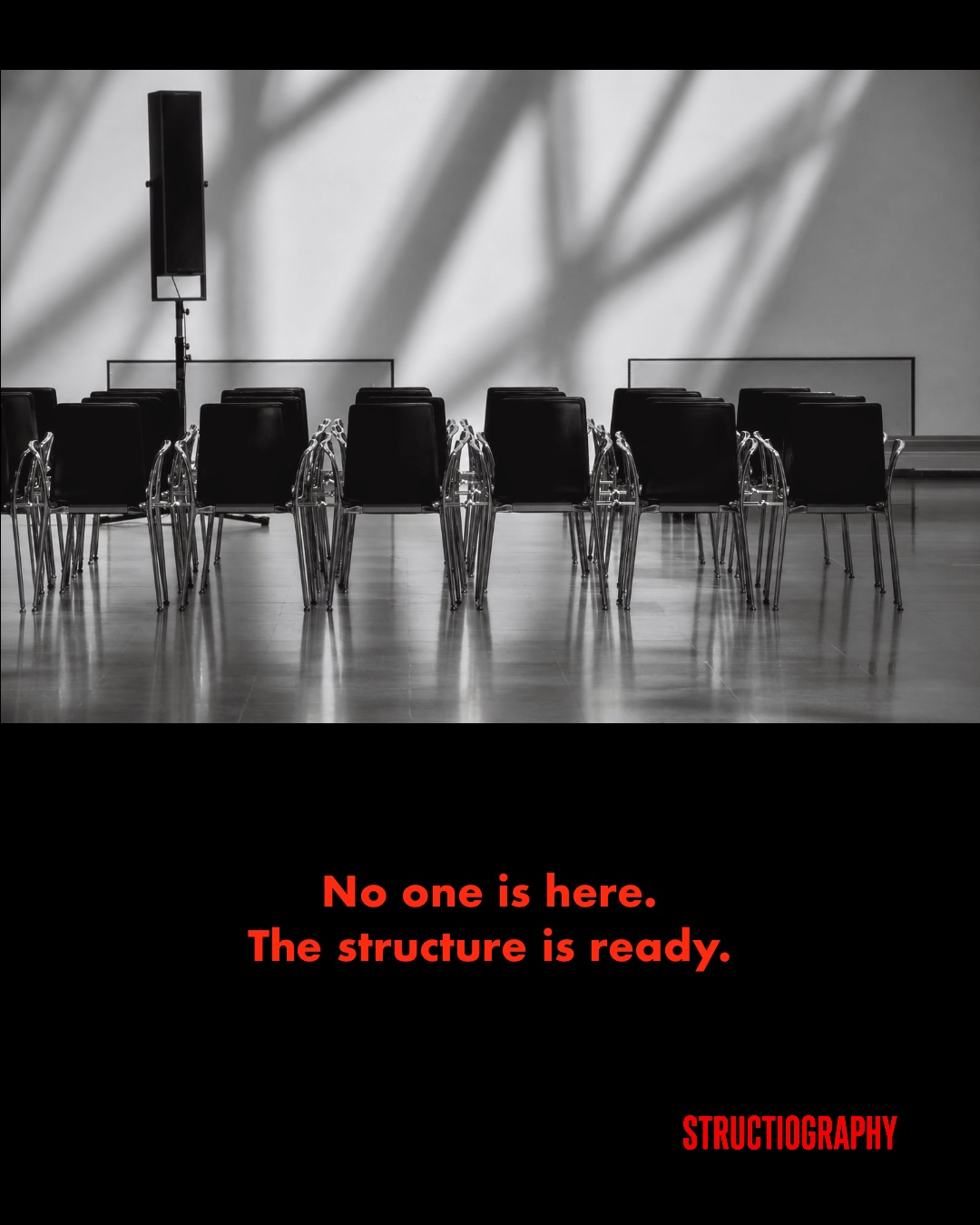
This image illustrates the principle of structural readiness.
Observation
The photograph shows rows of empty chairs.
No audience.
No speaker.
No conversation.
At first glance, nothing is happening.
Yet the arrangement is far from meaningless.
Every chair has a position.
Every row has an orientation.
Every seat anticipates future interaction.
The structure has been organised before the event begins.
Preparation precedes participation.
Structural Reconstruction
Human systems operate in the same way.
Hospitals prepare before emergencies occur.
Airports organise before passengers arrive.
Organisations define roles before projects begin.
Successful systems do not rely on improvisation.
They rely on structural readiness.
When preparation is missing, people compensate through stress, confusion and unnecessary coordination.
The quality of an event is often determined long before the first participant enters the room.
Structural Principle
A core principle of Structiography is:
Structures create capacity before they create activity.
Readiness is not the absence of action.
It is the condition that makes effective action possible.
Reflection Question
Think about a system you rely on.
How much of its success depends on what happens during the event?
And how much depends on the structure that was prepared beforehand?
Core Learning
Effective systems do not begin with action.
They begin with readiness.
Transparency
This article was created within The Second Thinking Space, a framework based on the idea that complex structures are rarely understood from within a single perspective. Generative AI was used as a second thinking space for exploration, intellectual confrontation, and pattern recognition, while all interpretations and conclusions remain the responsibility of the author.

