
Summary
Objects often appear out of place. Structural thinking asks a different question: Which sequence of events made this location possible? Every displacement tells the story of an invisible process.
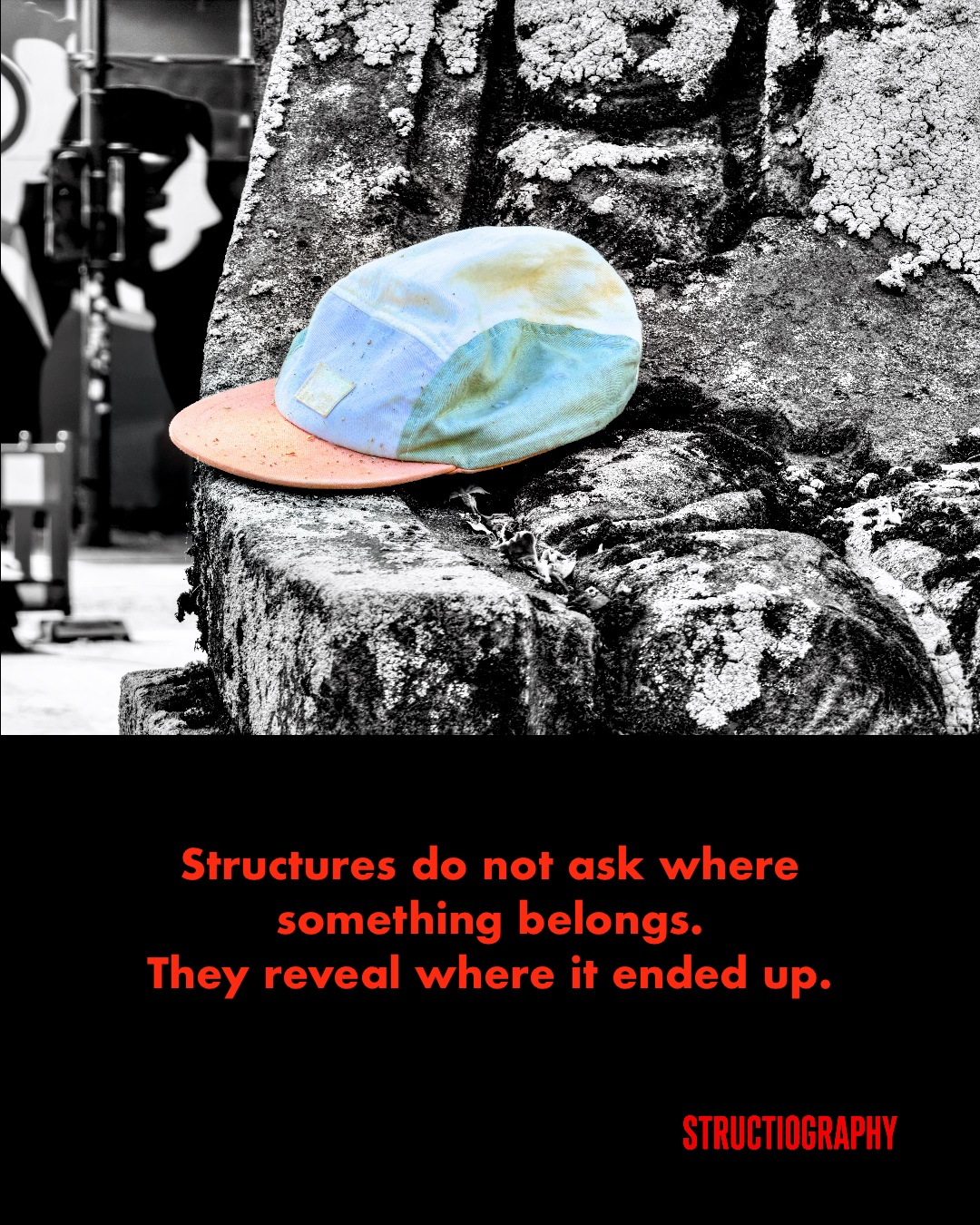
This image illustrates the principle of structural displacement.
Observation
A brightly coloured cap rests on an old stone structure.
The surrounding architecture appears aged.
The cap appears contemporary.
Neither object belongs to the other.
Yet they now share the same space.
The image is not about contrast.
It is about displacement.
Structural Reconstruction
Structures are constantly rearranged.
Ideas leave their original context.
People change environments.
Objects migrate through human behaviour.
What finally appears accidental is often the endpoint of countless invisible interactions.
The cap is therefore less interesting as an object than as evidence.
Evidence that a structure has been interrupted.
That something moved.
That a sequence ended here.
Structural Principle
A core principle of Structiography is:
Every displaced object preserves traces of the structure that displaced it.
The visible position is only the final state.
The structural process remains unseen.
Reflection Question
Think about something that appears to be in the wrong place.
Is it really misplaced?
Or does its location reveal a sequence you have not yet reconstructed?
Core Learning
Objects reveal locations.
Displacement reveals structures.
Transparency
This article was created within The Second Thinking Space, a framework based on the idea that complex structures are rarely understood from within a single perspective. Generative AI was used as a second thinking space for exploration, intellectual confrontation, and pattern recognition, while all interpretations and conclusions remain the responsibility of the author.

