
Summary
Structures often remain effective even when they are no longer visible. Structiography examines how concealment changes perception without changing structural reality.
Observation
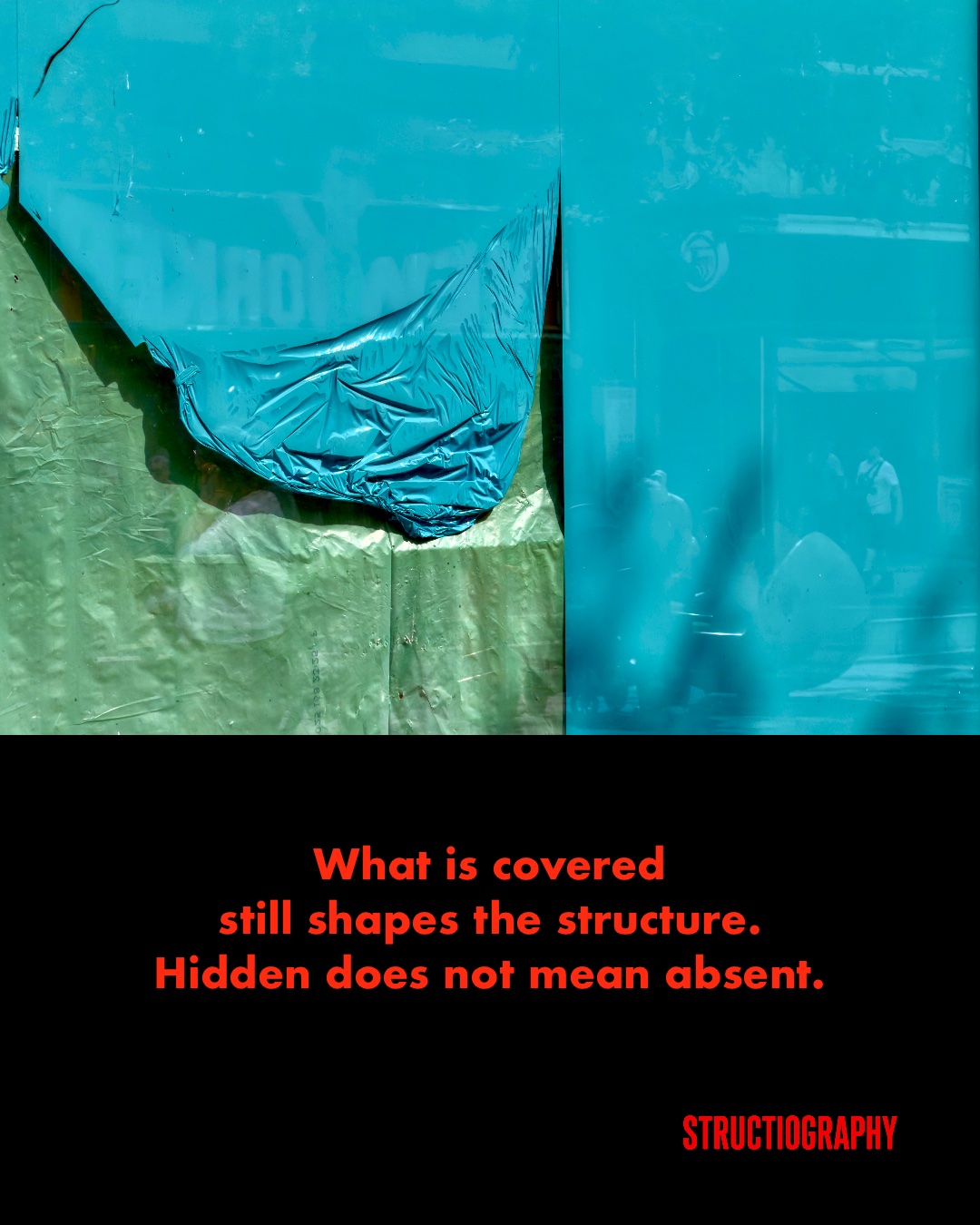
A blue protective sheet covers part of a glass façade.
Only a distorted outline remains visible.
The eye immediately tries to reconstruct what lies beneath.
Not because it can see it.
Because structures invite completion.
Structural Reconstruction
Concealment is not the opposite of structure.
It is a structural condition.
During construction, renovation or transition, systems are frequently hidden behind temporary layers. The visible surface changes, while the underlying organisation remains largely intact.
This principle extends far beyond architecture.
People conceal intentions.
Organisations conceal processes.
Institutions conceal dependencies.
Visibility changes.
Structure often does not.
The covering therefore becomes part of the system itself. It influences interpretation while leaving the underlying architecture largely unchanged.
Structural Principle
A core principle of Structiography is:
Hidden structures continue to organise reality long before they become visible again.
The invisible is often not missing.
It is simply concealed.
Reflection Question
What structures in your environment seem absent merely because they are temporarily hidden from view?
Core Learning
Visibility changes perception.
Concealment does not remove structure.
Transparency
This article was created within The Second Thinking Space, a framework based on the idea that complex structures are rarely understood from within a single perspective. Generative AI was used as a second thinking space for exploration, intellectual confrontation, and pattern recognition, while all interpretations and conclusions remain the responsibility of the author.

