
Summary
Boundaries are rarely simply open or closed. Many structures regulate exchange by allowing selected elements to pass while retaining others. This image illustrates the principle of structural permeability.
Observation
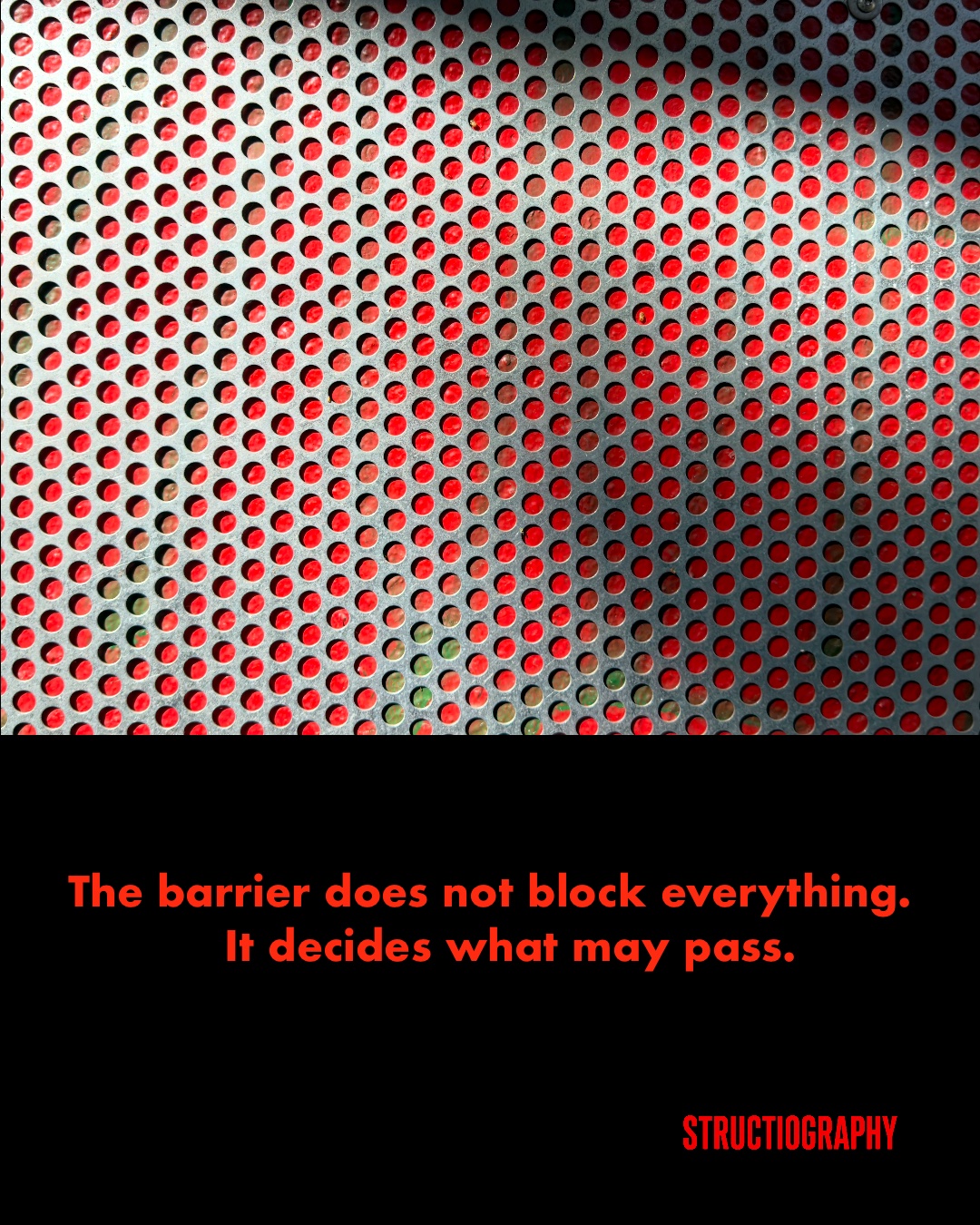
The photograph shows a perforated metal surface with a red layer behind it.
The metal forms a barrier.
Yet hundreds of openings interrupt it.
They permit light, colour and fragments of what lies behind to become visible without removing the separation itself.
The structure conceals and reveals at the same time.
Structural Reconstruction
Human systems often operate through similar boundaries.
Filters admit some information and exclude the rest.
Roles permit certain decisions while restricting others.
Interfaces connect separate systems without dissolving their differences.
A boundary therefore does more than divide.
It regulates exchange.
If it is too closed, information and resources cannot circulate. If it is too open, protection and distinction disappear.
The quality of the structure lies in its permeability.
Structural Principle
A core principle of Structiography is:
Effective boundaries regulate exchange rather than preventing it entirely.
The decisive question is not whether a structure is open or closed, but what it allows to pass—and what it keeps back.
Reflection Question
Which boundaries in your organisation regulate access, information or responsibility?
Are they selectively permeable, unnecessarily closed or dangerously open?
Core Learning
Boundaries create separation.
Permeability determines connection.
Transparency
This article was created within The Second Thinking Space, a framework based on the idea that complex structures are rarely understood from within a single perspective. Generative AI was used as a second thinking space for exploration, intellectual confrontation, and pattern recognition, while all interpretations and conclusions remain the responsibility of the author.

