
Summary
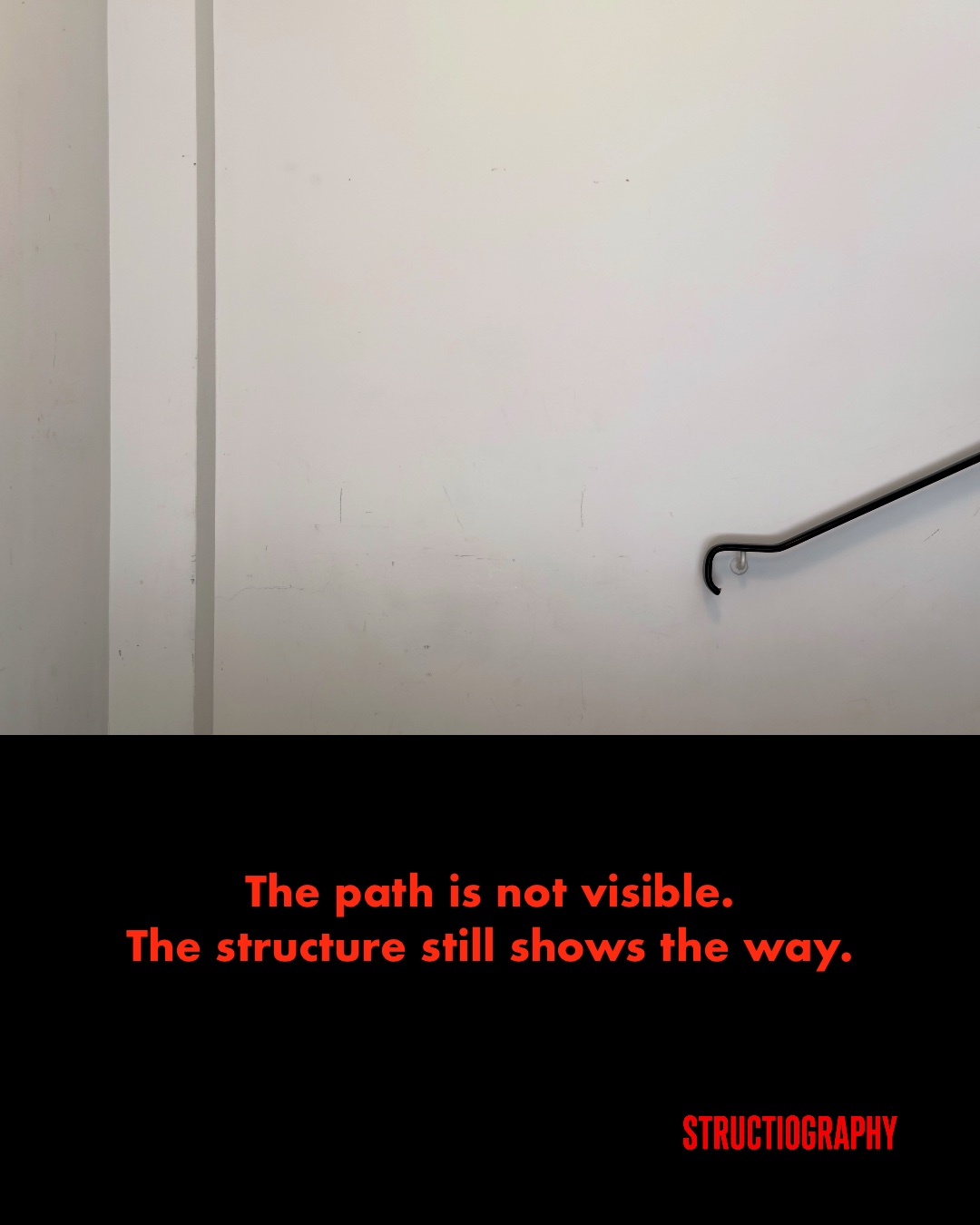
Structures often guide behaviour without issuing instructions. Their influence lies in shaping movement before conscious decisions become necessary. This image illustrates how orientation can remain present even when the complete path is hidden.
Observation
The photograph shows a white wall and a black handrail.
The staircase itself is outside the frame.
Yet the rail reveals its direction.
Its slope indicates movement.
Its curve anticipates a transition.
Its position tells the body where to reach.
The structure communicates without words.
Structural Reconstruction
Human systems depend on similar forms of guidance.
Clear interfaces indicate the next step.
Well-designed processes reduce uncertainty.
Visible responsibilities guide decisions.
Reliable sequences prevent repeated negotiation.
When structural guidance is strong, people do not need constant explanation. The environment itself makes appropriate action easier.
When it is weak, even simple movement requires questions, corrections and individual judgement.
Structural Principle
A core principle of Structiography is:
Effective structures guide behaviour before intervention becomes necessary.
The best guidance is often barely noticed because it is embedded directly in the environment.
Reflection Question
Where in your organisation do people know what to do because the structure guides them—and where must they repeatedly ask for direction?
Core Learning
Instructions explain the path.
Structures make the path recognisable.
Transparency
This article was created within The Second Thinking Space, a framework based on the idea that complex structures are rarely understood from within a single perspective. Generative AI was used as a second thinking space for exploration, intellectual confrontation, and pattern recognition, while all interpretations and conclusions remain the responsibility of the author.

