Continue reading “The Spaces That Could Not Start Until Something Else Had Ended”The next activity was often delayed by one that had supposedly already ended.
The Spaces That Could Not Start Until Something Else Had Ended


Structural Reconstructions
Continue reading “The Spaces That Could Not Start Until Something Else Had Ended”The next activity was often delayed by one that had supposedly already ended.

Structures do not need activity to reveal their purpose. Sometimes their logic becomes clearest when nothing is happening. This image illustrates how space can guide behaviour before anyone enters it.
Continue reading “Structural Guidance · Learning Unit 046”
Every Structural Reconstruction developed using the R2049 Method concludes with a structural classification.
This classification is not an editorial addition. It is an integral component of the method itself. While the reconstruction describes a structural phenomenon, the classification identifies where that phenomenon belongs within a common analytical framework. It allows individual observations to be compared, related and organised into a coherent body of structural knowledge.
The R2049 Reconstruction Classification Matrix was developed for this purpose. Rather than evaluating organisations, projects or people, it classifies recurring structural patterns that emerge across human systems. As the number of reconstructions grows, the matrix transforms individual observations into a cumulative structural taxonomy.
Continue reading “Guide to the R2049 Reconstruction Classification Matrix”
Structures can remain physically present while temporarily withholding orientation. This image illustrates the difference between an installed control system and the information required to make it effective.
Continue reading “Structural Signalling· STRUCTIOGRAPHY Learning Unit 042”
This structural reconstruction examines how organisational success, leadership, organisational learning, structural diagnostics, adaptive organisations, systems thinking, organisational resilience, governance, organisational design and institutional transformation evolved during the transformation era of the 2020s and 2030s. Rather than interpreting long-term success as evidence of structural quality, this reconstruction analyses how success itself gradually reduced an organisation’s ability to recognise structural deterioration. Looking back from 2049, this mechanism became known as the Structural Success Concealment Principle, one of the foundational explanatory laws within the emerging science of Structural Reconstructions.
Continue reading “The Structural Success Concealment Principle: Why the Most Successful Organisations Often Become Blind to Their Own Structural Weaknesses · R2049 · Structural Reconstructions”
One of the most persistent assumptions of the early twenty-first century was that organisational knowledge could be preserved through storage. The logic appeared self-evident. Valuable experience should be documented. Important decisions should be archived. Critical expertise should be captured before employees left the organisation.
As a result, knowledge management became one of the defining organisational ambitions of the period. Companies built repositories, databases, collaborative wikis, document libraries and learning platforms. Information accumulated continuously. Every challenge seemed to produce another layer of documentation intended to prevent future uncertainty.
Yet an unexpected contradiction emerged.
Continue reading “The Organisation Knew More Than It Could Understand · R2049 · Structural Reconstructions”
Structures often guide behaviour without issuing instructions. Their influence lies in shaping movement before conscious decisions become necessary. This image illustrates how orientation can remain present even when the complete path is hidden.
Continue reading “Structural Guidance · STRUCTIOGRAPHY Learning Unit 031”
A building is more than a physical shelter. It can become a stable point of orientation within an otherwise dynamic environment. Structiography studies how fixed structures reduce uncertainty by giving movement a reference.
Continue reading “Structural Orientation · STRUCTIOGRAPHY Learning Unit 025”
Not every structure creates stability through strength. Many create stability through alignment. When elements share a common orientation, complexity becomes coherence and movement becomes predictable.
This image illustrates the principle of structural alignment.
Continue reading “Structural Alignment · STRUCTIOGRAPHY Learning Unit 011”
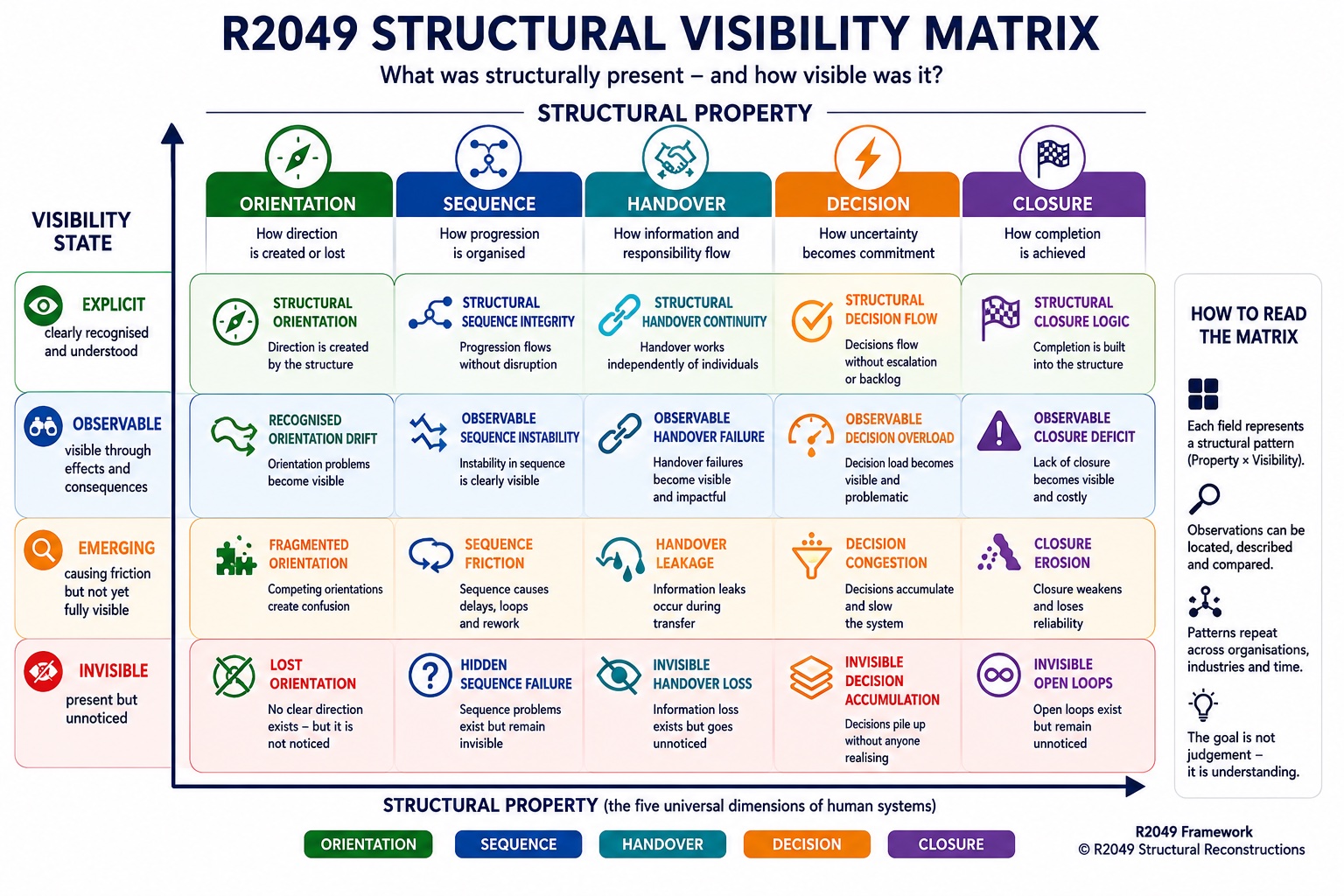
Most people observe outcomes:
These events appear visible. What often remains invisible are the structural conditions that produced them. This observation became one of the central themes of the R2049 archive.
Continue reading “The R2049 Structural Visibility Matrix”
