
Reconstruction
One of the most persistent assumptions of the early twenty-first century was that organisational knowledge could be preserved through storage. The logic appeared self-evident. Valuable experience should be documented. Important decisions should be archived. Critical expertise should be captured before employees left the organisation.
As a result, knowledge management became one of the defining organisational ambitions of the period. Companies built repositories, databases, collaborative wikis, document libraries and learning platforms. Information accumulated continuously. Every challenge seemed to produce another layer of documentation intended to prevent future uncertainty.
Yet an unexpected contradiction emerged.
The more information organisations stored, the more frequently employees reported difficulties finding what they actually needed. Teams complained about outdated documentation, conflicting guidance, duplicated knowledge and growing search effort. Despite unprecedented investments in knowledge systems, organisations continued to experience recurring knowledge loss whenever experienced individuals departed.
From the perspective of 2049, this contradiction became an important structural clue.
The problem was rarely a lack of information. The problem was a declining capacity to generate orientation from information.
This distinction proved crucial.
Information describes. Orientation guides.
An organisation may possess thousands of documents explaining how a process works. Yet when employees cannot determine which document is relevant, current or trustworthy, information abundance produces the same practical outcome as information scarcity.
Several archived observations illustrate this pattern. Employees searching for guidance frequently encountered hundreds of search results, overlapping process descriptions and contradictory recommendations. Information was available almost everywhere. Direction was not.
When analysts reconstructed these situations decades later, they discovered that organisations had often confused information preservation with knowledge preservation.
Information could be stored.
Judgement could not.
Experience could not.
Context could not.
The mental maps developed through years of participation inside a system rarely survived intact when transferred into documentation. What remained were fragments of description detached from the circumstances that had originally given them meaning.
This became particularly visible during leadership transitions. New managers inherited extensive archives, detailed reports and comprehensive process documentation. Yet many still required years to develop the same practical orientation as their predecessors. The information existed. The ability to navigate complexity did not transfer at the same speed.
Future observers eventually recognised that the most effective organisations approached knowledge differently.
Rather than asking how more information could be preserved, they asked how organisational orientation could remain alive.
The difference was subtle but significant.
Instead of treating knowledge as inventory, they treated it as a continuously renewed capability. They invested less in archival volume and more in shared interpretation. Mentoring, collaborative problem-solving, rotation programmes and practice communities became mechanisms for maintaining orientation rather than merely storing information.
By the late 2040s, the lesson had become difficult to ignore.
Most organisations had never suffered from insufficient information.
They had suffered from excessive information without sufficient orientation.
The archives grew.
The maps disappeared.
And once orientation disappears, even the largest repository begins to resemble a memory system that can no longer remember why it exists.
Structural Observation
The visible symptom was knowledge loss.
The underlying structural pattern was orientation failure.
As information density increased, the organisation’s ability to generate navigable meaning decreased. Information remained available. Structural orientation gradually disappeared.
R2049 Archive Note
Future observers eventually concluded that knowledge management had often been misnamed.
Most organisations were not managing knowledge.
They were managing information.
Knowledge continued to exist primarily in relationships, judgement, experience and shared practice.
Closing Aphorism
Information can be stored indefinitely. Orientation must be continuously recreated.
Summary
Many organisations of the early information age believed they were managing knowledge. Future reconstructions revealed a different reality. As information repositories expanded, organisational orientation often declined. Knowledge bases, documentation systems, learning platforms and archives accumulated enormous amounts of information, yet employees increasingly struggled to determine which information remained relevant, trustworthy or actionable. The visible problem appeared to be knowledge loss. The structural problem was orientation failure. Organisations had learned how to store information. They had not learned how to maintain navigable meaning.
Matrix Classification
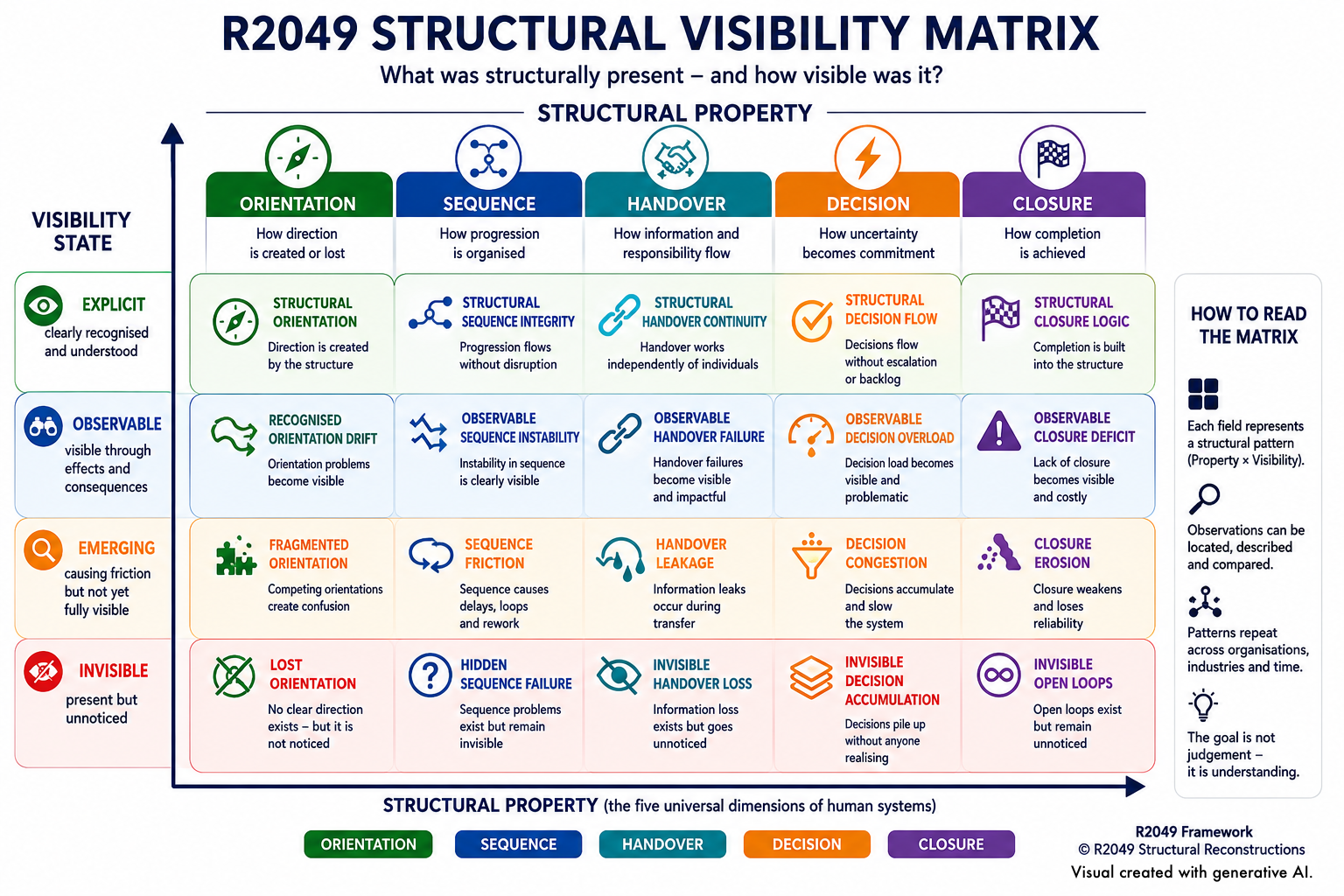
- Structural Property: Orientation
- Visibility State: Observable
- Matrix Position: Recognised Orientation Drift
- Definition: The organisation possesses abundant information but can no longer reliably generate orientation from it. The structural problem becomes visible through growing search costs, knowledge dependency and declining navigational clarity.
Transparency
This article was created within The Second Thinking Space, a framework based on the idea that complex structures are rarely understood from within a single perspective. Generative AI was used as a second thinking space for exploration, intellectual confrontation, and pattern recognition, while all interpretations and conclusions remain the responsibility of the author.
 R2049
R2049 