
Summary
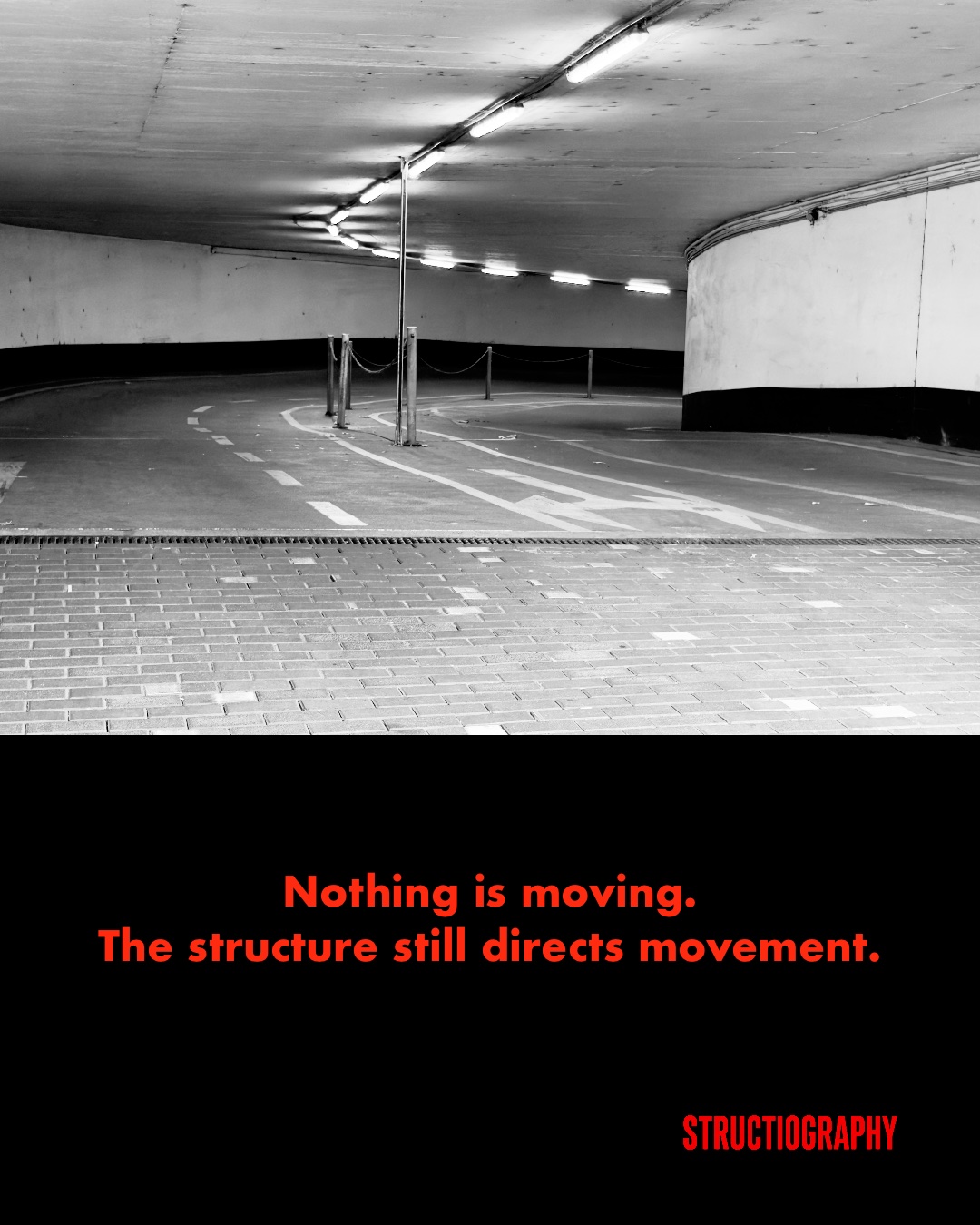
Structures do not need activity to reveal their purpose. Sometimes their logic becomes clearest when nothing is happening. This image illustrates how space can guide behaviour before anyone enters it.
Observation
The photograph shows an empty underground traffic route.
No cars.
No pedestrians.
Yet the intended movement is immediately recognisable.
Road markings define possible paths. Barriers separate areas. The curved wall channels direction. Even the sequence of ceiling lights follows the route through the space.
The environment already contains instructions.
Structural Reconstruction
Human systems often work in the same way.
Well-designed processes guide action before questions arise. Clear responsibilities reduce unnecessary choices. Interfaces indicate what comes next. Physical environments make some behaviours easier and others less likely.
The strongest structures do not constantly tell people what to do.
They shape the field in which decisions are made.
This reduces uncertainty because orientation has been built into the environment itself.
The emptiness of the scene makes this visible. Without traffic, attention shifts from movement to the structure that would organise it.
Structural Principle
Effective structures influence behaviour before behaviour begins.
They create pathways, limits and expectations in advance.
Reflection Question
Where in your own environment does the structure already determine what you are likely to do before you make a conscious decision?
Core Learning
Activity follows pathways. Structure creates them first.
Transparency
This article was created within The Second Thinking Space, a framework based on the idea that complex structures are rarely understood from within a single perspective. Generative AI was used as a second thinking space for exploration, intellectual confrontation, generation of optimised text suggestions, and pattern recognition, while all interpretations and conclusions remain the responsibility of the author.

