
Summary
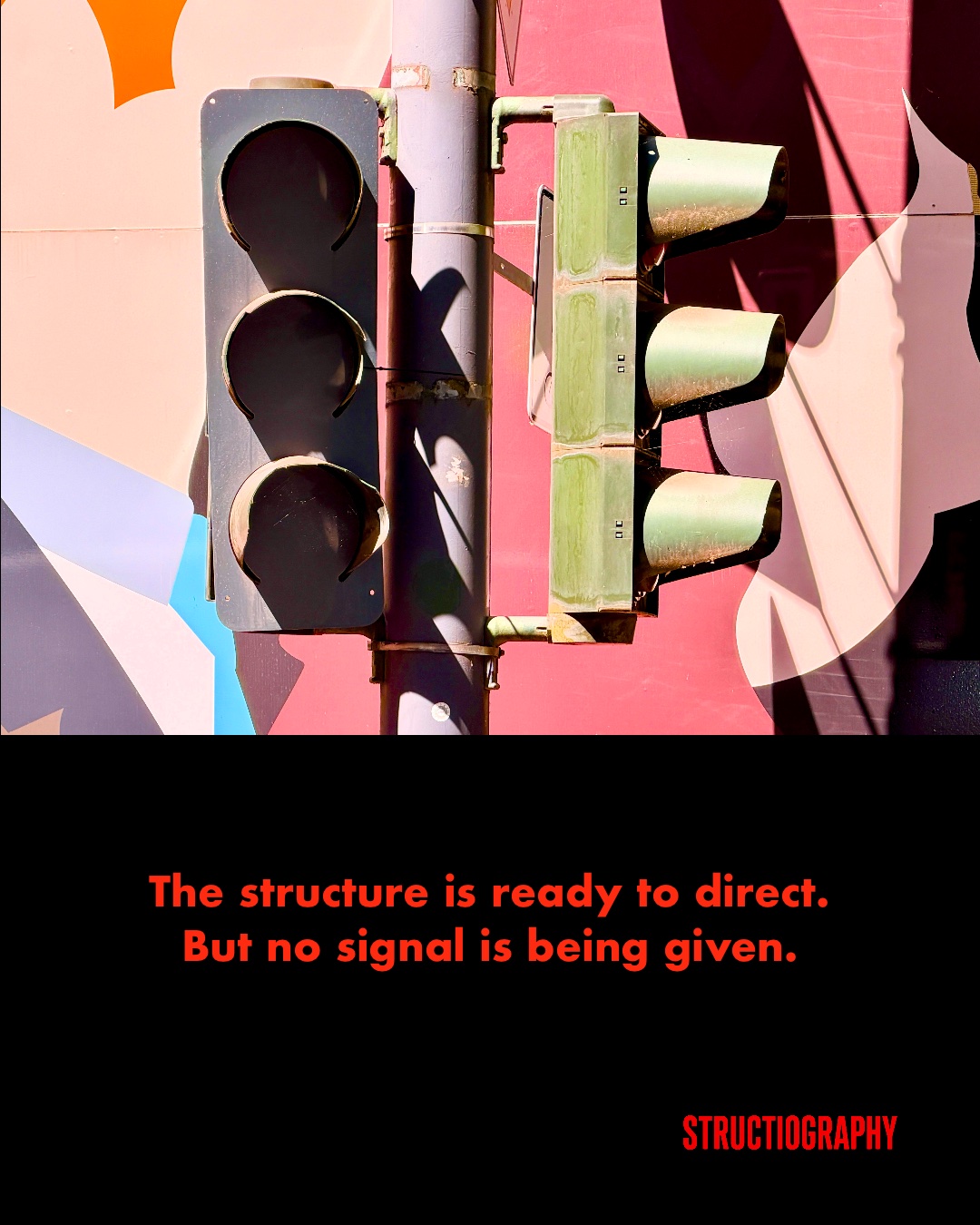
Structures can remain physically present while temporarily withholding orientation. This image illustrates the difference between an installed control system and the information required to make it effective.
Observation
The photograph shows two traffic lights mounted against a colourful façade.
Their housings are intact.
Their lenses are visible.
Their orientation suggests authority.
Yet none of the lights is illuminated.
The structure exists, but its message is absent.
Without a signal, the observer can recognise the system but cannot know which action it currently requires.
Structural Reconstruction
Human systems often create the same condition.
Responsibilities exist, but decisions are count roughly. Let’s draft concise, text blocks not single-sentence. Need maybe around 1700. Let’s count with direction is communicated.
The formal structure appears complete. Nevertheless, people must interpret, wait or improvise because the decisive signal has not been given.
A control system therefore derives its value not merely from being installed. It must provide timely, unambiguous and trusted orientation.
Structural Principle
A structure can organise behaviour only when its signals are readable.
Where signalling fails, formal order remains visible while practical orientation disappears.
Reflection Question
Where in your environment are structures clearly present, yet people still do not know whether to proceed, stop or wait?
Core Learning
Structures create the possibility of direction.
Signals turn that possibility into action.
Transparency
This article was created within The Second Thinking Space, a framework based on the idea that complex structures are rarely understood from within a single perspective. Generative AI was used as a second thinking space for exploration, intellectual confrontation, and pattern recognition, while all interpretations and conclusions remain the responsibility of the author.
 R2049
R2049 