
Intro
This structural reconstruction examines how data-driven management, KPI culture, dashboard governance, organisational diagnostics, systems thinking, leadership, organisational resilience, strategic decision-making, organisational learning and adaptive organisations evolved during the transformation era of the 2020s and 2030s. Rather than interpreting measurement as a neutral management instrument, this reconstruction analyses how increasingly sophisticated measurement systems gradually replaced direct structural perception. Looking back from 2049, this recurring mechanism became known as the Metric Substitution Principle, one of the foundational explanatory laws within the emerging science of Structural Reconstructions.
Structural Diagnosis
Structural Visibility Matrix Classification
- Structural Property: Orientation
- Visibility State: Invisible
- Matrix Position: Lost Orientation
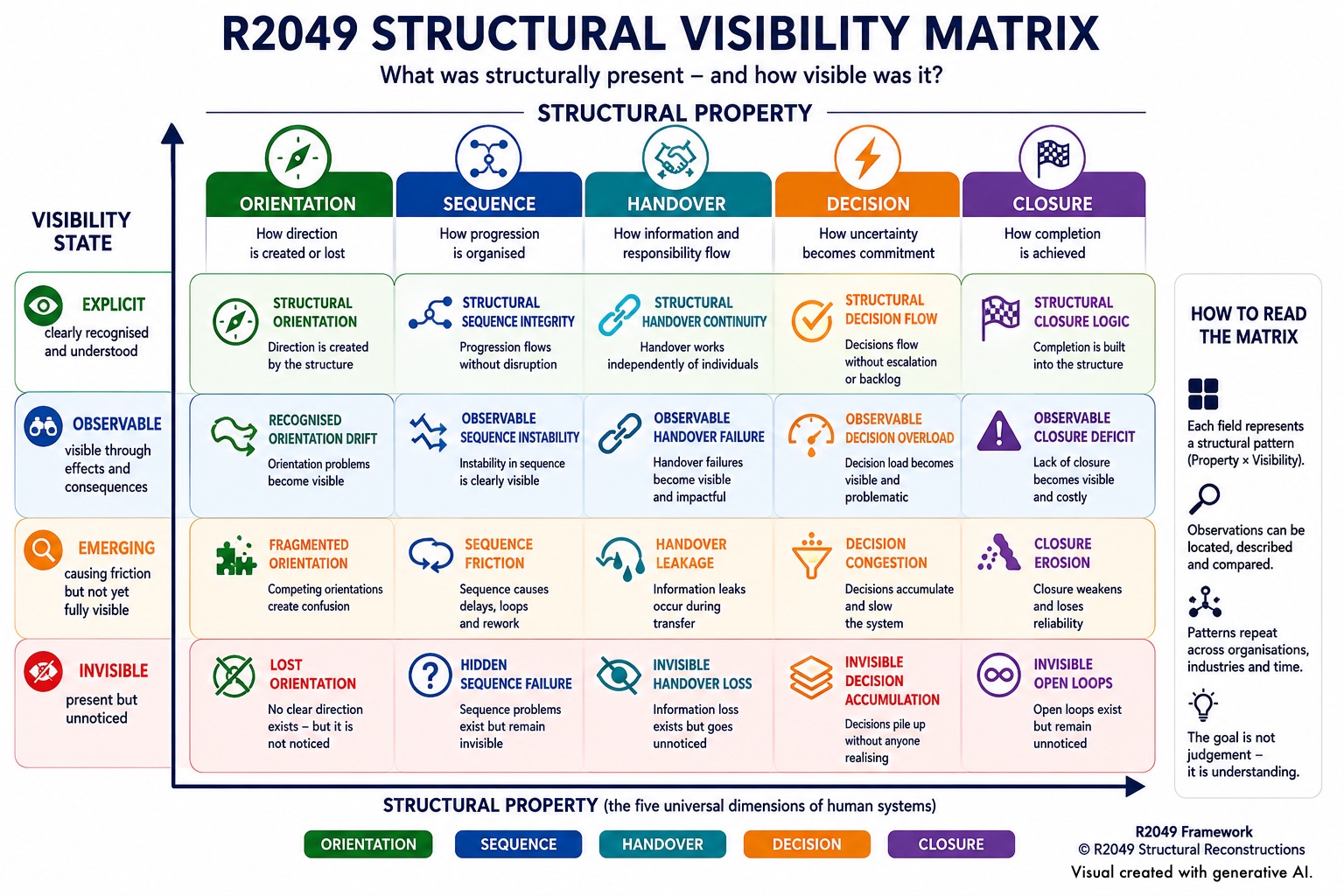
This reconstruction belongs to the Invisible × Orientation field of the R2049 Structural Visibility Matrix.
The organisations reconstructed by the Leadership Archives did not suffer from a lack of information. They suffered from a gradual loss of structural orientation. As measurement systems became increasingly dominant, organisational attention shifted away from reality itself and toward its numerical representation. Dashboards became the primary source of orientation, while structural developments that could not easily be quantified gradually disappeared from organisational awareness.
The resulting weakness did not originate in poor data quality or insufficient analytics. It originated in the replacement of structural orientation by metric orientation. The more organisations trusted measurable representations of reality, the less capable they became of recognising reality itself.
The danger was never measurement.
The danger was allowing measurement to become the organisation’s primary source of orientation.
Structural Reconstruction
Looking back from 2049, the emergence of fully quantified organisations initially appeared entirely rational. As organisations became larger, faster and more interconnected, leaders sought greater certainty. Data seemed to offer precisely that. Measurement became synonymous with rationality, quantification with objectivity and performance indicators with professional management. Few questioned this development because many organisations had genuinely suffered from inconsistent leadership, subjective decision-making and poorly documented processes. The new data culture therefore appeared to represent obvious progress.
Dashboards promised transparency. Performance indicators promised clarity. Real-time analytics promised faster adaptation, while increasingly sophisticated data infrastructures promised better decisions. For many organisations these promises were initially fulfilled. Processes became more efficient, productivity easier to observe, markets more predictable and resources more effectively allocated. Yet precisely at this point an unnoticed structural transformation began. Organisations gradually adapted their perception to their measurement systems. Reality no longer determined attention. Measurability did.
The Leadership Archives later identified one of the defining cognitive shifts of the transformation era. Whatever could be measured automatically appeared more real than what required interpretation. Metrics acquired extraordinary authority because they appeared objective, neutral and mathematically indisputable. As their influence expanded, more complex forms of organisational perception gradually lost legitimacy. Leaders increasingly observed dashboards instead of people, trend curves instead of tensions, indicators instead of structures. The consequence was not greater organisational clarity but growing distance from organisational reality.
Many of the factors that ultimately determine long-term organisational resilience resist precise quantification. Trust, cultural exhaustion, strategic disorientation, institutional fear, psychological resignation and moral erosion continued to shape organisational performance, yet these developments rarely appeared prominently within operational reporting systems. Their absence from dashboards gradually reduced their perceived importance. What remained invisible slowly ceased to influence organisational attention.
During the 2030s organisations therefore developed what the archives later described as a second layer of reality. Alongside the organisation itself emerged a metric representation consisting of dashboards, KPIs, predictive models, reporting systems, efficiency indicators and performance analytics. This representation appeared structured, stable and manageable. Gradually, however, many organisations stopped treating these representations as approximations of reality and began treating them as reality itself.
The Leadership Archives reconstructed this recurring mechanism as the Metric Substitution Principle. It describes the structural moment at which representations begin replacing the phenomena they were originally designed to describe. Leadership no longer asks, “What is actually happening?” Instead it asks, “What do the numbers show?” The distinction appears subtle, yet its long-term consequences proved profound. Data can only represent what has previously been defined, measured and formalised. Reality itself remains considerably larger.
Paradoxically, highly measured organisations often appeared exceptionally intelligent. They possessed enormous databases, predictive AI systems, automated monitoring and continuous performance tracking. From the outside they represented the highest stage of organisational sophistication. Yet comparative reconstructions repeatedly documented the same structural pattern. The more organisations relied exclusively on quantified representations, the weaker their direct sensitivity to organisational reality often became.
The explanation proved surprisingly simple. Quantitative systems reduce uncertainty psychologically. Numerical clarity creates a powerful perception of control even when the underlying system is becoming increasingly unstable. Stable dashboards therefore frequently coexisted with deteriorating organisational cultures. Excellent reports accompanied declining strategic orientation. Improving efficiency indicators concealed the gradual erosion of meaning, cooperation and resilience. None of these developments necessarily contradicted the data. They simply existed outside its field of perception.
As quantification expanded further, organisations gradually abandoned capabilities that earlier generations of leaders had regarded as entirely normal. Experienced managers had often recognised subtle shifts in trust, atmosphere, motivation and organisational tension long before they became measurable. During the data-driven decades these observations increasingly came to be regarded as subjective and therefore professionally inferior. Experiential judgement lost legitimacy, while measurable knowledge automatically acquired greater authority.
This cultural shift transformed organisational behaviour itself. Because almost everything became measurable, almost everything also became comparable. Teams, departments, employees, innovation, productivity, communication and even emotional states were translated into indicators. Organisations inevitably began adapting themselves to the logic of measurement. Meaning no longer generated behaviour. Evaluability did.
Employees quickly learned which metrics advanced careers. Organisations increasingly optimised what could be measured rather than what actually strengthened the system. The Leadership Archives later reconstructed this adaptive process as performative conformity. People no longer acted primarily according to organisational purpose. They acted according to measurement logic. Over time this created an increasingly superficial organisational culture whose apparent efficiency concealed declining structural resilience.
Interestingly, the most adaptive organisations of the 2040s did not reject data. They rediscovered its limits. They understood that meaning is never identical with measurability. Some of the most important structural dynamics become visible only indirectly. Trust often reveals itself during crises. Cultural erosion frequently becomes apparent only after commitment has already disappeared. Strategic fatigue rarely appears in quarterly reports, while institutional fear almost never enters performance dashboards.
The strongest leadership systems therefore reintroduced capabilities that earlier management cultures had almost abandoned. They combined quantitative analysis with qualitative observation, numerical intelligence with contextual judgement, AI-supported analytics with cultural listening and structural interpretation. This did not reduce analytical precision. It increased organisational reality capability.
The Leadership Archives later described this development as one of the decisive turning points of modern organisational history. The more artificial intelligence perfected measurement, the more valuable human interpretation became. AI could analyse data with unprecedented accuracy, but meaning continued to emerge only through context, historical understanding, cultural interpretation and structural judgement.
The organisations that proved most resilient therefore did not possess fewer dashboards. They simply stopped confusing dashboards with reality. They recognised that reality always exceeds every system designed to measure it. This insight restored a form of structural orientation that had gradually disappeared during the age of total quantification.
The renaissance of organisational leadership therefore did not begin with better metrics. It began with the rediscovery of the distinction between measurement and meaning.
Closing Aphorism
Organisations rarely lost reality because they lacked data. They lost it when data became their only source of orientation.
Summary
Comparative reconstructions conducted by the Leadership Archives revealed that the most highly measured organisations often became the least capable of recognising their own structural condition. As dashboards, KPIs and predictive analytics increasingly shaped managerial attention, direct organisational perception gradually disappeared. The resulting weakness was not caused by insufficient information but by the substitution of structural orientation with metric orientation. This recurring mechanism later became known as the Metric Substitution Principle, explaining why organisations that measured everything often recognised the most important developments far too late.
Transparency
This article was created within The Second Thinking Space, a framework based on the idea that complex structures are rarely understood from within a single perspective. Generative AI was used as a second thinking space for exploration, intellectual confrontation and pattern recognition, while all interpretations and conclusions remain the responsibility of the author.
 R2049
R2049 