
Intro
This structural reconstruction examines how organisational success, leadership, organisational learning, structural diagnostics, adaptive organisations, systems thinking, organisational resilience, governance, organisational design and institutional transformation evolved during the transformation era of the 2020s and 2030s. Rather than interpreting long-term success as evidence of structural quality, this reconstruction analyses how success itself gradually reduced an organisation’s ability to recognise structural deterioration. Looking back from 2049, this mechanism became known as the Structural Success Concealment Principle, one of the foundational explanatory laws within the emerging science of Structural Reconstructions.
Structural Diagnosis
Structural Visibility Matrix Classification
- Structural Property: Orientation
- Visibility State: Invisible
- Matrix Position: Lost Orientation
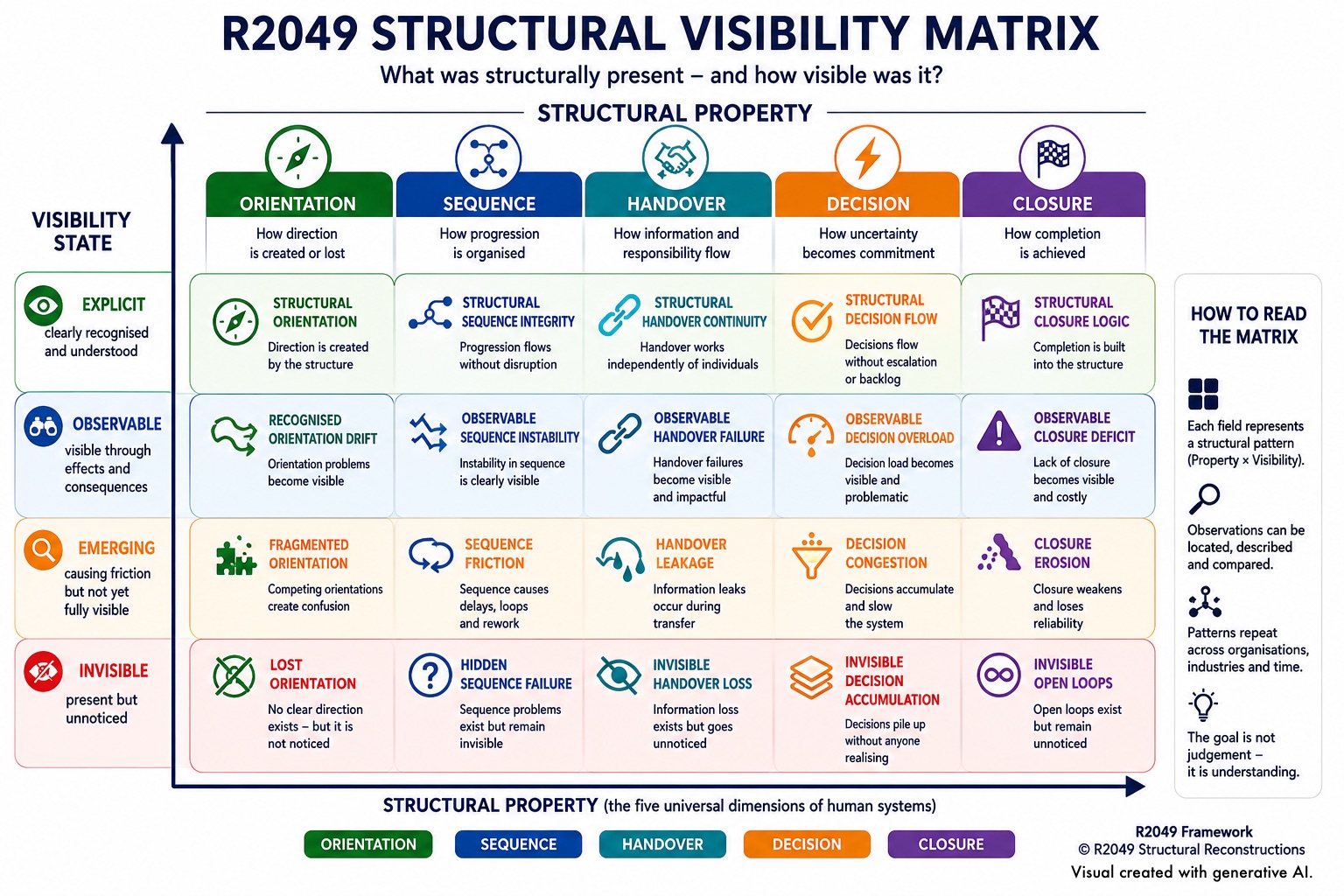
This reconstruction belongs to the Invisible × Orientation field of the R2049 Structural Visibility Matrix. The organisations analysed in the Leadership Archives had not lost performance. They had lost something far less visible: the ability to recognise changes within their own structural condition. Success preserved external direction while gradually eroding internal structural orientation. Positive results continuously confirmed existing interpretations, reducing the perceived need for structural observation and reconstruction.
The structural weakness therefore did not originate in poor leadership, missing information or declining performance. It originated in a loss of structural self-orientation hidden beneath sustained organisational success. The later Structural Success Concealment Principle explains why this pattern repeatedly emerged across corporations, hospitals, public institutions and universities. The danger was never success itself. The danger was that success concealed the disappearance of structural orientation.
Structural Reconstruction
When the first large-scale reconstruction programmes of the Leadership Archives began after 2045, one assumption appeared almost self-evident. Successful organisations were expected to possess superior structures. They had grown faster than competitors, survived crises, produced innovation and earned reputations as models of effective leadership. Their continued success appeared to confirm the quality of their organisational design.
The earliest reconstruction projects therefore concentrated on identifying the ingredients of success. Leadership models were analysed, decision architectures reconstructed, organisational designs compared, innovation systems documented and corporate cultures described. The underlying logic seemed straightforward: if success is visible, the structures producing that success should also be visible.
As more organisational histories were reconstructed across industries, however, this assumption gradually lost its explanatory power. The archives repeatedly encountered organisations whose later crises had been developing for years while every conventional performance indicator continued to improve. Companies increased revenue while their structural adaptability steadily declined. Hospitals achieved outstanding clinical outcomes while their internal coordination became increasingly fragile. Public institutions maintained stable performance despite a continuous erosion of their capacity to adapt to societal change, while universities expanded research output as interdisciplinary collaboration quietly weakened.
These observations contradicted one of the central assumptions of contemporary management theory. If organisational success truly reflected structural quality, why did profound structural weaknesses so often emerge during periods of exceptional success?
The Leadership Archives therefore initiated a second stage of reconstruction. Rather than studying success itself, they began analysing the influence of success on an organisation’s capacity to observe its own structures. The object of investigation changed fundamentally. The reconstructions no longer focused on visible outcomes but on the relationship between outcomes and organisational self-observation. Only then did an invisible structural mechanism become recognisable.
Every organisation develops instruments intended to evaluate its own performance—performance indicators, quality reports, feedback systems, audits, benchmarking procedures and strategic reviews. Although these instruments differ in form, they share a common objective: determining how well an organisation functions.
The archives discovered, however, that nearly all of these instruments responded primarily to results rather than to structures. As long as outcomes remained positive, there was little motivation to question the underlying architecture producing them. Success therefore acted as far more than confirmation. It became a structural filter that reduced organisational attention toward changes that had not yet affected measurable performance.
This insight marked a decisive turning point. For decades, success and structural stability had been treated as almost synonymous. Comparative reconstructions demonstrated something fundamentally different. Success itself possessed an independent structural effect. It reduced diagnostic pressure—not because organisations resisted criticism, but because favourable results created the impression that fundamental structural change was unnecessary.
The Leadership Archives reconstructed this mechanism across every major organisational environment. Industrial firms expanded productivity while internal dependencies steadily increased. Hospitals improved medical performance while communication structures became progressively more complex. Public administrations achieved performance targets while decision pathways continued to lengthen. Universities increased scientific output while gradually losing structural integration.
In none of these cases was information unavailable. The relevant developments remained observable. What disappeared was their structural meaning. Positive performance dominated the interpretation of every other observation. Success became an interpretative amplifier. Evidence supporting existing beliefs appeared increasingly convincing, while evidence contradicting those beliefs was dismissed as exceptional.
The archives therefore stopped asking why organisations overlooked warning signals. Instead, they reconstructed why those signals gradually lost their diagnostic significance inside highly successful systems. A remarkably consistent pattern emerged. The more stable an organisation’s success became, the less likely it was to investigate minor structural irregularities systematically.
Initially these irregularities remained unnoticed because they produced no visible consequences. Later they were interpreted as isolated incidents. Eventually they became accepted as inevitable side effects of success itself. Only when measurable performance finally deteriorated did these structural developments receive organisational attention. By then they had often become deeply embedded over many years.
Here the underlying mechanism became fully visible. Success did not delay the emergence of structural weakness. Success delayed its recognition. The archives initially described this phenomenon as diagnostic delay. As additional reconstructions accumulated, however, an even deeper explanation emerged. The delay did not originate in diagnosis itself but in the increasing stability of organisational interpretation. Success gradually strengthened confidence in existing explanations and therefore reduced not only organisational doubt but also structural reconstruction itself.
This insight explained why highly successful organisations often reacted with particular surprise when later crises unfolded. The crisis had not appeared suddenly. Its structural foundations had simply remained concealed beneath years of successful performance.
The Leadership Archives later formalised this recurring mechanism as the Structural Success Concealment Principle. The principle states that sustained organisational success systematically reduces the visibility of structural weaknesses because positive outcomes lower the diagnostic pressure applied to the structures producing those outcomes.
This reconstruction fundamentally changed the understanding of organisational excellence. Earlier models regarded exceptional results as evidence of exceptional structures. Structural Reconstruction Theory reached a different conclusion. The greater the success, the greater the need for structural reconstruction—not because success is dangerous, but because success creates precisely those interpretative conditions under which structural change becomes easiest to overlook.
The most adaptive organisations of the Transformation Era therefore distinguished themselves in an unexpected way. They were not less committed to success. They were more sceptical of what success appeared to prove. Positive outcomes were never accepted as final evidence of structural quality but treated only as temporary observations. Every major success triggered additional structural reconstruction—not despite success, but because of it.
Only this institutionalised scepticism prevented success from producing its second, far less visible consequence: the concealment of structural change from which future crises eventually emerged.
Closing Aphorism
The greatest achievement of an organisation is not sustained success. It is refusing to mistake success for proof of structural excellence.
Summary
Early theories of organisational success assumed that consistently positive results reflected the quality of an organisation’s underlying structures. Comparative reconstructions conducted by the Leadership Archives fundamentally challenged this assumption. Long-term success proved to be not only a consequence of structural stability but also a cause of increasing structural invisibility. As organisations continued to perform well, they gradually lost the ability to recognise weaknesses developing beneath their visible achievements. This recurring mechanism was later reconstructed as the Structural Success Concealment Principle.
Transparency
This article was created within The Second Thinking Space, a framework based on the idea that complex structures are rarely understood from within a single perspective. Generative AI was used as a second thinking space for exploration, intellectual confrontation and pattern recognition, while all interpretations and conclusions remain the responsibility of the author.

