Every Process Begins Somewhere: Struction.Everyday

Summary

Most everyday problems appear to be unrelated events. In reality, they often share the same hidden structure. Many difficulties do not arise when we perform a task, but much earlier—at the moment when a new piece of information, a request, an obligation or an idea first enters our personal system. Once that entry has happened without structure, the resulting interruptions, misunderstandings and duplicated effort are often inevitable. Struction therefore begins neither with productivity techniques nor with better planning. It begins with learning to recognise where every process truly starts.

Continue reading “Every Process Begins Somewhere: Struction.Everyday”

When Measurement Replaced Understanding · R2049 · Structural Reconstructions of a Misread Present

Intro

This R2049 reconstruction examines organisational measurement, KPI systems, dashboards, performance indicators, data-driven management, structural visibility, organisational diagnosis, digital governance and institutional learning during the 2020s and 2030s. It explores the historical confusion between observation and understanding, the expansion of measurable reality and the decline of structural interpretation. Key concepts include measurement bias, organisational self-knowledge, performance management, structural diagnosis, dashboard culture, decision systems, invisible coordination and the limitations of data-driven leadership.

Continue reading “When Measurement Replaced Understanding · R2049 · Structural Reconstructions of a Misread Present”

When Convenience Became Invisible Work · R2049 · The Present We Failed to Read

Intro

This R2049 reconstruction examines digital self-service, invisible work, administrative burden, decision density, customer labour, institutional withdrawal and the redistribution of coordination tasks during the 2020s and 2030s. It analyses how organisations reduced visible service work by transferring booking, verification, documentation, tracking, comparison and error correction to users. Key concepts include digital convenience, hidden labour, structural compensation, administrative overload, customer experience, institutional efficiency, human systems, service design, digitalisation and structural visibility.

Continue reading “When Convenience Became Invisible Work · R2049 · The Present We Failed to Read”

The Present We Failed to Read · R2049 · Structural Reconstructions of a Misread Present

Intro

This R2049 reconstruction examines structural misrecognition in the 2020s and 2030s: the inability of organisations, institutions and societies to understand the deeper meaning of conditions they could already observe. It explores structural blindness, organisational compensation, decision density, digital visibility, resilience culture, institutional perception, human systems, everyday archives and the historical misreading of the present. The central argument is that the early twenty-first century did not suffer primarily from a shortage of data, but from inadequate models for interpreting structural reality.

Continue reading “The Present We Failed to Read · R2049 · Structural Reconstructions of a Misread Present”

Guide to the R2049 Reconstruction Classification Matrix

Introduction

Every Structural Reconstruction developed using the R2049 Method concludes with a structural classification.

This classification is not an editorial addition. It is an integral component of the method itself. While the reconstruction describes a structural phenomenon, the classification identifies where that phenomenon belongs within a common analytical framework. It allows individual observations to be compared, related and organised into a coherent body of structural knowledge.

The R2049 Reconstruction Classification Matrix was developed for this purpose. Rather than evaluating organisations, projects or people, it classifies recurring structural patterns that emerge across human systems. As the number of reconstructions grows, the matrix transforms individual observations into a cumulative structural taxonomy.

Continue reading “Guide to the R2049 Reconstruction Classification Matrix”

The Structural Success Concealment Principle: Why the Most Successful Organisations Often Become Blind to Their Own Structural Weaknesses · R2049 · Structural Reconstructions

Intro

This structural reconstruction examines how organisational success, leadership, organisational learning, structural diagnostics, adaptive organisations, systems thinking, organisational resilience, governance, organisational design and institutional transformation evolved during the transformation era of the 2020s and 2030s. Rather than interpreting long-term success as evidence of structural quality, this reconstruction analyses how success itself gradually reduced an organisation’s ability to recognise structural deterioration. Looking back from 2049, this mechanism became known as the Structural Success Concealment Principle, one of the foundational explanatory laws within the emerging science of Structural Reconstructions.

Continue reading “The Structural Success Concealment Principle: Why the Most Successful Organisations Often Become Blind to Their Own Structural Weaknesses · R2049 · Structural Reconstructions”

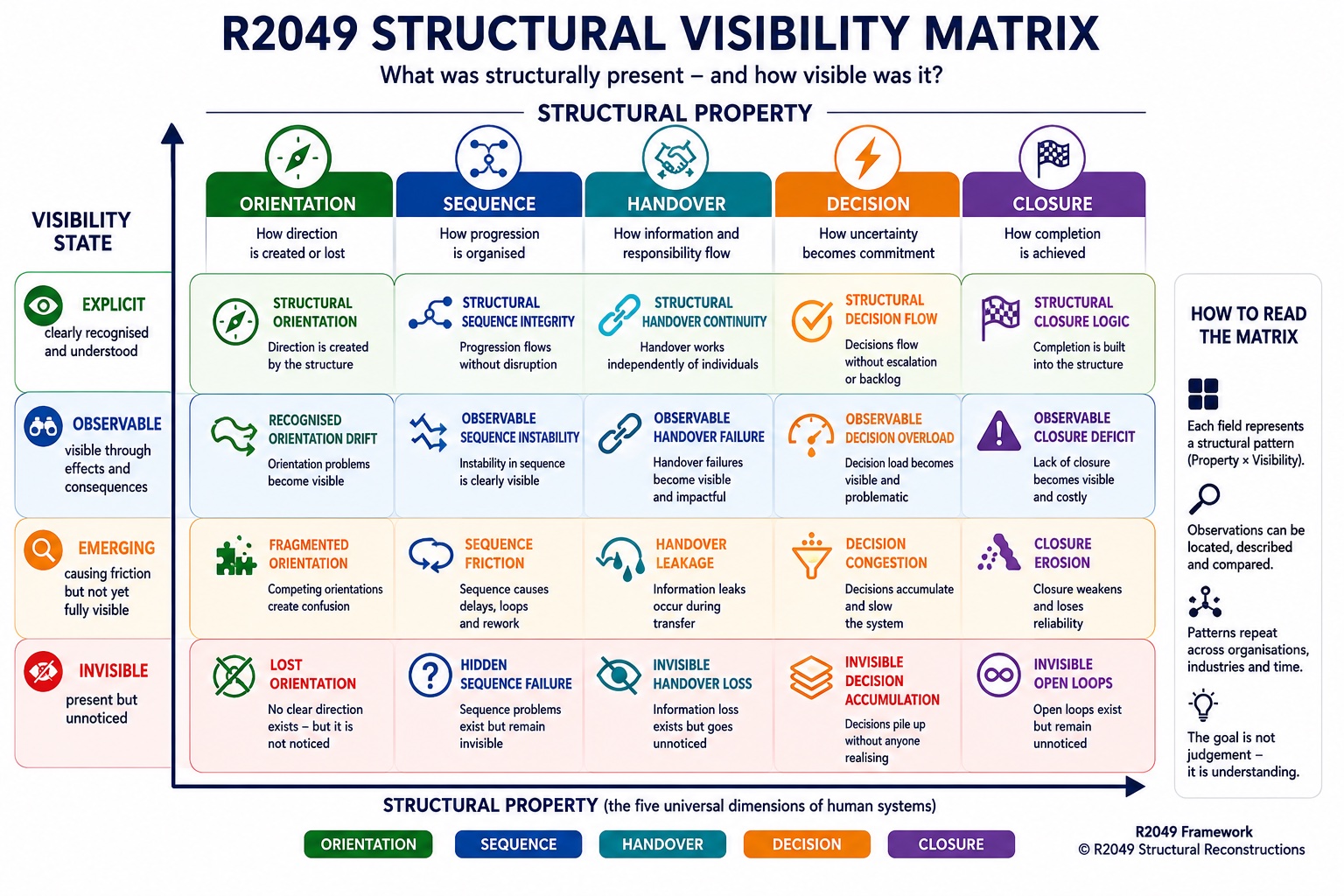
The R2049 Structural Visibility Matrix

A Guide to Reading Structural Reconstructions

Introduction

Most people observe outcomes:

  • A meeting failed.
  • A project stalled.
  • A team became overloaded.
  • A decision took too long.
  • A customer became frustrated.

These events appear visible. What often remains invisible are the structural conditions that produced them. This observation became one of the central themes of the R2049 archive.

Continue reading “The R2049 Structural Visibility Matrix”