
Intro
This R2049 reconstruction examines structural misrecognition in the 2020s and 2030s: the inability of organisations, institutions and societies to understand the deeper meaning of conditions they could already observe. It explores structural blindness, organisational compensation, decision density, digital visibility, resilience culture, institutional perception, human systems, everyday archives and the historical misreading of the present. The central argument is that the early twenty-first century did not suffer primarily from a shortage of data, but from inadequate models for interpreting structural reality.
The Historical Misunderstanding
For many years, historians described the early twenty-first century as an age of uncertainty. The phrase appeared reasonable. Governments confronted recurring crises, organisations operated under accelerating technological pressure, institutions lost public confidence, and individuals experienced an increasingly unstable relationship with work, time, information and one another.
Yet the archival record later contradicted the dominant interpretation.
The people of the 2020s and 2030s had not lived in a world that was fundamentally invisible to them. They had possessed extensive information about economic dependencies, demographic change, psychological exhaustion, institutional overload, technological concentration, social fragmentation and ecological risk. They had measured employee engagement, patient satisfaction, productivity, attention, mobility, sleep, consumer behaviour, learning outcomes and public sentiment. Their devices documented where they went, what they purchased, how long they remained, what they searched for and what interrupted them.
The period had generated more evidence about itself than almost any society before it.
What had been missing was not information.
What had been missing was the ability to recognise the structural meaning of that information.
The defining failure of the age was therefore not blindness in the literal sense. The evidence had been visible. It had appeared in dashboards, medical reports, employee surveys, waiting rooms, staff turnover, unfinished projects, improvised signs, overloaded families and increasingly elaborate digital systems.
The problem was that each signal had been interpreted through categories that protected the prevailing order from deeper examination.
The present had not been hidden.
It had been misread.
The Age That Explained Everything Incorrectly
The early twenty-first century had been remarkably productive in generating explanations. Almost every difficulty had been assigned a name, a cause and an intervention. Employees who struggled with workload required resilience. Managers who failed to prioritise required better leadership skills. Families who could not coordinate care required improved self-organisation. Citizens who felt overwhelmed by digital administration required greater digital competence. Institutions that lost trust required better communication. Organisations that produced delays required optimisation.
These explanations were rarely entirely false. That was precisely why they endured.
They identified something that could be observed at the surface while leaving the structural production of the problem untouched. A person could indeed improve personal resilience. A manager could learn to communicate more clearly. A family could introduce a shared calendar. A public service could redesign its online interface. An organisation could streamline a workflow.
But the interventions often treated the final location of a problem as though it were its original cause.
Exhaustion appeared in individuals, so individuals were trained. Confusion appeared at interfaces, so interfaces were redesigned. Delay appeared in workflows, so employees were told to work more efficiently. Distrust appeared in public opinion, so institutions intensified their messaging.
The structure that continuously reproduced the symptom remained largely outside the diagnosis.
This pattern later became known as structural displacement: the tendency to locate responsibility where a system’s consequences became visible rather than where they had been generated.
The age became highly skilled at responding to manifestations. It remained comparatively weak at reconstructing origins.
When Exhaustion Was Made Personal
Few examples illustrated the misreading more clearly than the treatment of exhaustion.
By the late 2020s, fatigue, concentration problems, emotional depletion and the sense of permanent insufficiency had become widespread across professions and social groups. These experiences were discussed openly. Employers introduced wellbeing programmes. Digital applications offered breathing exercises, sleep analysis and attention training. Books, podcasts and seminars taught people how to set boundaries, protect their energy and organise their lives more effectively.
The public discussion was extensive. The structural diagnosis was not.
The dominant explanation suggested that people had failed to adapt adequately to a demanding environment. They had not learned to manage complexity, control distraction or maintain psychological stability under pressure.
Later reconstructions showed a different picture.
Many people had been operating inside systems with rising decision density, fragmented responsibilities, incomplete handovers and permanent interruption. They had been required to compensate for unclear processes, switch continuously between communication channels and remain available for unresolved matters that could reappear at any time.
The exhausting element had not always been the volume of work itself. It had often been the absence of reliable sequence, closure and orientation.
A completed task could restore cognitive capacity. An unresolved task remained mentally active. A clear decision reduced complexity. A provisional decision preserved it. A stable handover transferred responsibility. An ambiguous handover duplicated attention.
The people of the period rarely measured these structural burdens. They measured hours, output, stress levels and absence. The invisible architecture linking these variables was largely overlooked.
As a result, individuals were encouraged to become more resilient inside systems that continuously consumed resilience.
The treatment had strengthened the compensator while preserving the cause.
When Organisational Survival Was Mistaken for Organisational Health
The same misreading occurred inside organisations.
Many organisations of the early 2030s had appeared stable because they continued to deliver services, meet deadlines, answer customers and maintain daily operations. Their leaders interpreted ongoing functionality as evidence that the underlying structure remained viable.
Yet operational continuity had concealed a growing dependence on informal human correction.
Experienced employees remembered what systems forgot. Assistants clarified what instructions left ambiguous. Teams created private spreadsheets to compensate for inadequate central software. Managers mediated between incompatible processes. Individuals monitored unfinished tasks that no formal mechanism reliably closed.
None of these activities necessarily appeared in performance reports. They were classified as experience, flexibility, teamwork or commitment.
The better employees became at compensating, the less pressure the organisation experienced to correct the structure.
Competence therefore acquired a second, largely unrecognised function. It no longer served only to perform work. It served to repair the conditions under which work had to be performed.
This produced one of the central paradoxes of the period:
The organisation appeared strongest where its people had become most skilled at concealing its weakness.
The eventual crises seemed sudden only because the compensatory labour preceding them had remained invisible. When experienced staff retired, left or became exhausted, the structure did not abruptly deteriorate. Its existing deterioration became observable.
Later analysts therefore stopped asking merely whether an organisation was functioning. They asked a more diagnostic question:
What human effort was required to make its functioning appear normal?
That question changed the historical interpretation of thousands of organisational collapses.
The Confusion of Visibility with Understanding
The societies of the 2020s believed deeply in visibility.
They installed sensors, cameras, tracking systems, performance dashboards and real-time reporting platforms. They assumed that greater data availability would produce better decisions. What could be counted could be managed. What could be observed could be controlled. What could be recorded could later be understood.
This assumption survived even as evidence against it accumulated.
Organisations received more reports but struggled to distinguish signals from noise. Public institutions collected more information while becoming less able to explain their own procedures. Individuals had access to constant updates yet felt increasingly uncertain about what required attention.
The volume of observation rose faster than the capacity for interpretation.
A camera could document that people repeatedly ignored a designated route. It could not, by itself, determine whether the route was poorly designed. A dashboard could display declining productivity. It could not decide whether the cause was low motivation, fragmented work or excessive coordination. An algorithm could identify patterns in employee behaviour. It could not automatically reveal which organisational assumptions had produced them.
The age possessed increasingly precise representations of measurable reality. It often mistook those representations for reality itself.
This was not simply a technical limitation. It was a structural misconception. Systems had been designed to make activities visible without necessarily making their relationships intelligible.
Later historical work distinguished sharply between data visibility and structural visibility.
Data visibility showed what happened.
Structural visibility revealed why it continued to happen.
The early twenty-first century expanded the first at extraordinary speed. It developed the second far more slowly.
The Ordinary Evidence
For decades, historians had focused on major announcements, political decisions, technological breakthroughs and public crises. The revised interpretation of the period began elsewhere.
It began with ordinary objects.
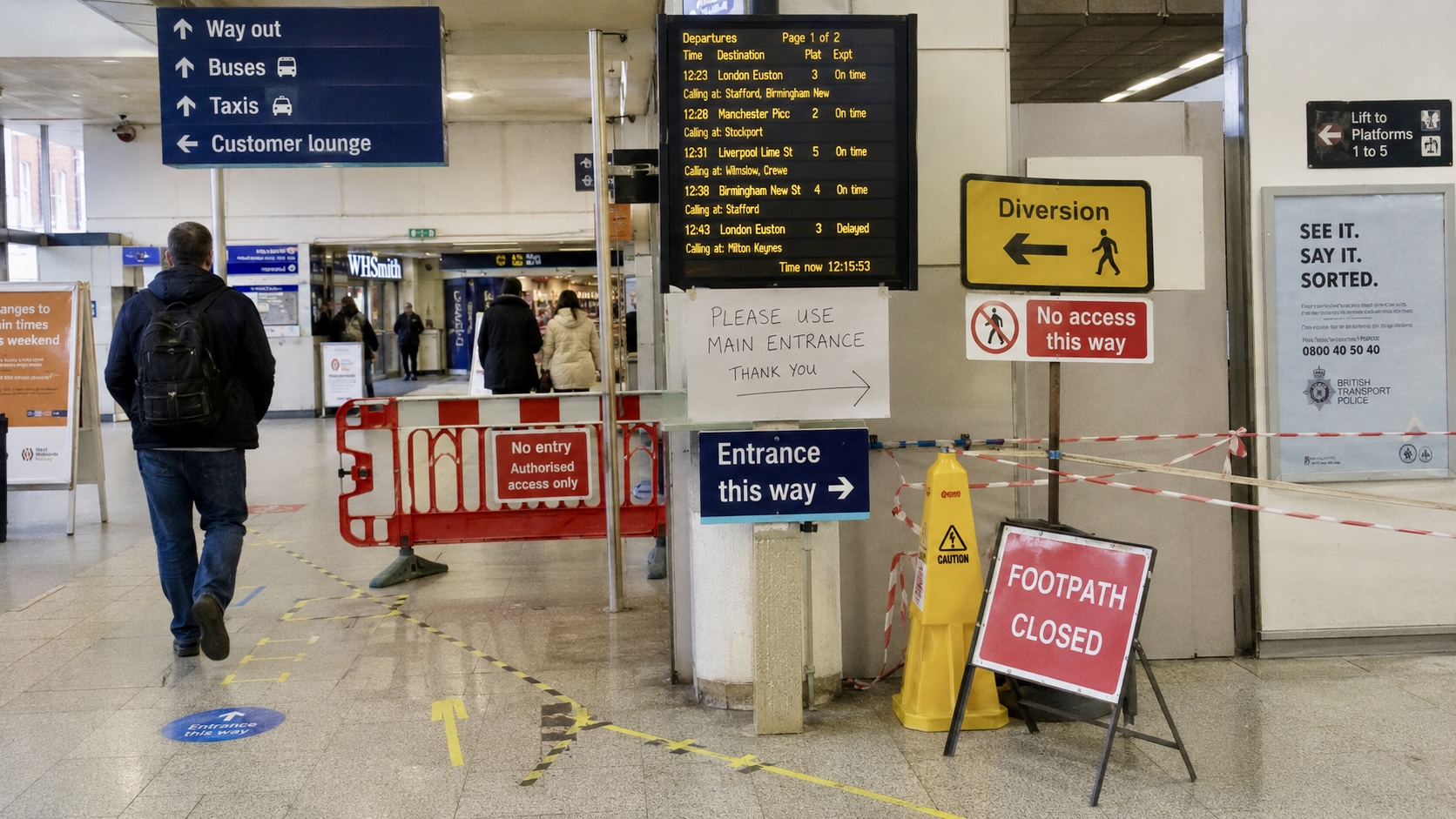
Researchers examined handwritten signs placed beside digital terminals. They studied empty reception desks, improvised barriers, duplicate forms, unofficial instructions, personal notebooks, abandoned service counters and printed lists taped to office walls.
These objects had once appeared temporary, trivial or aesthetically insignificant. In retrospect, they became evidence.
A handwritten sign beside an automated system revealed that formal instructions had failed to produce sufficient orientation. A private spreadsheet revealed that the official information system could not support actual coordination. An empty reception desk showed that a human interface had been removed while its orientational function remained necessary. A queue without a visible line demonstrated that waiting had not disappeared but had been redistributed into digital uncertainty.
The material culture of the period documented the difference between how systems had been designed and how they had actually been made usable.
This became the foundation of what later scholars called the Everyday Archives.
The archive no longer consisted only of official records. It included the minor adaptations through which people had preserved daily continuity.
A strip of adhesive tape could reveal more about an institution than its annual report.
A handwritten arrow could expose an orientation failure hidden beneath a multimillion-euro digital infrastructure.
An unanswered notification could document the transfer of administrative responsibility from institution to individual.
The most valuable evidence had often been ignored because it looked too ordinary to be historical.
The Historical Error of Scale
The people of the period expected history to announce itself dramatically.
They looked for revolutions, crashes, breakthroughs and visible points of no return. They assumed that major transformations would be recognisable because their first appearance would also be significant.
But structural change rarely respected this expectation.
It entered daily life through small alterations in sequence, responsibility and closure. A task that had once been completed by an institution became a task the user had to perform. A conversation became a form. A decision became a recommendation. A waiting room became a digital queue. A permanent position became a sequence of temporary assignments. An experienced employee became the only person who understood how an essential process actually worked.
None of these changes appeared decisive in isolation.
Together, they reconstructed the architecture of everyday life.
The historical error was therefore partly an error of scale. People searched for events large enough to explain the future while overlooking the accumulation of small structural transfers already producing it.
They asked when the transformation had begun.
The archive showed that it had begun repeatedly, in thousands of ordinary situations that no one considered important enough to name.
Why the Present Resisted Recognition
The present had not been misread solely because people lacked suitable concepts. It had also been misread because accurate interpretation threatened too many established explanations.
If exhaustion had been structurally generated, employers could not treat it only as a personal wellbeing issue. If families had functioned as unpaid social infrastructure, public systems could not describe care solely as a private responsibility. If employees had maintained organisational stability through continuous compensation, leadership could not claim that formal processes were working as designed.
Structural recognition redistributed responsibility.
That made it politically, economically and psychologically disruptive.
A personal explanation could often be addressed without altering the institution. A structural explanation questioned the institution’s design, priorities and allocation of burden.
For this reason, societies repeatedly preferred explanations that permitted local improvement without systemic reconstruction. They encouraged people to adapt, optimise, communicate and recover. These interventions could offer genuine relief. They also delayed the moment at which deeper questions became unavoidable.
The present resisted recognition because its prevailing institutions participated in producing the categories through which it was interpreted.
They did not necessarily conceal reality intentionally.
They rendered it legible in forms that protected their own continuity.
What 2049 Changed
The major shift of the 2040s was not the discovery of entirely new evidence. It was the reinterpretation of evidence that had existed for decades.
Researchers began linking employee exhaustion to decision architecture rather than workload alone. Institutional trust was analysed through procedural experience rather than communication strategy alone. Family stress was examined as a consequence of transferred coordination work. Digital convenience was evaluated alongside the administrative responsibilities it shifted onto users.
The object of diagnosis changed.
Instead of asking what was wrong with the individual, analysts asked what recurring structural condition required the individual to compensate.
Instead of asking whether a process produced an outcome, they asked what hidden effort had been necessary to produce it.
Instead of asking whether information was available, they asked whether people could derive orientation from it.
Instead of asking how quickly work moved, they asked whether it reached a reliable conclusion.
This did not eliminate personal responsibility. It placed personal action inside the architecture that shaped its possibilities.
The result was a more demanding but more accurate understanding of human systems. People were neither helpless products of structure nor autonomous actors operating outside it. They were participants in arrangements that distributed attention, responsibility, uncertainty and control in unequal ways.
The central analytical unit was no longer the isolated person or the abstract institution.
It was the relationship between them.
The Archive Had Already Begun
By 2049, the most revealing documents of the early century were not always those originally created for historical preservation.
They were photographs of temporary signs that remained in place for years. They were screenshots of interfaces requiring users to solve problems created by the service itself. They were internal messages asking who was responsible for matters that had already passed through several departments. They were calendars filled with coordination tasks that no institution officially counted as work.
These fragments exposed the practical reality beneath formal descriptions.
They showed a society that had not simply become more complex. It had redistributed complexity without naming the redistribution.
They showed organisations that had not merely become more efficient. They had transferred corrective effort to those closest to the operational consequences.
They showed individuals who had not simply become less resilient. They had been required to absorb more ambiguity, interruption and unfinished responsibility.
The archive had therefore begun long before anyone recognised it as an archive.
Every improvised correction had been a record.
Every recurring workaround had been a diagnosis.
Every ordinary frustration had contained information about the system that produced it.
Reconstruction Note
The early twenty-first century was not defined by its inability to see change.
It saw change constantly.
Its error lay in the frameworks through which change was interpreted. Structural consequences were personalised. Systemic dependencies were described as flexibility. Permanent compensation was praised as commitment. Growing decision density was marketed as choice. Surveillance was confused with knowledge. Continuity was mistaken for stability.
The deeper meaning of the period became visible only when later observers stopped asking what people had failed to do and began asking what structures had required them to do repeatedly.
That change in question altered the archive.
It also altered history.
The future had not first appeared in laboratories, government strategies or corporate forecasts. It had appeared in ordinary places: beside the broken terminal, behind the empty desk, inside the unresolved task, within the family calendar and beneath the performance indicator that still appeared acceptable.
Nothing had been hidden.
But almost everything important had been explained too narrowly.
That was how a society surrounded by evidence had failed to read its own present.
Summary
By 2049, the defining failure of the early twenty-first century was no longer understood as a lack of information. The societies of the 2020s and 2030s had recorded, measured and discussed almost every significant transformation taking place around them. Yet they repeatedly misinterpreted what they saw. Exhaustion was treated as an individual weakness, organisational fragility as a productivity problem, permanent availability as connection, digital surveillance as knowledge and human compensation as evidence of resilience. This reconstruction examines why the present had remained unreadable despite unprecedented visibility—and why the most consequential historical evidence had appeared not in spectacular crises, but in ordinary systems that still seemed to function.
Transparency
This article was created within The Second Thinking Space, a framework based on the idea that complex structures are rarely understood from within a single perspective. Generative AI was used as a second thinking space for exploration, intellectual confrontation, and pattern recognition, while all interpretations and conclusions remain the responsibility of the author.
 R2049
R2049 