
Summary
A building is more than a physical shelter. It can become a stable point of orientation within an otherwise dynamic environment. Structiography studies how fixed structures reduce uncertainty by giving movement a reference.
Observation
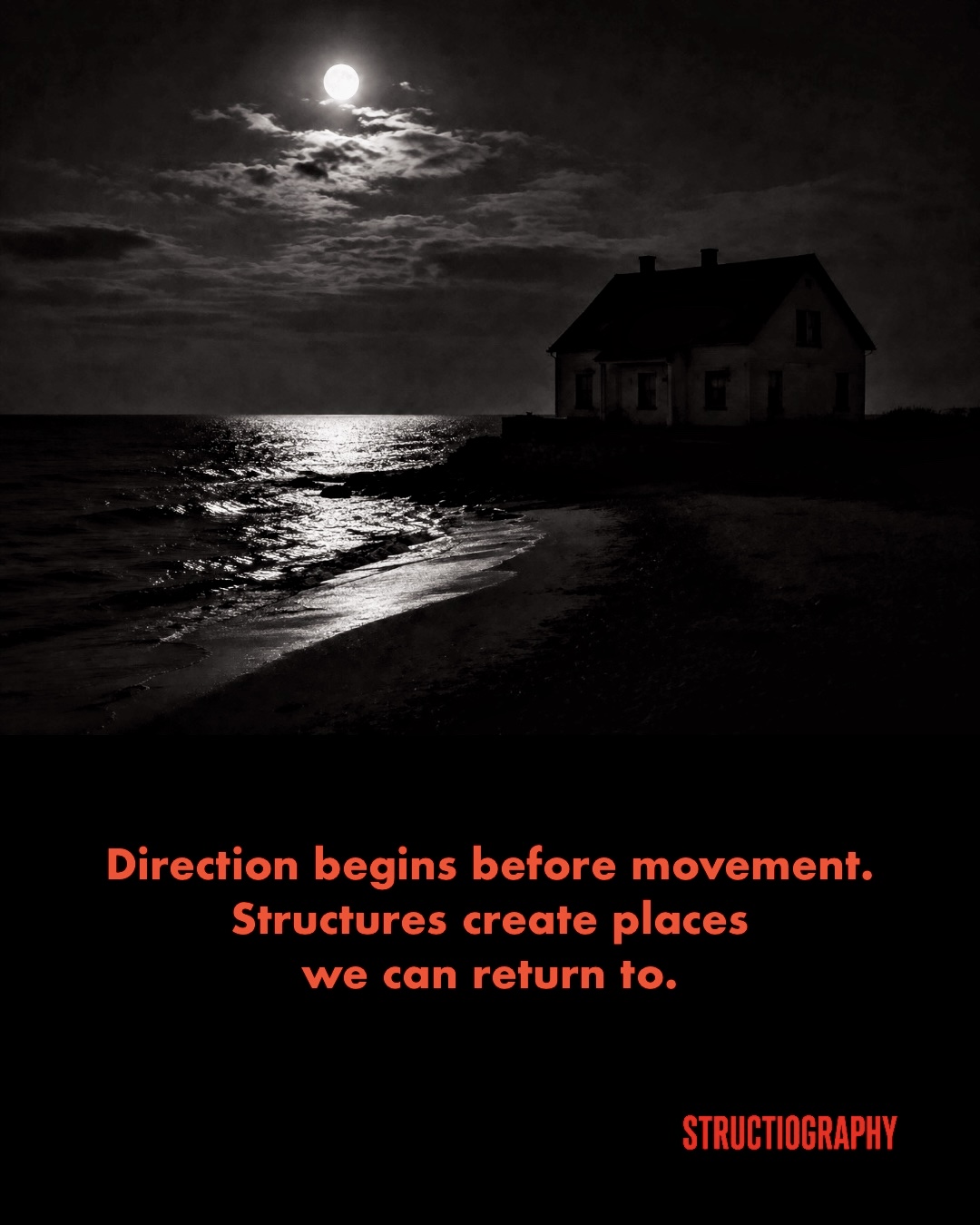
A solitary house stands beside the sea beneath a full moon.
Everything around it is in motion.
Clouds drift.
Waves advance and retreat.
Moonlight changes with every passing moment.
Only the house appears unmoved.
Structural Reconstruction
Orientation does not emerge from movement.
It emerges from stability.
The sea offers countless possible directions but no lasting reference. The shoreline shifts with every wave, and the light continuously transforms the landscape.
The house interrupts this uncertainty.
It becomes a structural anchor—a fixed element that allows everything else to be interpreted in relation to it.
This is why humans have always built landmarks, towers, harbours and homes.
Not simply to occupy space.
But to organise it.
Structural Principle
A core principle of Structiography is:
Stable structures create orientation by remaining reliable while their environment changes.
The greater the surrounding uncertainty, the more valuable a stable point becomes.
Reflection Question
What functions as your structural anchor when everything around you is changing?
Core Learning
Movement attracts attention.
Stability creates orientation.
Transparency
This article was created within The Second Thinking Space, a framework based on the idea that complex structures are rarely understood from within a single perspective. Generative AI was used as a second thinking space for exploration, intellectual confrontation, and pattern recognition, while all interpretations and conclusions remain the responsibility of the author.

