
Summary
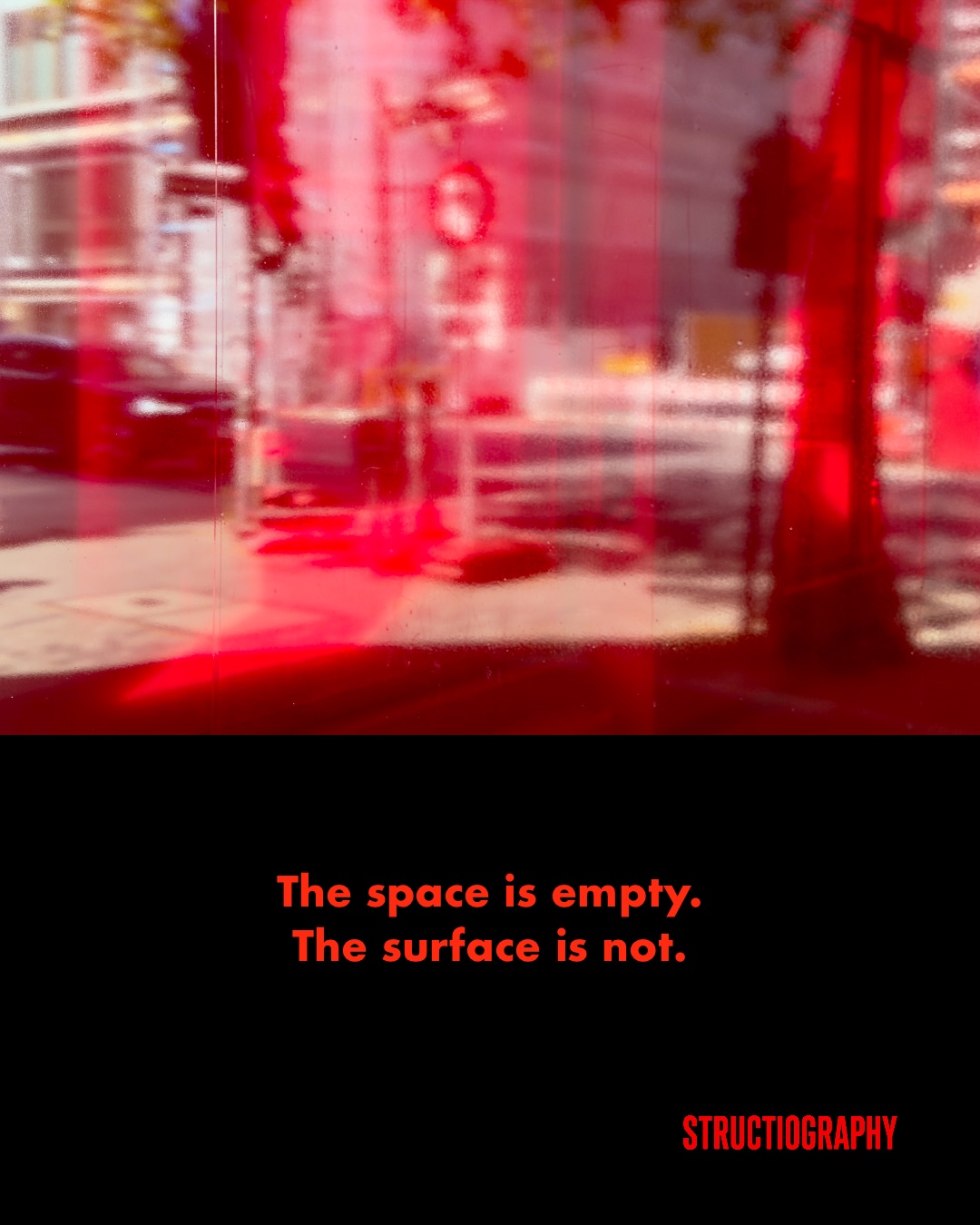
Structures do not always reveal a single reality. Sometimes they conceal one layer while reflecting another. This image illustrates how visibility can become structurally mixed: what lies behind disappears, while what stands outside takes its place.
Observation
The photograph shows the shop window of an empty retail space.
The glass has been covered with red foil.
The interior is no longer clearly visible.
Yet the surface does not become blank.
Instead, it captures the surrounding street scene.
Buildings, movement and light appear as reflections across the sealed frontage.
The result is a doubled structure.
Inside, there is vacancy.
Outside, there is activity.
The surface joins both without fully revealing either.
Structural Reconstruction
Many human systems operate in the same way.
An organisation may appear active because communication, branding or routine still reflect vitality.
A role may appear occupied although its actual function has become hollow.
A process may look intact from the outside while internally it has already lost substance.
In such cases, the visible surface no longer represents the inner condition.
It overlays it.
What we see is partly concealment and partly reflection.
Structural Principle
A core principle of Structiography is:
Structures can hide their internal reality by reflecting external activity.
The crucial question is therefore not only what a surface shows, but whether it reveals the structure behind it or merely mirrors its environment.
Reflection Question
Where in your own environment does visible activity conceal internal emptiness rather than express real structural substance?
Core Learning
Not everything visible is revealing.
Sometimes a structure hides itself by reflecting something else.
Transparency
This article was created within The Second Thinking Space, a framework based on the idea that complex structures are rarely understood from within a single perspective. Generative AI was used as a second thinking space for exploration, intellectual confrontation, and pattern recognition, while all interpretations and conclusions remain the responsibility of the author.
 R2049
R2049 