
Summary
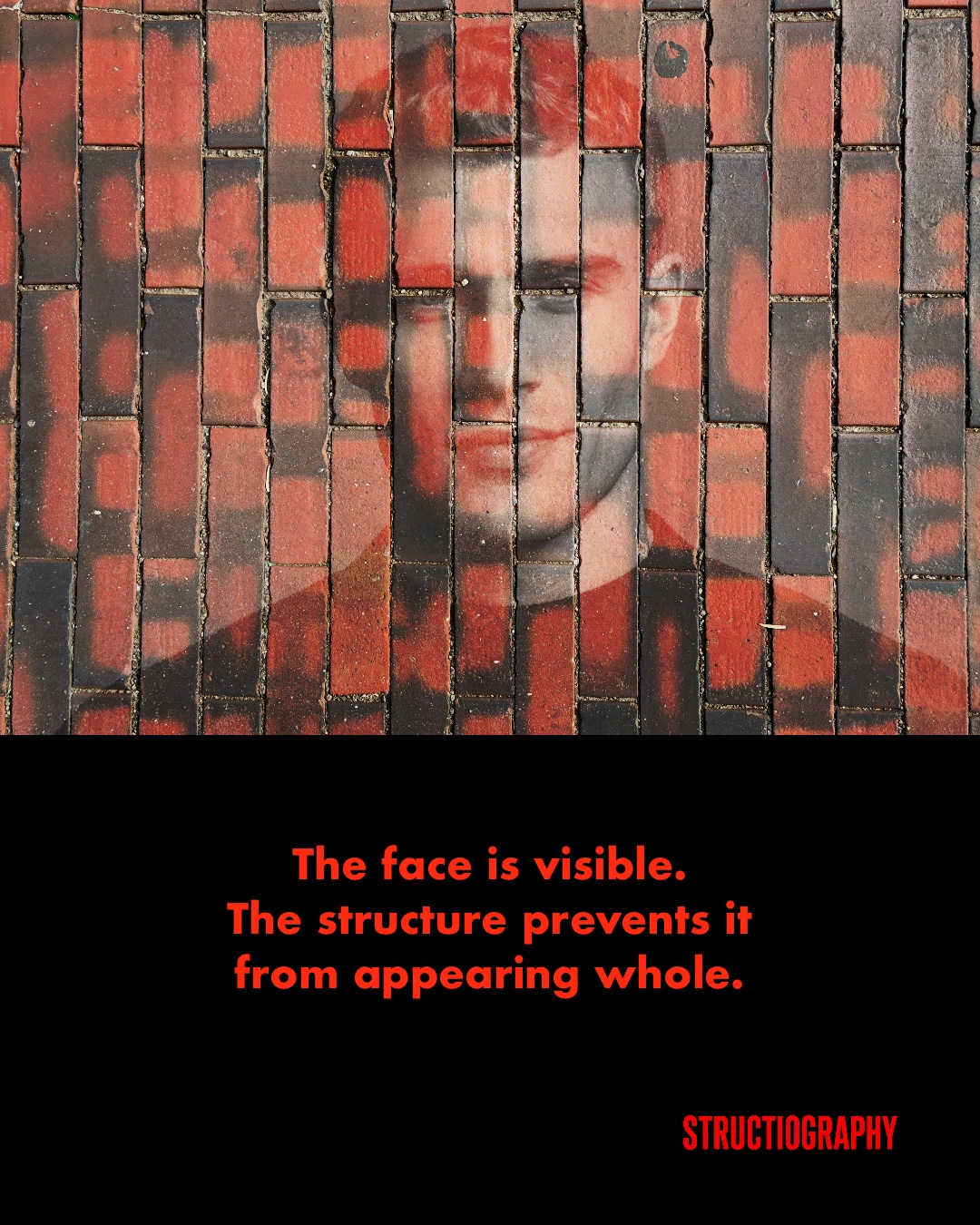
Structures do not merely carry content. They shape how content can appear. This image illustrates how an intact image becomes fragmented when it passes through a segmented surface. What is seen remains recognisable, yet it is broken into structural units.
Observation
The photograph shows a brick pavement.
Across the red and dark tiles, the faint image of a man’s face becomes visible.
The face is not present as a complete surface.
It appears only in fragments.
Each brick carries a portion.
Each joint interrupts continuity.
The image can still be recognised.
But it can no longer appear as a seamless whole.
Structural Reconstruction
Human systems often function in the same way.
A clear strategy is broken into departments.
A coherent experience is divided across interfaces.
A person is reduced to isolated data points, roles or functions.
The original whole does not disappear.
But it becomes difficult to perceive because the structure through which it is expressed fragments it.
This is one of the central problems of structural observation:
What is real may remain present, yet appear distorted because the surrounding structure interrupts its continuity.
Structural Principle
A core principle of Structiography is:
Structures do not only reveal reality. They also fragment it.
To understand a system, one must therefore ask not only what is visible, but how the structure divides, interrupts or distributes what is visible.
Reflection Question
Where in your own environment is something meaningful still present, but only in fragments because the structure no longer allows the whole to appear?
Core Learning
A whole can remain real
even when a structure only allows it to appear in parts.
Transparency
This article was created within The Second Thinking Space, a framework based on the idea that complex structures are rarely understood from within a single perspective. Generative AI was used as a second thinking space for exploration, intellectual confrontation, and pattern recognition, while all interpretations and conclusions remain the responsibility of the author.

