
Summary
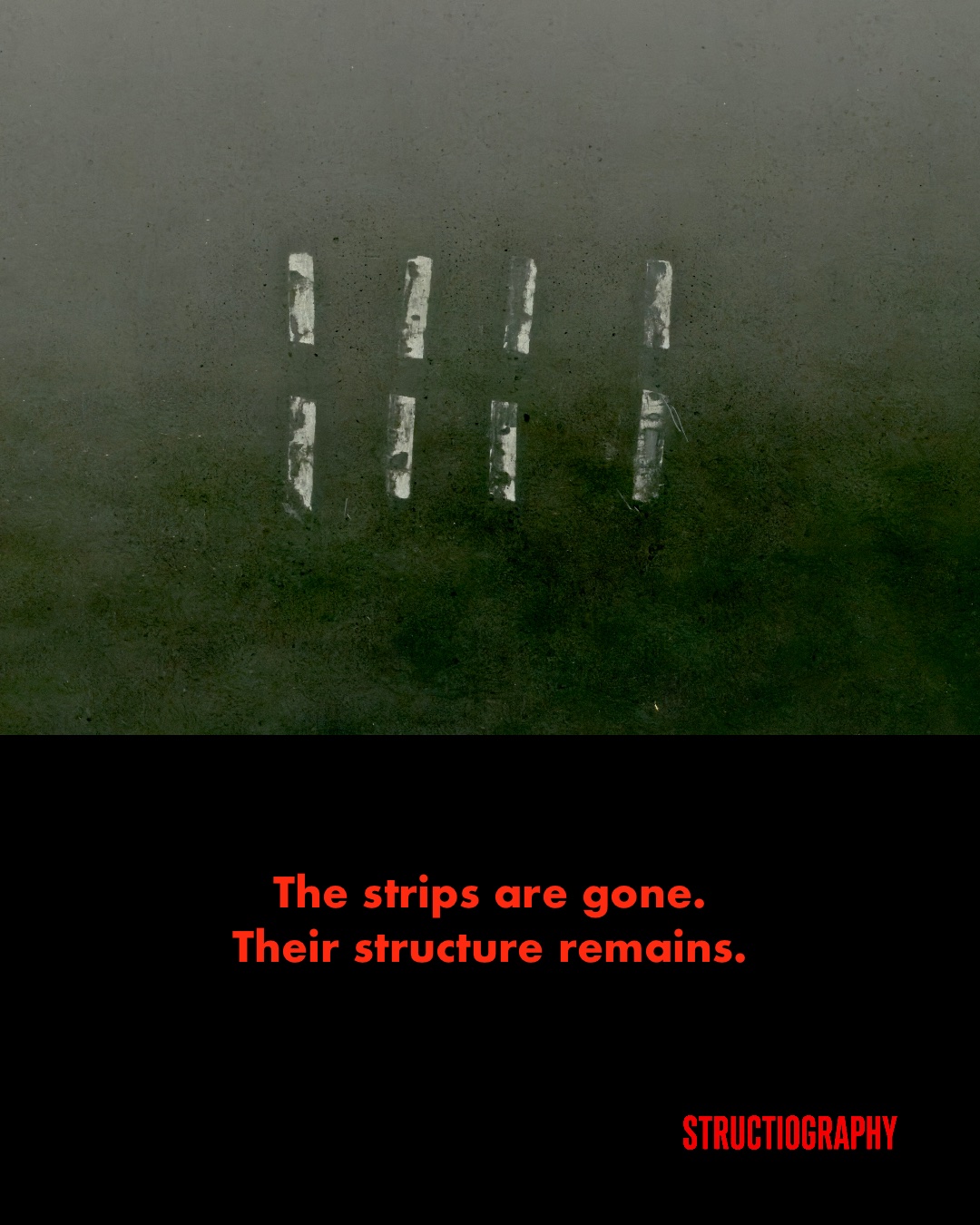
Structures do not disappear the moment their visible elements are removed. Often, what remains is not the thing itself, but the trace of its former presence. This image illustrates how absence can still be structurally legible.
Observation
The photograph shows a dark door surface.
At its centre, several pale vertical marks remain.
The adhesive strips themselves are no longer there.
Only their traces are visible.
The pattern is incomplete.
Yet it is precise enough to indicate that something had once been attached here.
The object is gone.
The structure of its placement remains.
Structural Reconstruction
Human systems often work in the same way.
A role may be officially removed, yet its dependencies remain.
A process may be ended, yet the habits it created continue.
A decision may be reversed, yet its consequences still organise behaviour.
What disappears visibly does not always disappear structurally.
Residual traces often reveal more than the original object.
They show where something acted, how it was arranged and what surface it altered.
Structural observation therefore includes not only active forms, but also residues.
Structural Principle
A core principle of Structiography is:
Structures often remain legible through the traces they leave behind.
Absence is not emptiness.
It can be evidence.
Reflection Question
What in your own environment has supposedly ended, but still leaves visible or invisible traces that continue to shape the present?
Core Learning
A structure may be removed.
Its residue may still organise perception.
Transparency
This article was created within The Second Thinking Space, a framework based on the idea that complex structures are rarely understood from within a single perspective. Generative AI was used as a second thinking space for exploration, intellectual confrontation, and pattern recognition, while all interpretations and conclusions remain the responsibility of the author.

