
Summary
Many structures are not built for permanence. They serve as temporary arrangements that make comparison, evaluation and adjustment possible. This image illustrates how provisional order can itself be structurally meaningful.
Observation
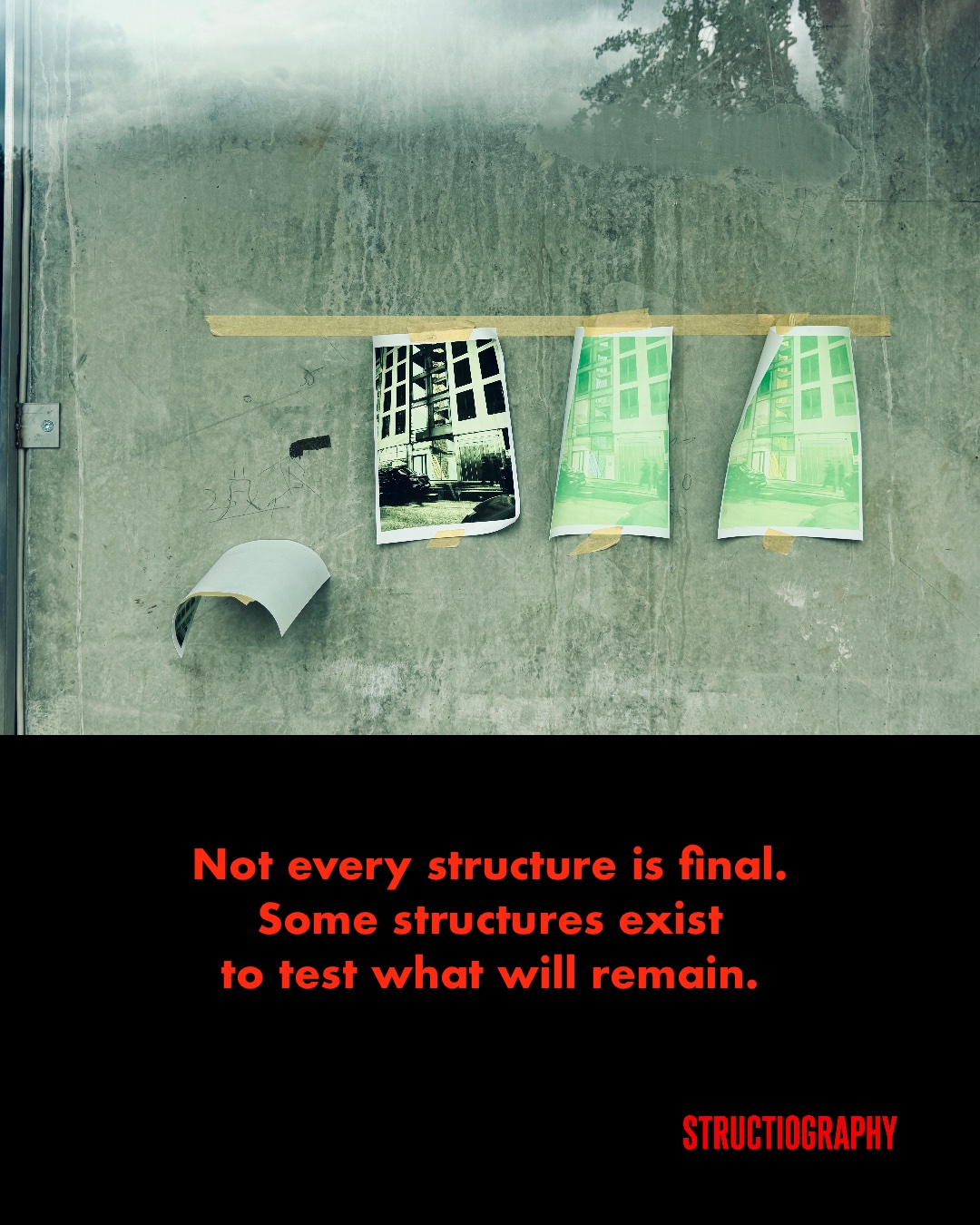
The photograph shows several printed images attached to a surface with masking tape.
One print hangs flat.
Two others curl slightly outward.
A fourth has already fallen away and remains suspended below.
Nothing appears finished.
The arrangement is temporary, fragile and revisable.
Yet it is not random.
The images have been placed in a line.
They can be compared.
They can be judged.
They can be replaced.
Structural Reconstruction
Human systems often depend on provisional structures.
Drafts precede final decisions.
Pilot phases precede rollout.
Temporary roles stabilise transition.
Test arrangements make differences visible before commitment becomes binding.
What appears unfinished is therefore not necessarily weak.
It may be functionally incomplete by design.
Its purpose is not to endure.
Its purpose is to support selection.
The tape, the spacing and even the looseness of the arrangement create a structural condition in which alternatives can still be examined.
Structural Principle
A core principle of Structiography is:
Temporary structures often exist to enable comparison before permanence is established.
Provisionality is not the absence of order.
It is an order designed for revision.
Reflection Question
Where in your own environment are temporary arrangements treated as disorder, even though they may be necessary for learning, testing or deciding?
Core Learning
Some structures are built to last.
Others are built to make a better final structure possible.
Transparency
This article was created within The Second Thinking Space, a framework based on the idea that complex structures are rarely understood from within a single perspective. Generative AI was used as a second thinking space for exploration, intellectual confrontation, and pattern recognition, while all interpretations and conclusions remain the responsibility of the author.

