
Summary
Structures can suggest a function without actually providing it. This image illustrates the difference between a visible promise and the material conditions required to fulfil it.
Observation
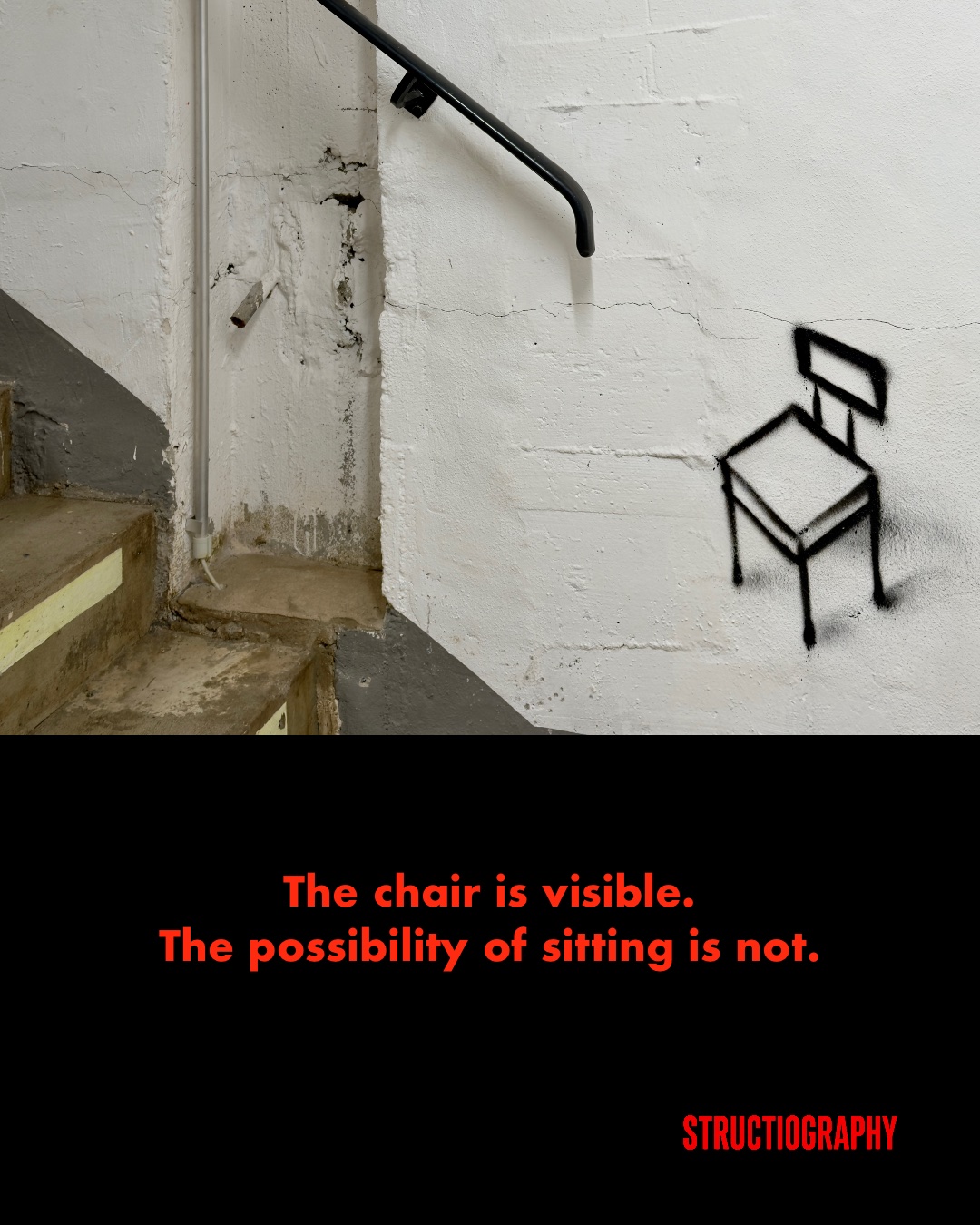
The photograph shows a stairwell with steps and a handrail. On the wall, a chair has been drawn in black paint.
The chair is immediately recognisable. It signals rest, support and the possibility of taking a seat.
Yet no chair exists.
The image represents a function that the physical environment does not provide.
What is visible is not an object, but the idea of one.
Structural Reconstruction
Human systems frequently create similar discrepancies.
A job title suggests authority without granting decision-making power. A strategy promises direction without defining priorities. A digital tool appears to simplify work while creating additional tasks. A value statement announces trust while control remains unchanged.
In each case, the structure communicates a capability that it does not materially enable.
The representation may be convincing.
The function remains absent.
Structural observation must therefore distinguish between what a system claims to provide and what its actual conditions make possible.
Structural Principle
A core principle of Structiography is:
A represented function is not the same as an available function.
Structures should be assessed by what they enable, not by what they display.
Reflection Question
Where in your environment does a visible promise suggest support, authority or opportunity that the underlying structure does not actually provide?
Core Learning
Symbols can announce a function.
Only structures can make it usable.
Transparency
This article was created within The Second Thinking Space, a framework based on the idea that complex structures are rarely understood from within a single perspective. Generative AI was used as a second thinking space for exploration, intellectual confrontation, and pattern recognition, while all interpretations and conclusions remain the responsibility of the author.

