
Summary
Structures are rarely read through a single code. Formal systems communicate rules, but informal additions often introduce a second layer of meaning. This image shows how an official sign and a small personal symbol can occupy the same surface and produce a structural tension between regulation and appropriation.
Observation
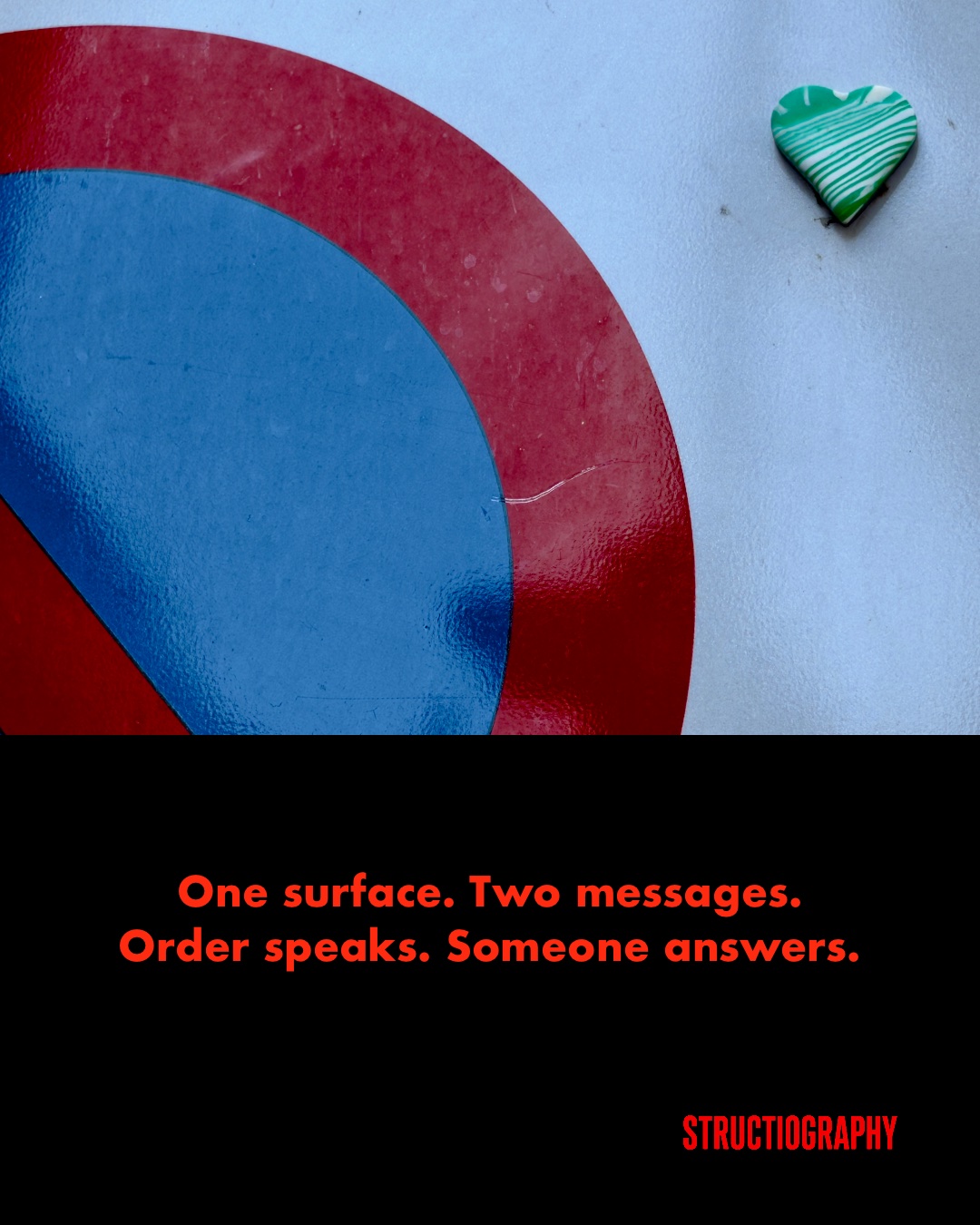
The photograph shows part of a circular prohibition sign in red and blue. In the upper right corner, separated from the official marking, a small green heart appears on the same metallic surface.
The two elements do not belong to the same visual system. One is standardised, public and regulatory. The other is private, decorative and emotionally coded.
Yet they now form a single scene.
Structural Reconstruction
This is not just a contrast of shapes or colours. It is a collision of codes.
The traffic sign represents formal order. It is designed to regulate behaviour without ambiguity. The small heart introduces something the sign was never meant to carry: affection, playfulness, personal trace, perhaps even quiet irony. It does not remove the rule, but it changes the reading situation.
Many structures work in exactly this way. Official systems establish function, while unofficial insertions modify atmosphere, interpretation or use. Rules are rarely encountered in their pure form. They are touched, commented on, softened or subtly contradicted by human presence.
What matters structurally is that a system can carry more than its intended message.
Structural Principle
Formal structures often attract informal counter-signs.
Where regulation appears, appropriation often follows. A structure does not remain untouched simply because it was designed to be clear.
Reflection Question
Where in your environment do official rules and informal human gestures appear on the same surface — and what does that combination reveal?
Core Learning
Structures communicate formally. People answer informally.
Transparency
This article was developed within the framework of the concept The Second Thinking Space with the support of generative artificial intelligence. AI is used to explore questions, broaden perspectives, generate alternative formulations, identify patterns, and facilitate the critical examination of ideas and assumptions.
The article has been substantively reviewed, editorially revised, and approved by the author. All editorial decisions, evaluations, interpretations, and conclusions are the sole responsibility of the author.

