
Summary
Large structures often depend on very small points of attachment. This image illustrates how stability can be produced by elements whose importance is disproportionate to their size.
Observation
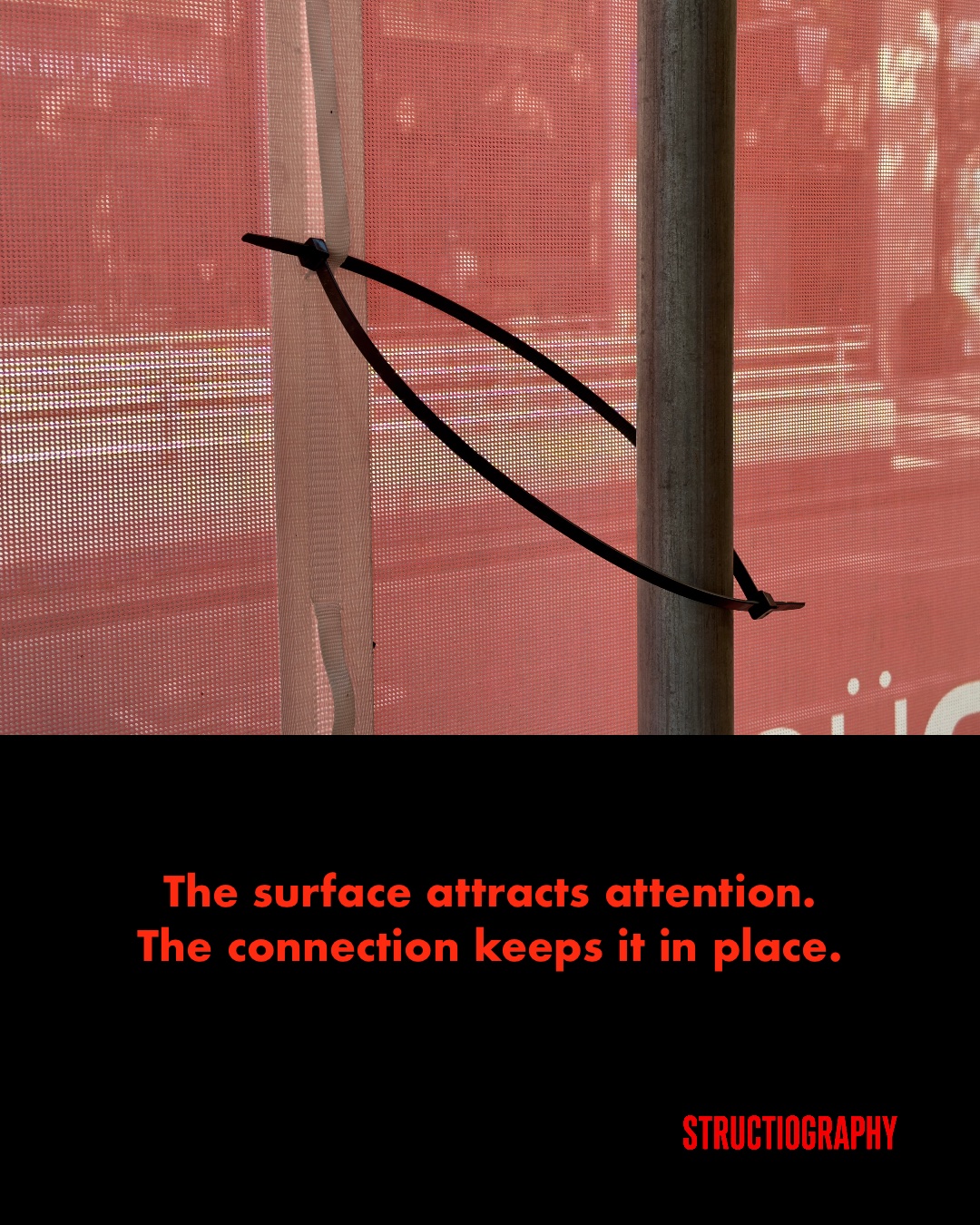
The photograph shows red protective mesh attached to a vertical support.
Two black cable ties cross the surface and connect it to the structure behind.
They are simple.
Inexpensive.
Almost incidental.
Yet without such fastening points, the large sheet would lose its position.
The visible surface depends on a much smaller connection.
Structural Reconstruction
Human systems contain similar fastening points.
A brief handover connects two process stages.
A clearly assigned responsibility links a task to a person.
A shared rule keeps different activities aligned.
A reliable interface joins otherwise separate systems.
These elements often receive little attention because they do not represent the main activity.
But when they fail, larger structures begin to loosen.
What appears to be a problem of the whole system may therefore originate at one small connection point.
Structural Principle
The stability of a structure often depends on the quality of its smallest connections.
Structural analysis should therefore look not only at large components, but at the points that hold them together.
Reflection Question
Which small connection in your organisation would create disproportionate disruption if it suddenly failed?
Core Learning
Large structures attract attention. Small connections preserve them.
Transparency
This article was developed within the framework of the concept The Second Thinking Space with the support of generative artificial intelligence. AI is used to explore questions, broaden perspectives, generate alternative formulations, identify patterns, and facilitate the critical examination of ideas and assumptions.
The article has been substantively reviewed, editorially revised, and approved by the author. All editorial decisions, evaluations, interpretations, and conclusions are the sole responsibility of the author.

