
Summary
Structure can become visible when a simple form is set against a complex surrounding field. The contrast does not merely separate two visual zones. It organises perception.
Observation
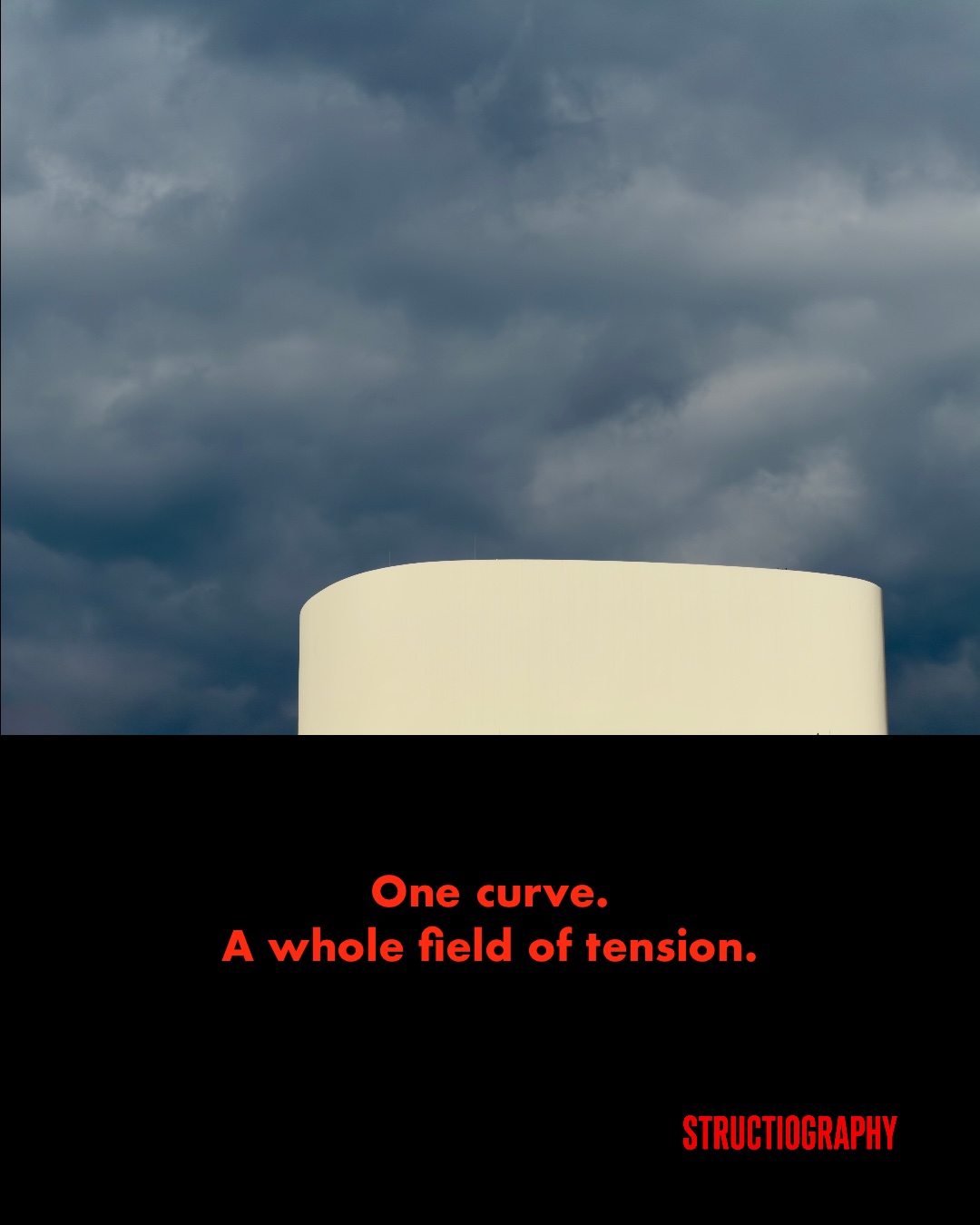
The photograph shows the upper part of a public building.
Only a small portion of the architecture is visible: a pale curved form rising into the lower part of the frame. Above it, dark clouds fill the sky.
What matters here is not the building as an object in itself. What matters is the relationship between two different kinds of order. The building appears controlled, smooth and geometrically stable. The sky appears shifting, irregular and unsettled.
The eye immediately registers the difference. A single curved edge is enough to divide the image into two contrasting structural conditions.
Structural Reconstruction
This is a useful Structiographic exercise because it trains the ability to see structure through opposition.
The building does not need to be shown in full. Even this fragment is sufficient. Its rounded top establishes a clear boundary, and that boundary allows the surrounding atmosphere to be read differently. The clouds seem heavier because the architectural form is so calm. The building seems more self-contained because the sky is so unstable.
Structure often becomes visible in exactly this way: not through detail, but through contrast between unlike systems.
One field is continuous and man-made.
The other is diffuse and meteorological.
One suggests permanence.
The other suggests change.
The image becomes readable because these two orders meet at a single line.
Structural Principle
A clear form can reveal itself most strongly when placed against an unstable field.
Reflection Question
How often does structure become visible not because something is complex, but because one simple form is placed against a more irregular surrounding?
Core Learning
A boundary does more than divide. It makes different kinds of order perceptible.
Transparency
This article was developed within the framework of the concept The Second Thinking Space with the support of generative artificial intelligence. AI is used to explore questions, broaden perspectives, generate alternative formulations, identify patterns, and facilitate the critical examination of ideas and assumptions.
The article has been substantively reviewed, editorially revised, and approved by the author. All editorial decisions, evaluations, interpretations, and conclusions are the sole responsibility of the author.

