
Summary
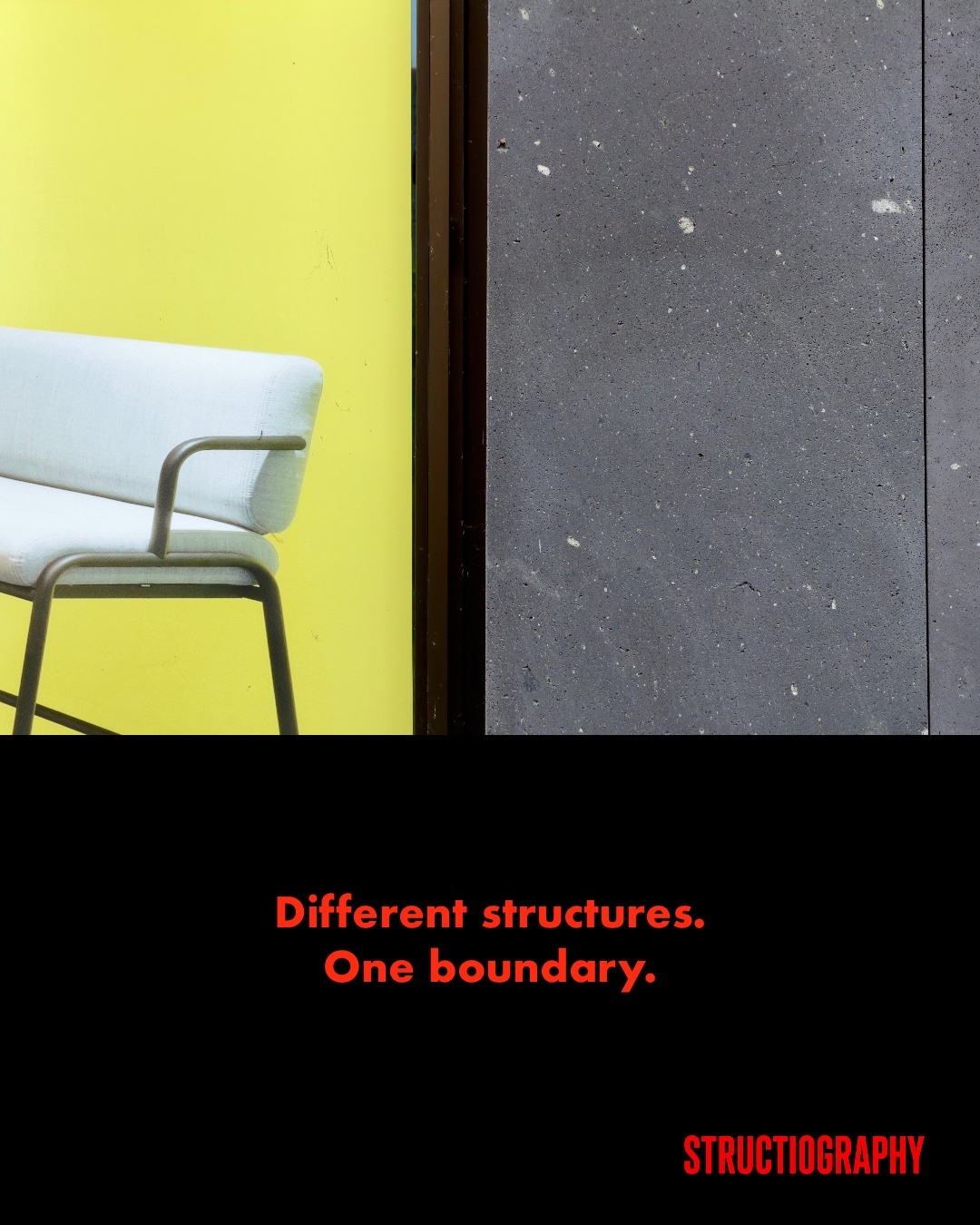
The image shows how two distinct visual and functional structures meet at a clearly defined boundary. Structiography uses this contrast to demonstrate that structural meaning often emerges not within isolated elements, but at the point where different systems come into contact.
Observation
The photograph shows two sharply separated visual fields.
On the left, a bright yellow surface contains the partial image of a chair. On the right, a grey stone façade occupies most of the frame. A narrow dark vertical element forms the boundary between them.
Neither side is unusual on its own. What makes the image structurally legible is their immediate adjacency.
Colour meets restraint. Representation meets material surface. Commercial display meets architecture.
Structural Reconstruction
Structiography asks us to look beyond the individual elements and examine what happens at their boundary.
The yellow field does not gradually merge into the stone. One structure ends and another begins. The dividing line therefore becomes more than a physical edge: it marks a transition between two different visual and functional systems.
Such transitions occur constantly in everyday life. Public and private space meet at doors. Different responsibilities meet at handovers. Digital and physical processes meet at interfaces.
Problems often arise not within either side, but where one structure encounters another.
The image therefore trains the eye to recognise adjacency as a structural condition. What matters is not only what exists on each side, but how clearly the transition between them is defined.
Structural Principle
When different structures meet, the boundary between them becomes structurally significant.
Reflection Question
Where in your environment do two clearly different systems meet — and what happens exactly at their point of contact?
Core Learning
Structures do not exist only as isolated arrangements.
Their boundaries determine how they meet.
Transparency
This article was developed within the framework of the concept The Second Thinking Space with the support of generative artificial intelligence. AI is used to explore questions, broaden perspectives, generate alternative formulations, identify patterns, and facilitate the critical examination of ideas and assumptions. The article has been substantively reviewed, editorially revised, and approved by the author. All editorial decisions, evaluations, interpretations, and conclusions are the sole responsibility of the author.
 R2049
R2049 