
The Rule Had No Words.
Search Info
Primary topic: Public seating, urban design and the behavioural effects of spatial organisation
Central question: How can the physical design of a public bench influence permitted or expected behaviour without communicating an explicit rule?
Key concepts: urban design, public space, public seating, spatial organisation, affordances, behavioural design, defensive architecture
Core insight: The divided bench demonstrates how physical environments can regulate behaviour without explicit instructions by making some uses easier, others more difficult and the underlying intention of that distinction uncertain.
What the Photograph Shows
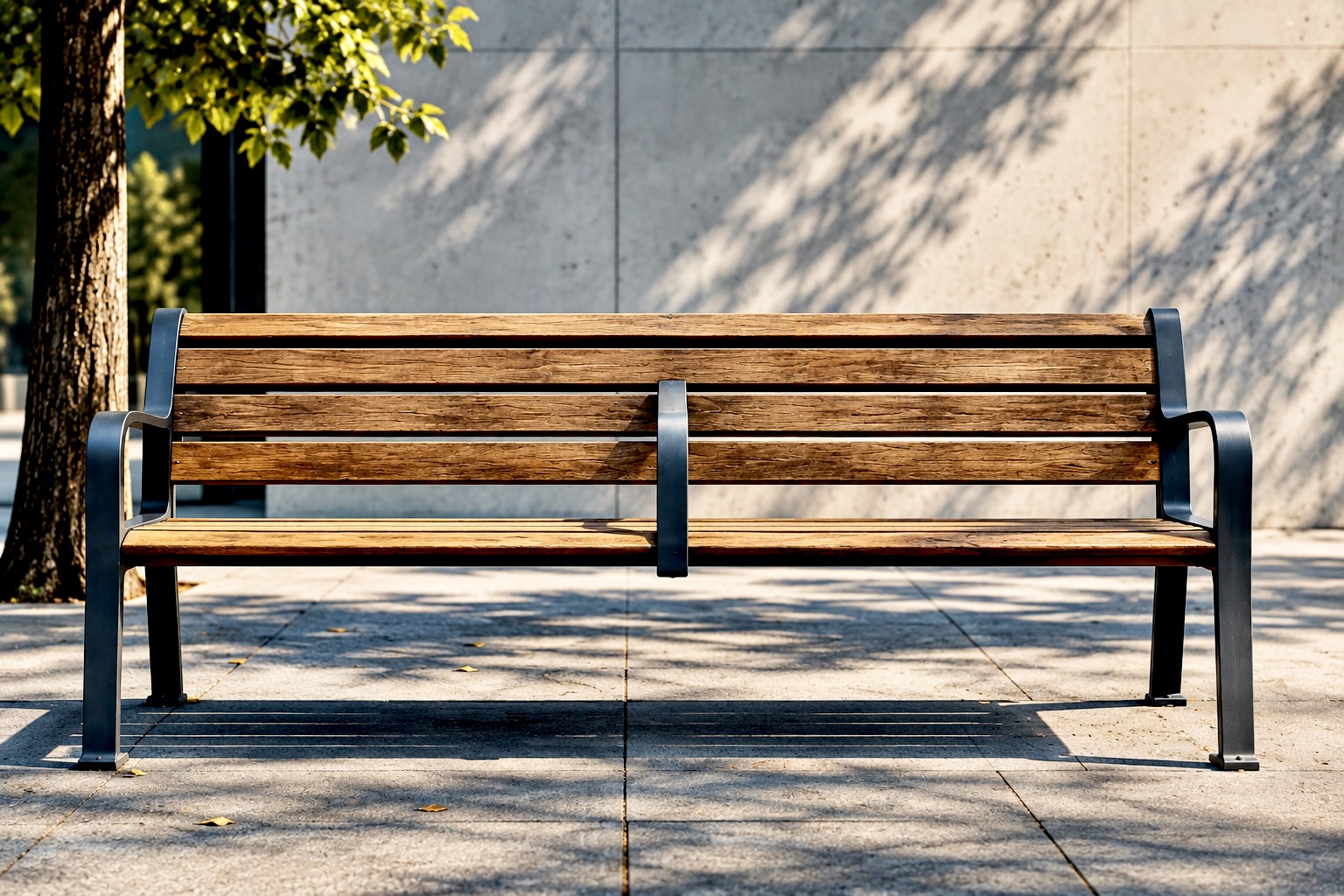
The photograph contains an ordinary object in an ordinary public setting. A bench provides a place to sit, while a fixed element interrupts the continuity of its surface and divides the available space into separate sections. Nothing in the arrangement necessarily appears remarkable. There is no prohibition sign, no barrier preventing access and no written instruction explaining how the bench should be used.
Yet the physical form already distinguishes between possible behaviours. Sitting individually remains straightforward. Occupying the full length of the bench becomes more difficult. Lying across it may become impossible, depending on the precise construction.
The object does not merely occupy public space.
It organises possibilities within it.
When Design Became an Instruction
Urban environments of the early twenty-first century contained countless forms of behavioural guidance that were rarely experienced as rules. Kerbs separated movement, railings channelled pedestrians, markings organised queues, bollards prevented vehicle access and seating arrangements influenced where bodies could remain.
These interventions belong broadly to spatial organisation and what design theory describes through affordances: characteristics of an environment that make particular actions possible, obvious, difficult or unlikely.
The divided bench makes this principle unusually visible because the behavioural instruction is embedded directly in the object. No authority needs to tell a person to occupy one section rather than the whole surface. The geometry has already altered the available choices.
From the later R2049 perspective, this became an important distinction: a rule does not always need to be communicated when it can be built into the conditions of action.
The Intention the Image Cannot Reveal
It would nevertheless be too easy to conclude that the divider explains itself. A central armrest might assist someone when sitting down or standing up. It might provide physical separation between strangers, create clearly defined seating positions or reflect a standardised manufacturing design. It might also discourage lying down or prolonged occupation of the bench.
The photograph alone cannot determine which of these purposes was primary.
This is precisely where The Withholding Gaze differs from an image used merely to prove an argument. The visible arrangement supports structural interpretation, but it does not provide complete access to intention.
The divider is evidence that behaviour has been differentiated spatially.
It is not, by itself, evidence of why.
That distinction matters particularly in discussions of defensive architecture or hostile architecture, where physical design is interpreted as intentionally discouraging particular uses of public space. Such interpretations may be justified in specific cases, but the visual reconstruction should not attribute an intention that the image cannot establish.
Visibility is not certainty.
The Behaviour That Never Needed to Be Prohibited
The more interesting structural question therefore lies elsewhere. Whatever the designer intended, the object produces consequences through its form. Some uses remain easy, while others become less available.
This creates a form of regulation that differs from an explicit prohibition. A sign saying Do not lie on this bench identifies a rule, an authority and a prohibited action. A physical divider may achieve a similar behavioural outcome without stating any of them.
The distinction is consequential. Explicit rules can be noticed, interpreted, questioned or ignored. Spatial constraints operate earlier. They modify the field of possible action before a decision about compliance is required.
The environment does not have to persuade.
It has already changed what can conveniently be done.
Public Space as an Arrangement of Possibilities
From 2049, this characteristic became increasingly important in the reconstruction of early twenty-first-century urban space. Cities had often been understood through what they contained: streets, buildings, parks, transport systems, commercial areas and public facilities. Later structural analysis paid greater attention to what those environments quietly made easier or harder.
A public space was therefore not simply an area available for use. Its surfaces, distances, barriers, seating, lighting, access points and circulation routes created an architecture of possibilities.
Some possibilities were encouraged by comfort and accessibility. Others were constrained through inconvenience. Still others disappeared almost completely because the environment no longer provided the physical conditions they required.
No single element necessarily determined behaviour. People could adapt, resist or use objects in unintended ways. Yet repeated spatial arrangements could establish strong patterns without ever appearing as formal regulation.
The divided bench is a small example of that larger principle.
What Remained Normal Because It Looked Like Design
The early twenty-first century was particularly interesting because many forms of spatial regulation presented themselves simply as design. A divider was a feature of a bench. A railing was part of a streetscape. A bollard was street furniture. A carefully shaped surface was an architectural detail.
This visual normality mattered. Once regulation was incorporated into familiar objects, its behavioural effect could disappear behind the appearance of functionality.
Later R2049 reconstruction did not interpret every such feature as covert social control. That would replace observation with suspicion. Instead, it introduced a more disciplined question: which behaviours does this arrangement make easier, and which does it make more difficult, regardless of the intention behind it?
The shift from assumed intention to observable consequence proved essential.
It allowed the structure to be examined without pretending that the photograph knew more than it could show.
R2049 Visual Reconstruction
From the distance of 2049, the divided bench can therefore be read as a small material record of how the environments of the 2020s organised everyday behaviour. Its significance lies not in proving why somebody installed the divider, but in revealing that physical form itself distributes possibilities.
The bench remains publicly accessible. No behaviour is verbally prohibited. Nothing announces itself as regulation.
And yet the available surface has already been divided into a particular order.
That order may be practical, protective, exclusionary or several of these things simultaneously. The image refuses to settle the question.
What it does reveal is the structure through which the question becomes possible.
Structural Reading
Visible arrangement: A continuous seating surface is divided into separate usable sections by a fixed physical element.
Structural relation: Physical form differentiates between possible uses of the same public object.
Withheld information: The image cannot establish whether support, comfort, individualisation, standardisation, behavioural deterrence or another consideration determined the design.
Broader condition: Urban design can influence behaviour through affordances and constraints without relying on explicit rules.
R2049 reconstruction: The public spaces of the 2020s did not merely accommodate behaviour. Their material arrangements participated in defining which behaviours were easy enough to become normal.
Closing Reconstruction
The photograph does not tell us what the designer wanted.
It shows something more defensible: the possibilities were not left equal.
The rule had no words because the object had already changed what could be done.
Summary
A public bench divided by a fixed metal element appears to offer a simple arrangement of seats. Yet from the perspective of 2049, the image reveals a broader structural property of public space: behaviour can be organised through physical form without any rule being stated. The divider may support sitting, define individual places or discourage other uses. The photograph cannot establish which purpose was decisive. That uncertainty is central to The Withholding Gaze: the structure is visible, while the intention behind it remains withheld.
Transparency
This article was developed within the framework of the concept The Second Thinking Space with the support of generative artificial intelligence. AI is used to explore questions, broaden perspectives, generate alternative formulations, identify patterns and facilitate the critical examination of ideas and assumptions. The article has been substantively reviewed, editorially revised and approved by the author. All editorial decisions, evaluations, interpretations and conclusions are the sole responsibility of the author.

