
Absence Left a Shape.
Search Info
Primary topic: Material traces, urban surfaces and the visibility of removed structures
Central question: What can a physical trace reveal when the object that produced it is no longer present?
Key concepts: material traces, urban surfaces, architectural change, absence, visual evidence, environmental memory, material culture
Core insight: A removed object can remain structurally visible through the difference it leaves behind, allowing an image to establish that something changed without revealing exactly what disappeared.
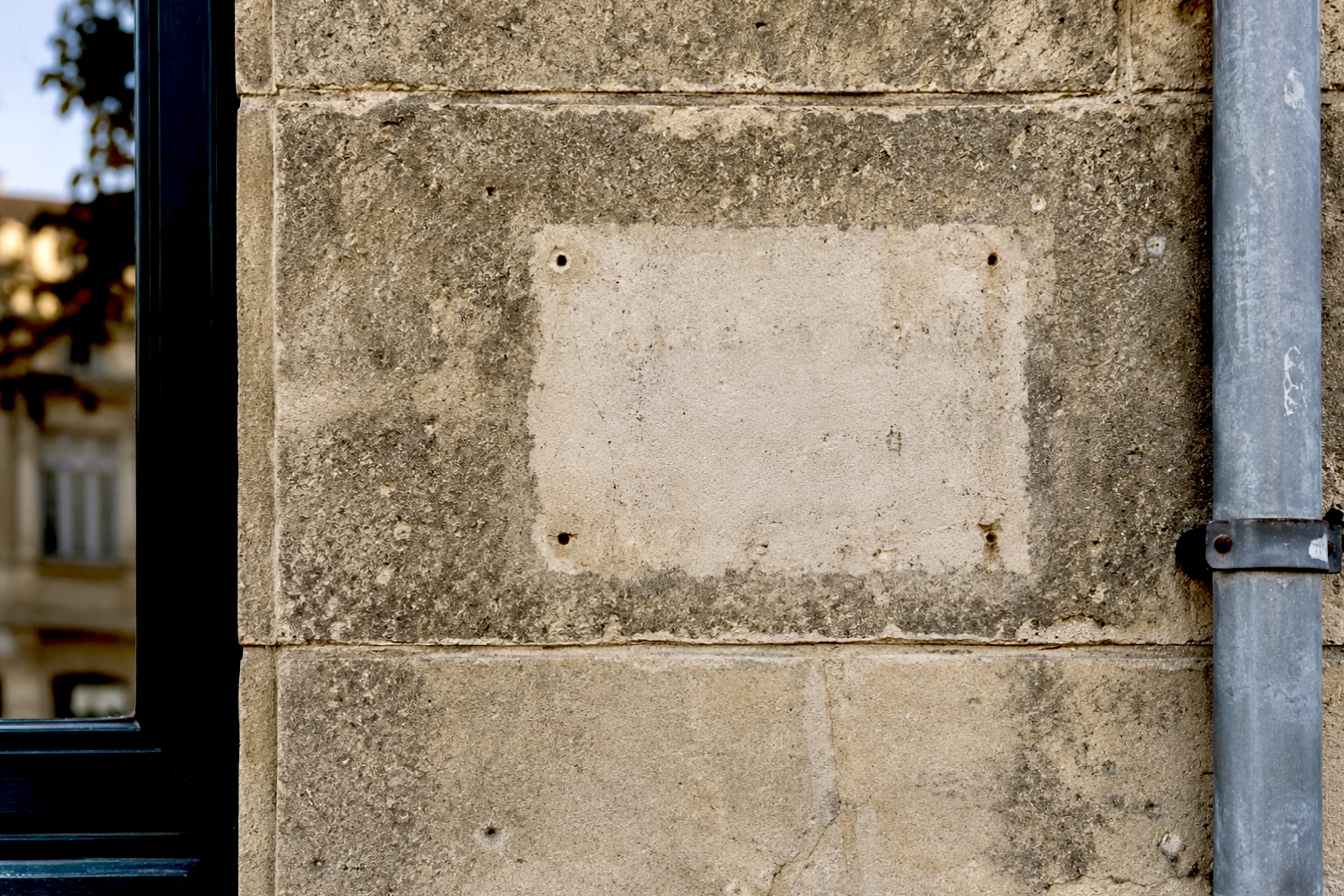
A Wall With Something Missing
The photograph appears to show very little. A wall has aged unevenly. Its surface carries dirt, fading, weathering or discolouration accumulated over time. Within that larger field, however, a rectangular area is noticeably different. It may be cleaner, lighter or less weathered than its surroundings. Small holes or fixing points remain near its edges.
There is no object there now.
Yet the empty area does not look empty in the ordinary sense. Its difference from the surrounding surface gives it a boundary. Something that is physically absent continues to occupy a visually recognisable position.
The photograph therefore contains an unusual inversion. The missing object is invisible, but its former presence is not.
When Removal Did Not Restore the Previous State
Everyday perception often treats removal as a return to absence. A sign is taken down, a machine removed, a partition dismantled or a piece of furniture moved away. The object is gone, and the space it occupied appears to become available again.
Material environments are rarely so reversible.
Objects interact with their surroundings while they are present. They block sunlight, protect surfaces from rain, create pressure, leave fixing points, interrupt fading and prevent dirt from accumulating evenly. When the object disappears, these differences can remain.
Removal therefore does not necessarily restore an earlier condition. It can produce a third state: neither the original surface nor the later arrangement, but a surface containing evidence of both.
This is the structural significance of the trace.
It records a transition.
Environmental Memory Without Intention
Memory is usually associated with people, documents, photographs or deliberately preserved records. Yet physical environments also retain differences produced by previous conditions.
This can be understood as environmental memory: the persistence of material effects after the situation that created them has ended.
The term does not imply that a wall literally remembers. It identifies a structural relationship between past conditions and present surfaces. What happened earlier has altered what can be seen now.
Such memory can be entirely accidental. Nobody needed to preserve the removed object or document its history. The surrounding material did so indirectly because it aged differently while the object was present.
The resulting evidence is weak in one sense and remarkably strong in another. It may tell us almost nothing about what the object was. But it can tell us with considerable visual force that something was there.
The Difference Between a Trace and an Explanation
This distinction is central to The Withholding Gaze.
A rectangular mark may suggest a sign. Fixing holes may support that interpretation. The dimensions or position might make certain possibilities more plausible than others. But unless additional evidence is available, the image cannot establish what the missing object displayed, why it was installed, who installed it or why it was eventually removed.
The temptation is to complete the image. Human perception is exceptionally comfortable with inference. Once a plausible explanation appears, uncertainty can disappear almost unnoticed. The trace becomes a former shop sign, an information board, an advertisement or a nameplate. But the photograph has not shown any of these things. It has shown a difference.
Visual reconstruction therefore requires a separation between evidence of previous presence and knowledge of previous identity.
The first may be strong while the second remains unavailable.
What Remains Visible
This is why such a photograph belongs specifically to the field What Remains Visible. Its subject is not deterioration, nostalgia or urban decay. Nor is the missing object itself the real subject.
The subject is persistence after disappearance.
The physical object has left the scene, but the relationship between object and environment remains partially legible. The surrounding surface has become a negative record of something it once accommodated.
What is visible is therefore relational rather than complete. We see the difference between exposed and protected surface, between occupied and unoccupied space, between what weathered and what did not.
The absent object becomes perceptible through the asymmetry it created.
The Surface as an Archive
From the perspective of 2049, such traces offered a different way of reading the physical environments of the early twenty-first century. Buildings and public spaces were not merely collections of objects present at a particular moment. Their surfaces contained overlapping states produced by installation, use, adaptation, repair and removal.
A filled doorway could remain visible in different brickwork. A removed partition could survive as a line across a floor. Lettering could disappear while variations in fading preserved its outline. Equipment could be dismantled while bolts, conduits or mounting points continued to indicate the arrangement it had required.
The environment therefore functioned as an imperfect archive.
Unlike a conventional archive, however, it did not preserve complete records. It preserved consequences.
This distinction matters. Consequences can establish that a previous condition existed without explaining that condition fully. The material trace is therefore both evidence and limitation.
It reveals history while withholding narrative.
The Withholding Gaze
Photography often attempts to increase visibility. It moves closer, improves detail, isolates the subject or selects a perspective from which ambiguity disappears.
The Withholding Gaze operates differently.
The trace on the wall does not need to be solved. Its incompleteness is not a photographic defect requiring correction. It is the analytical content of the image.
We can see enough to know that the present surface cannot be understood entirely as a present condition. Something preceding it has shaped what remains.
But the photograph refuses the comfort of complete reconstruction.
The past is visible as structure, not as story.
R2049 Visual Reconstruction
From the distance of 2049, this distinction became increasingly important when reading surviving environments from the 2020s. Not everything that shaped those environments remained physically present, and not everything absent had disappeared without consequence.
Some structures survived through traces rather than objects.
Their significance lay precisely in the gap between what could be established and what could only be inferred. The lighter rectangle, fixing holes or interrupted weathering could demonstrate former occupation of the surface. They could not recover the missing content.
The reconstruction therefore stops deliberately before certainty.
It recognises the trace without inventing the object.
Structural Reading
Visible arrangement: A weathered surface contains a clearly bounded area whose colour, condition or fixing points differ from its surroundings.
Structural relation: The difference indicates that the surface was previously exposed to different conditions within that area.
Withheld information: The image cannot establish with certainty what occupied the space, what purpose it served, who placed it there or why it was removed.
Broader condition: Physical environments preserve consequences of previous arrangements even after the arrangements themselves disappear.
R2049 reconstruction: The material world of the 2020s contained an unintended archive in which former structures remained partially visible through the differences they had left behind.
Closing Reconstruction
The object has disappeared. Its function may be forgotten and its meaning unrecoverable. Yet complete disappearance has not occurred.
The surface still distinguishes where something once was from where it was not.
That is enough to establish a past presence, but not enough to reconstruct a past certainty.
What disappeared left no explanation. It left a difference.
Summary
A lighter rectangle on a weathered wall, several empty fixing holes or the outline of a removed sign can make an absent object unexpectedly visible. The object itself has disappeared, yet the surface around it preserves evidence of its former presence. This Visual Reconstruction examines such traces as a form of environmental memory. The image can show that something occupied a particular place and altered its surroundings, while withholding its identity, purpose and history. What remains visible is therefore not the object, but the structural difference created by its absence.
Transparency
This article was developed within the framework of the concept The Second Thinking Space with the support of generative artificial intelligence. AI is used to explore questions, broaden perspectives, generate alternative formulations, identify patterns and facilitate the critical examination of ideas and assumptions. The article has been substantively reviewed, editorially revised and approved by the author. All editorial decisions, evaluations, interpretations and conclusions are the sole responsibility of the author.

