
Temporary Had No Deadline.
Search Info
Primary topic: Temporary repairs, maintenance and the normalisation of provisional solutions in everyday environments
Central question: What can a visibly improvised repair reveal when an object has regained enough function to remain in use without being fully restored?
Key concepts: temporary repair, maintenance, deferred maintenance, material culture, normalisation, functional restoration, built environment
Core insight: A provisional repair can become structurally durable when it restores enough function to remove the pressure that would otherwise force a permanent solution.
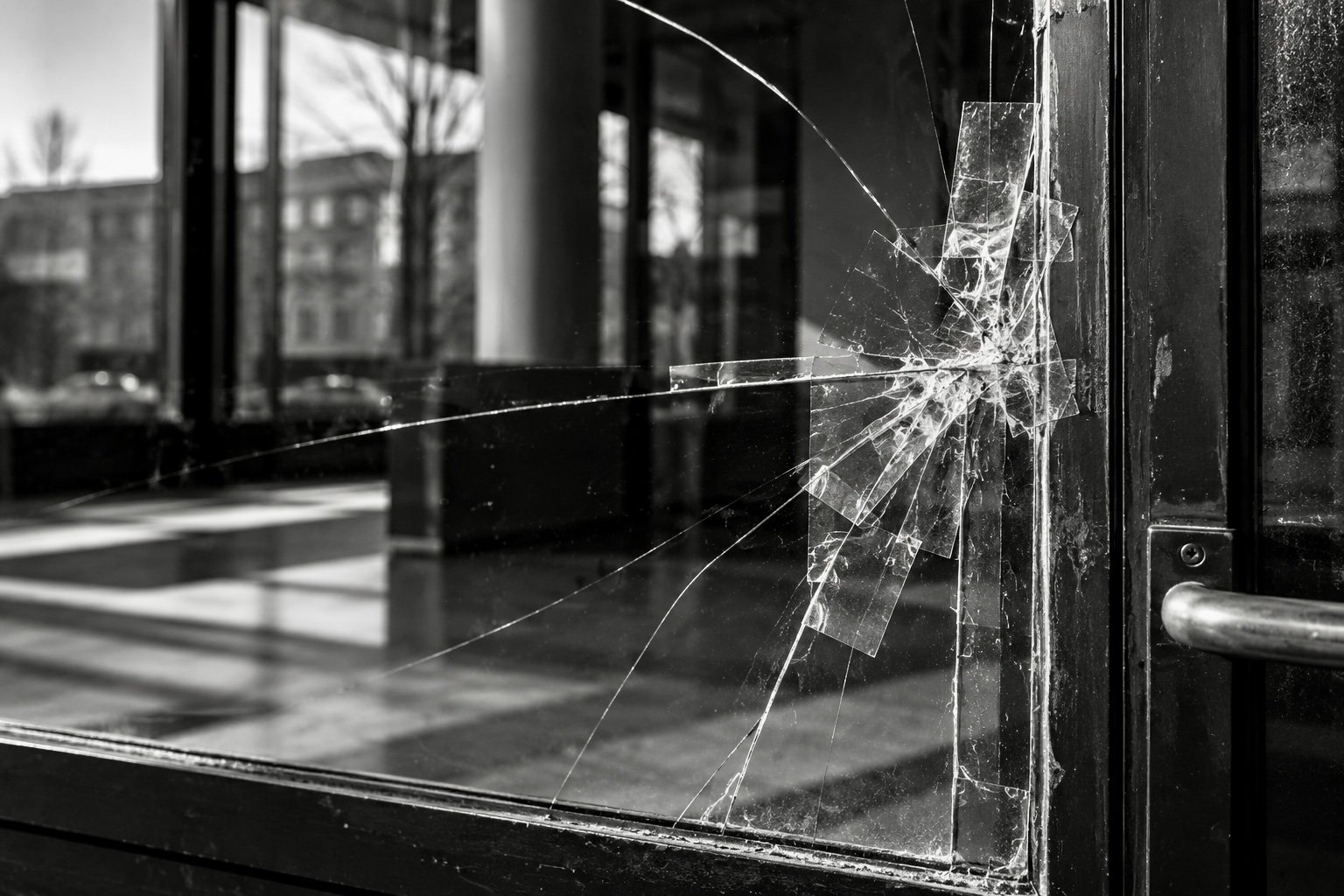
A Surface That Was Both Broken and Working
The photograph shows a pane of glass crossed by a visible crack. Transparent tape follows part of the damaged area, holding fragments or edges in place. The intervention has not concealed what happened. On the contrary, damage and repair remain simultaneously visible.
This produces an unusual visual state. The glass is not intact, but neither is it simply broken. Someone has intervened sufficiently to alter the consequences of the damage without returning the object to its previous condition.
The distinction is important because everyday language often compresses both outcomes into the same word: repaired.
Visually, they are not the same.
One restores the former state.
The other makes the altered state usable.
When Function Returned Before Condition
Maintenance is usually understood through function. A door should open, a roof should prevent water entering, a light should illuminate, a window should remain secure. When something fails, intervention attempts to restore the capability that has been lost.
Yet function and condition can recover independently.
A temporary intervention may restore enough stability for an object to continue serving its immediate purpose while leaving the underlying defect visible. Tape can secure glass. A cable tie can hold a component. A board can cover an opening. A container can collect a leak. A piece of cardboard can stabilise something that no longer stands correctly on its own.
Such measures are often entirely sensible. Immediate replacement may be impossible, unnecessary or economically disproportionate. A provisional repair can prevent a small failure from becoming a larger one.
The visual reconstruction therefore does not treat improvisation as evidence of neglect.
Its subject is what happens after improvisation succeeds.
The Structural Effect of a Successful Provisional Solution
A complete failure creates pressure.
Something cannot be used, an area becomes unsafe or an activity cannot continue. Attention is difficult to avoid because the defect interferes directly with normal operation.
A successful provisional repair changes this relationship. It does not necessarily eliminate the defect, but it reduces its consequences. The door works again. The glass remains in place. The machine can continue operating. The immediate interruption ends.
At that moment, something structurally significant occurs.
The repair removes part of the pressure for its own replacement.
This can be described as provisional stabilisation: a temporary intervention restores sufficient function for the underlying condition to cease demanding immediate resolution.
The better the provisional solution works, the weaker the operational reason to replace it quickly may become.
Success therefore creates the possibility of persistence.
The Photograph Cannot Tell Us How Long
A photograph of a taped crack presents an obvious temptation. Its improvised appearance encourages the viewer to assume that the repair has been there for a long time, that maintenance has been neglected or that nobody intends to replace the damaged glass.
None of those conclusions follows from the image alone.
The tape may have been applied ten minutes before the photograph was taken. A replacement pane may already have been ordered. The damage may have occurred that morning. Equally, the arrangement may have existed for months.
The image withholds duration.
This is crucial to The Withholding Gaze. Visual evidence establishes a condition at the moment of observation, but not automatically its history. The photograph shows a provisional form. It cannot establish whether that form is also temporally provisional.
The difference between the two is precisely what makes the image analytically useful.
We can see that the solution looks temporary. We cannot see whether time has treated it that way.
When Appearance and Status Separated
Ordinarily, temporary and permanent conditions are expected to look different. A temporary intervention appears unfinished; a permanent one appears integrated into the object or environment.
Yet everyday environments repeatedly disrupt this distinction.
An improvised solution may remain visibly improvised while becoming behaviourally accepted. People learn not to touch one part of a door, step around a damaged surface, lift an object in a particular way or ignore an aesthetic defect because its practical consequences have already been controlled.
The physical arrangement remains exceptional.
The behaviour around it becomes ordinary.
This creates a separation between material status and social status. Materially, the object still carries evidence of incompletion. Socially, it may already have been incorporated into normal use.
Nothing in the object itself records the moment at which this transition occurs.
Normalisation leaves no date.
The Maintenance Paradox
From the perspective of 2049, this revealed a recurring paradox in the built environments of the early twenty-first century.
The defects most likely to receive attention were often those that continued to interfere with use. A problem that remained disruptive repeatedly announced itself. A problem whose consequences had been successfully compensated for could become quieter.
This meant that maintenance priority did not always correspond neatly to physical condition.
It could correspond to remaining disruption.
The taped glass may still be damaged, but if it no longer prevents use, it competes for attention with everything else that is broken more urgently. The temporary solution has changed not merely the object but its position within the surrounding hierarchy of problems.
What was once a failure becomes a tolerable condition.
The repair has not removed the defect.
It has changed its priority.
Compensation Made Visible
Most structural compensation is difficult to photograph. A person remembers what a system forgets. An employee checks something manually because a process is unreliable. Someone repeatedly corrects an error before others notice it. The compensating activity disappears into behaviour.
A provisional physical repair is different.
Compensation has become material.
The tape is visible because another element can no longer perform its function unaided. It is an additional structure introduced to preserve enough of the original structure for continued use.
This makes the photograph unusually explicit.
We do not have to infer that compensation exists.
We can see it.
What remains unknown is whether the compensation is still regarded as temporary by those who live with it.
From Event to Environment
A crack begins as an event. Something happens, the material changes and intervention follows.
If the repair persists, however, the event gradually becomes part of the environment.
People encountering the object for the first time may never have seen it intact. The taped area is simply how the door looks. The board covering a damaged surface becomes part of the corridor. The cable tie becomes part of the machine’s visible anatomy.
Time changes the status of the arrangement without necessarily changing the arrangement itself.
This is a central concern of visual reconstruction because photographs capture environments after such transitions have occurred but rarely reveal the transition itself.
The camera records the result.
It does not record the moment when people stopped experiencing that result as unusual.
What the Surface Reveals
From 2049, provisional repairs therefore became valuable visual evidence of a wider structural property: systems do not always move cleanly from intact to broken and from broken to restored.
They can remain for long periods in intermediate conditions.
Functional enough to continue.
Defective enough to remain visibly altered.
Stable enough not to demand immediate intervention.
Incomplete enough never to become entirely invisible.
Such states complicate conventional distinctions between failure and normal operation. An object can be damaged and operational at the same time. A repair can be temporary in form and persistent in practice.
The photograph captures precisely that ambiguity.
R2049 Visual Reconstruction
The taped crack should therefore not be read simply as evidence of poor maintenance. The image cannot support that conclusion.
What it can support is more restrained and structurally more interesting.
At some point, damage occurred. An additional material intervention was introduced. That intervention allowed the damaged object to remain present rather than being immediately removed or completely restored.
The resulting arrangement contains two histories at once: the failure of the original condition and the success of the compensating condition.
Whether that success lasted an hour or a year remains outside the frame.
The photograph preserves the state.
It withholds its duration.
Structural Reading
Visible arrangement: A damaged object remains in use with an improvised or visibly provisional physical repair.
Structural relation: An additional material element compensates for a loss of the object’s original integrity and restores at least part of its usability.
Withheld information: The image cannot establish when the damage occurred, how long the repair has existed, whether permanent restoration is planned or how users evaluate the condition.
Broader condition: Temporary solutions can reduce the operational consequences of defects and thereby alter the urgency with which those defects are perceived.
R2049 reconstruction: The environments of the 2020s contained numerous intermediate states in which compensation had restored enough function for incompletion itself to become sustainable.
Closing Reconstruction
The most revealing feature of the photograph is not the crack.
Nor is it the tape.
It is the fact that both can exist together in an object that has apparently remained available for use.
The damage created the need for intervention. The intervention reduced the consequences of the damage. At precisely that point, the temporary solution acquired the structural conditions under which it could survive.
It was meant to last until the problem was solved. Then it solved enough of the problem to last.
Summary
A cracked glass panel held by transparent tape appears to document a minor act of maintenance. From the perspective of 2049, however, it reveals a more consequential distinction: restoring function is not the same as restoring condition. Once an improvised repair makes continued use possible, the defect may lose the urgency that would have triggered replacement. The image cannot tell us whether the repair lasted hours or years. It shows only a peculiar intermediate state in which something is visibly damaged, visibly compensated for and nevertheless sufficiently functional to remain part of the environment.
Transparency
This article was developed within the framework of the concept The Second Thinking Space with the support of generative artificial intelligence. AI is used to explore questions, broaden perspectives, generate alternative formulations, identify patterns and facilitate the critical examination of ideas and assumptions. The article has been substantively reviewed, editorially revised and approved by the author. All editorial decisions, evaluations, interpretations and conclusions are the sole responsibility of the author.

