
Temporary Had No End Date.
Search Info
Primary topic: Temporary repairs, maintenance and the normalisation of provisional solutions in public infrastructure and the built environment
Central question: What can an improvised repair reveal about the way temporary solutions become permanent parts of everyday environments?
Key concepts: maintenance, public infrastructure, built environment, temporary repair, deferred maintenance, normalisation, urban space
Core insight: A temporary repair becomes structurally significant when it restores enough function to remove the pressure for complete repair, allowing a provisional state to survive precisely because it works sufficiently well.
What the Photograph Shows
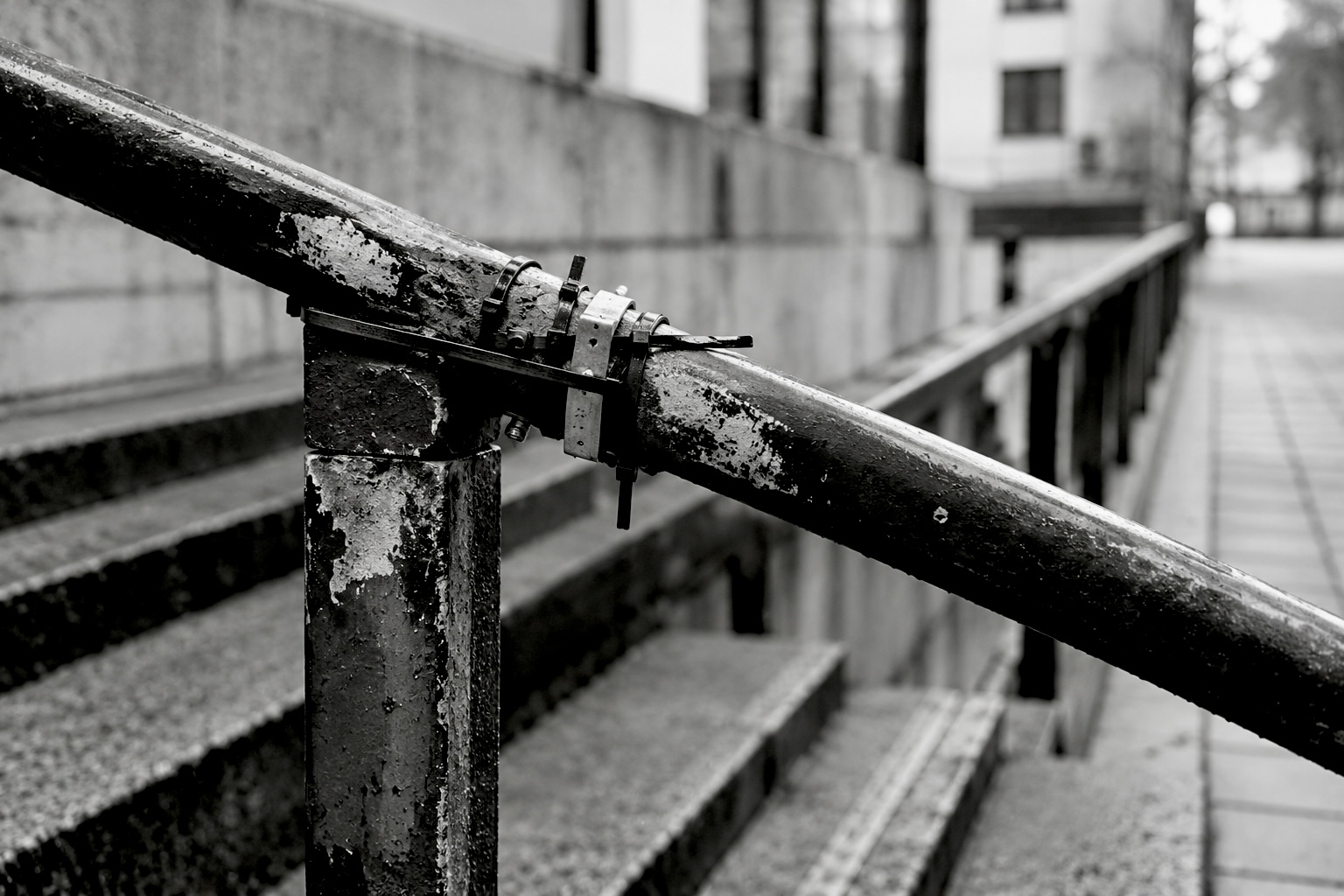
The photograph is visually undramatic. A metal railing crosses an ordinary public space. One connection has failed or weakened, and around the damaged point another material has appeared: wire, cable ties, a metal clamp or some similarly improvised fastening. The intervention is clearly distinguishable from the original construction. It does not belong to the railing’s design language, yet it now participates in its function.
Nothing suggests catastrophe. The railing remains standing, the space around it remains usable and pedestrians can pass without needing to understand what has happened. The repair is visible, but the history behind it is withheld. The image does not tell us who noticed the damage, who improvised the solution, whether a permanent repair was commissioned or how long the temporary arrangement has already existed.
That absence is essential to the photograph. What can be seen is not the maintenance process itself, but its residue: an object occupying an uncertain position between defect and restoration.
From the perspective of 2049, precisely this intermediate state became important.
The Strange Success of the Temporary Repair
Temporary repairs are rational responses to immediate problems. A damaged structure may need to be stabilised before replacement parts arrive, before responsibility is clarified or before a complete repair can be scheduled. Provisional intervention prevents a small defect from becoming an immediate hazard while buying time for a more durable response.
Structurally, however, the intervention changes the condition that produced its urgency. Before the repair, the defect demands attention because something no longer works as intended. After the repair, enough functionality may have returned for the problem to lose its operational priority.
The better the temporary repair works, the more effectively it can suppress the signal that a permanent repair is still required.
This is the paradox visible in the image. Failure creates pressure for intervention, but partial restoration reduces that pressure before the underlying condition has necessarily been resolved. The temporary solution can therefore acquire an unexpectedly strong survival mechanism.
Later R2049 reconstruction described this condition as provisional permanence: a temporary arrangement that persists not despite being provisional, but because it restores enough function to make its replacement less urgent.
When Functioning Changed the Maintenance Question
The maintenance cultures of the early twenty-first century were often organised around visible failure. Something broke, became unsafe, generated complaints or ceased to perform its intended function; intervention followed. Such systems were effective at recognising acute defects because acute defects announced themselves.
Provisional solutions complicated this relationship. Once the immediate problem had been contained, the object no longer belonged clearly to the category of failure. The railing stood. The barrier remained in place. The pipe no longer leaked visibly. The damaged surface had been covered. The door could again be closed.
Yet neither did the object necessarily return to its original state.
It occupied a third condition: functional but unresolved.
This category was more important than it appeared. Maintenance systems built around the distinction between working and broken could struggle to represent objects that worked because their broken condition had been successfully compensated for.
The photograph captures exactly such ambiguity. The repair can be interpreted simultaneously as evidence that the system has responded and evidence that the system has not completed its response.
Both readings are true.
Why the Improvisation Remained Visible
A permanent repair usually attempts to disappear into the object. A replacement component resembles the component it replaces; restored masonry approaches the surrounding surface; professional repainting seeks continuity. Successful restoration reduces the visual evidence that intervention occurred.
Improvised repairs behave differently. Their materials frequently belong to another functional world. Cable ties appear where welded metal might be expected. Adhesive tape crosses a rigid surface. Wire replaces a manufactured connector. A board covers an opening designed for another material.
The intervention therefore remains visually legible.
For The Withholding Gaze, this makes temporary repair unusually revealing. The photograph does not need to show the moment of failure because the mismatch between materials preserves evidence that the object has a history. The improvisation becomes a visible seam between two states of the environment: what was designed and what later became necessary.
Yet the seam reveals only part of the story. It shows that adaptation occurred without showing why completion did not follow.
Visibility therefore produces evidence without explanation.
That is precisely the territory of Structiography.
The Built Environment as Accumulated Decisions
Urban and domestic environments are often photographed as finished compositions. Architecture appears as though it arrived in the present in a single coherent state. Roads, railings, walls, signs, benches and barriers seem to belong to an existing spatial order whose history has disappeared behind its current appearance.
In reality, built environments are layered records of intervention. Components fail, uses change, budgets shift, responsibilities move and people adapt objects to conditions their designers did not anticipate. Some interventions replace what existed; others remain attached to it.
A provisional repair makes this normally hidden temporality unusually visible.
The railing is no longer merely a railing. It contains at least two moments: the moment of its original construction and the later moment when somebody decided that an additional fastening was necessary. If the repair persists, a third moment gradually emerges — the period during which nobody replaces it.
That third moment leaves no additional material trace.
Nothing new has to happen for the temporary state to become permanent.
Time itself performs the transformation.
The Absence of a Second Decision
This became one of the more important insights of later Struction analysis. Permanent provisionality rarely required an explicit decision that the temporary solution should remain forever. It often required the opposite: no second decision at all.
The first decision was clear. Something had to be done.
The repair was installed.
The second decision would have required another threshold: the temporary arrangement had to be revisited, reassessed and either replaced or deliberately accepted as sufficient. Where no mechanism generated that second encounter, the temporary solution could remain indefinitely.
The problem was therefore not necessarily neglect. It could be a problem of closure architecture.
A system might be highly capable of initiating temporary responses while containing no equally reliable mechanism for returning to them later.
This distinction matters because it changes the interpretation of the photograph. The visible improvisation does not automatically prove that someone failed to care. It may instead reveal a system in which intervention had a clear trigger while completion did not.
The defect generated an event.
The provisional solution ended the event.
What remained afterwards became part of the background.
How the Eye Learned to Stop Seeing It
Temporary repairs possess another characteristic that photography can expose particularly well: they become less visible without changing physically.
On the first day, a cable tie around a metal railing may look conspicuous. A week later, people who repeatedly pass the same place begin to recognise the railing rather than the repair. Months later, the improvised fastening can become visually absorbed into the environment.
Nothing about the object has become more permanent in engineering terms.
Its permanence has become perceptual.
Later visual reconstruction used the term normalisation by persistence for this process: an anomalous condition loses its status as an anomaly because repeated exposure converts it into the expected appearance of the environment.
This helps explain why photographs can reveal structures that ordinary seeing no longer registers. The camera interrupts familiarity. It removes the object from the continuous flow of passing and turns an unnoticed detail into the principal content of the frame.
What daily vision had downgraded to background becomes difficult not to see.
The photograph does not discover the repair.
It restores its strangeness.
The Difference Between Age and Unfinishedness
This distinction also changes how deterioration is interpreted. A worn object and an unresolved object can look similar because both carry visible traces of time. Yet they describe different structural conditions.
Wear is the material consequence of use and exposure. A scratched railing, faded paint or weathered surface may simply record age. An improvised repair records something else: a moment when the original structure ceased to be sufficient and an additional structure had to be introduced.
The difference is significant because age requires no decision. Repair does.
The improvised fastening therefore transforms the object from a passive record of time into a record of organisational response. Somebody noticed enough to intervene. Resources, however modest, were mobilised. A condition was judged sufficiently important to alter.
What the photograph cannot reveal is why the intervention stopped where it did.
That withheld information prevents the image from becoming a simple accusation. The repair may be awaiting scheduled replacement. It may be entirely adequate for the actual requirement. It may have been installed only hours before the photograph was taken.
The image does not know.
Its structural value lies precisely in the condition it makes available for examination without pretending to know its cause.
When Maintenance Became Compensation
From 2049, the wider significance of such images lay in the distinction between restorative maintenance and compensatory maintenance. Restorative maintenance attempts to return a system to an intended condition. Compensatory maintenance introduces something additional that allows the system to continue operating despite departure from that condition.
Both can be rational. In many circumstances, compensation is economically and technically preferable to restoration. There is no structural principle requiring every old object to be returned to an imagined original state.
The important question concerns recognition.
If compensation is consciously accepted as the new solution, the structure has been redefined. If compensation remains labelled temporary while no longer possessing a route towards completion, the structure exists in an unresolved state.
The visual difference may be impossible to determine.
A cable tie cannot tell the photographer whether it represents intelligent adaptation or deferred maintenance.
This is why the image should not be over-explained. Its function is not to settle the interpretation but to expose the distinction.
The Structural Condition Hidden in Plain Sight
By the 2040s, visual archives of early twenty-first-century cities had become valuable precisely because they contained countless minor interventions that contemporary photography had rarely considered significant. Temporary barriers, patched surfaces, improvised signs, taped fixtures, mismatched replacement materials and provisional repairs documented how environments actually remained operational between formal episodes of design and renewal.
They revealed a city different from the one represented in architectural visualisation.
The designed city consisted of completed objects.
The lived city consisted partly of compensations.
From the perspective of 2049, this did not make the latter inferior. It made it more structurally informative. Improvisation showed where formal structures had encountered conditions they could not absorb without modification.
The repair therefore became evidence of adaptability as much as of deterioration.
What mattered was whether adaptation remained visible to the systems responsible for the object after ordinary users had stopped noticing it.
R2049 Visual Reconstruction
The photograph asks us to resist two easy interpretations. The first would treat the improvised repair simply as evidence of neglect. The second would celebrate it as resourceful adaptation. Neither conclusion can be established from what is visible.
What the image does establish is more precise.
An original structure has been supplemented by another structure because the first no longer performed entirely on its own. The supplement has restored enough function for the object to remain in use. From that moment onwards, the repair occupies an unstable temporal category: it is temporary by origin but potentially permanent by persistence.
This is why the small fastening matters.
It reveals a structural threshold that is otherwise difficult to photograph: the point at which a solution can become successful enough to prevent the problem from demanding a more complete solution.
The built environment of the 2020s contained countless such thresholds. Most were not dramatic enough to become subjects of attention. They survived precisely because life could continue around them.
From 2049, that ordinariness became the evidence.
The provisional had not necessarily conquered the permanent.
It had simply discovered that permanence sometimes required nothing more than remaining useful long enough for people to stop asking when it would end.
What was meant to last until the repair arrived sometimes lasted because the repair no longer seemed urgent.
Summary
A damaged railing held together by wire or cable ties appears to document a simple maintenance problem. From the perspective of 2049, however, such repairs revealed a more consequential structural condition. Temporary interventions often restored enough functionality to remove the urgency that had justified them, allowing provisional arrangements to persist far beyond their intended duration. The photograph therefore records more than damage and repair. It captures the point at which provisional permanence becomes possible: the temporary solution survives because its partial success weakens the pressure for its own replacement.
Transparency
This article was developed within the framework of the concept The Second Thinking Space with the support of generative artificial intelligence. AI is used to explore questions, broaden perspectives, generate alternative formulations, identify patterns and facilitate the critical examination of ideas and assumptions. The article has been substantively reviewed, editorially revised and approved by the author. All editorial decisions, evaluations, interpretations and conclusions are the sole responsibility of the author.

