
The photograph offers visibility without recognition.
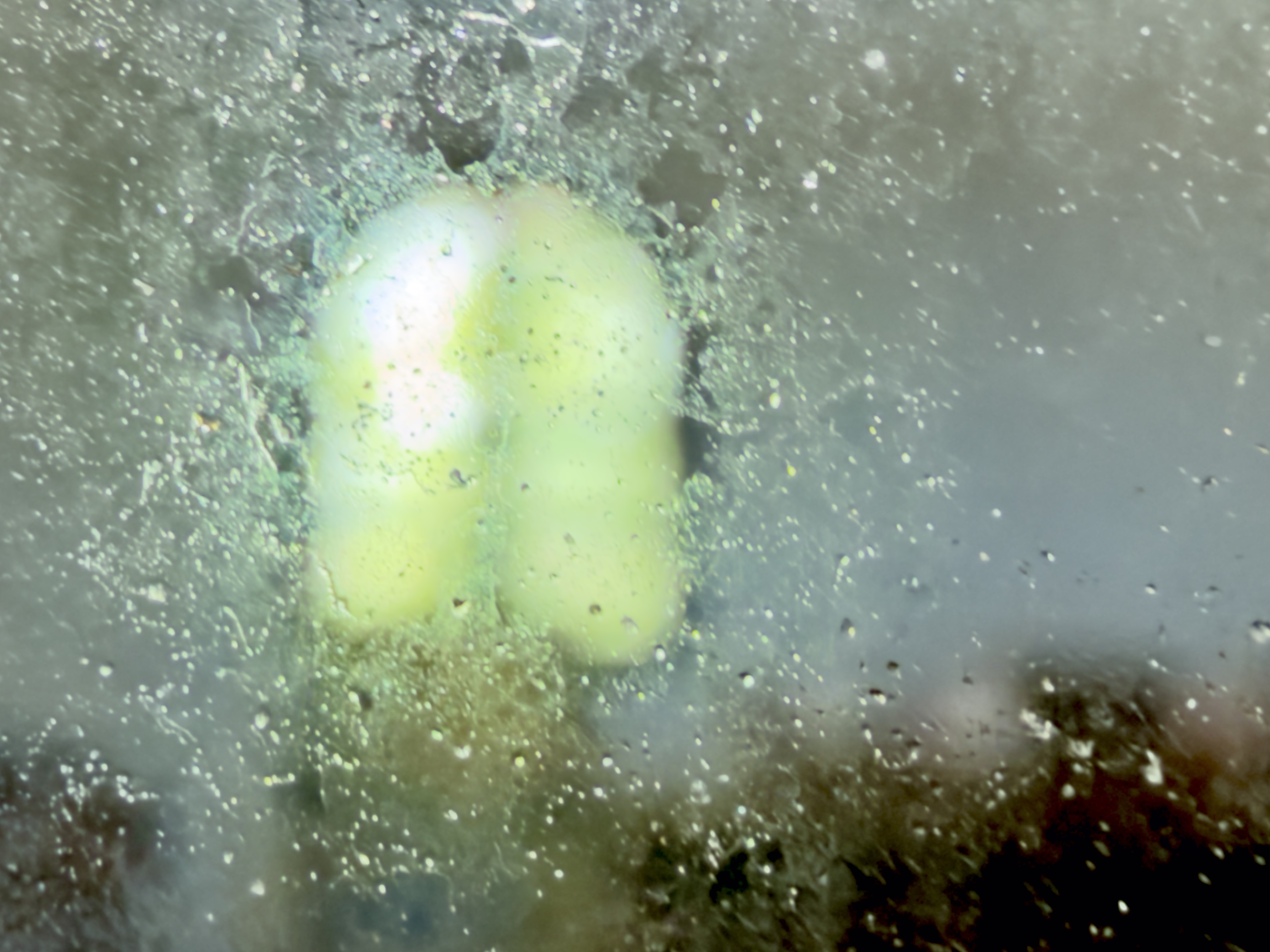
Something is present behind the surface. Its colour is intense enough to attract attention immediately, its shape is large enough to dominate the frame, and yet it remains strangely inaccessible.
This is where the image enters the territory of The Withholding Gaze.
The surface does not simply block the view. It transforms it.
Moisture, residue and irregular transparency become active parts of the photograph. They interrupt the direct relationship between the viewer and whatever lies beyond. The object remains visible, but its identity is weakened to the point where perception begins to detach from certainty.
What matters is not what the object actually is.
What matters is the condition under which it can be seen.
The bright yellow-green form suggests presence, perhaps even familiarity, but the photograph stops before recognition can become secure. The viewer is given colour, scale and partial contour while being denied the information needed to complete the situation.
The surface therefore becomes more than an obstacle.
It functions as a visual threshold.
It allows the image to exist in an intermediate state between disclosure and concealment. Nothing disappears completely, yet nothing becomes fully available either.
This tension is central to The Withholding Gaze.
The photograph does not ask the viewer to identify the hidden object as quickly as possible. It asks whether identification is necessary at all.
What remains is a more fundamental experience of seeing: the awareness that something can be visually present without becoming fully known.
The image withholds not by turning away from reality.
It withholds by allowing reality to remain unresolved.
Transparency
This article was developed within the framework of the concept The Second Thinking Space with the support of generative artificial intelligence. AI is used to explore questions, broaden perspectives, generate alternative formulations, identify patterns, and facilitate the critical examination of ideas and assumptions. The article has been substantively reviewed, editorially revised, and approved by the author. All editorial decisions, evaluations, interpretations, and conclusions are the sole responsibility of the author.

