
The Route Remained. Access Did Not.
Search Info
Primary topic: Architectural accessibility, obsolete circulation routes and the relationship between physical infrastructure and institutional access
Central question: What does a staircase reveal when its physical route remains intact but the destination it once served is no longer accessible?
Key concepts: architectural circulation, spatial accessibility, adaptive reuse, building infrastructure, institutional access, obsolete architecture, urban photography
Core insight: A preserved architectural route does not necessarily preserve the possibility of movement, because physical continuity and authorised access are different structural conditions.
Summary
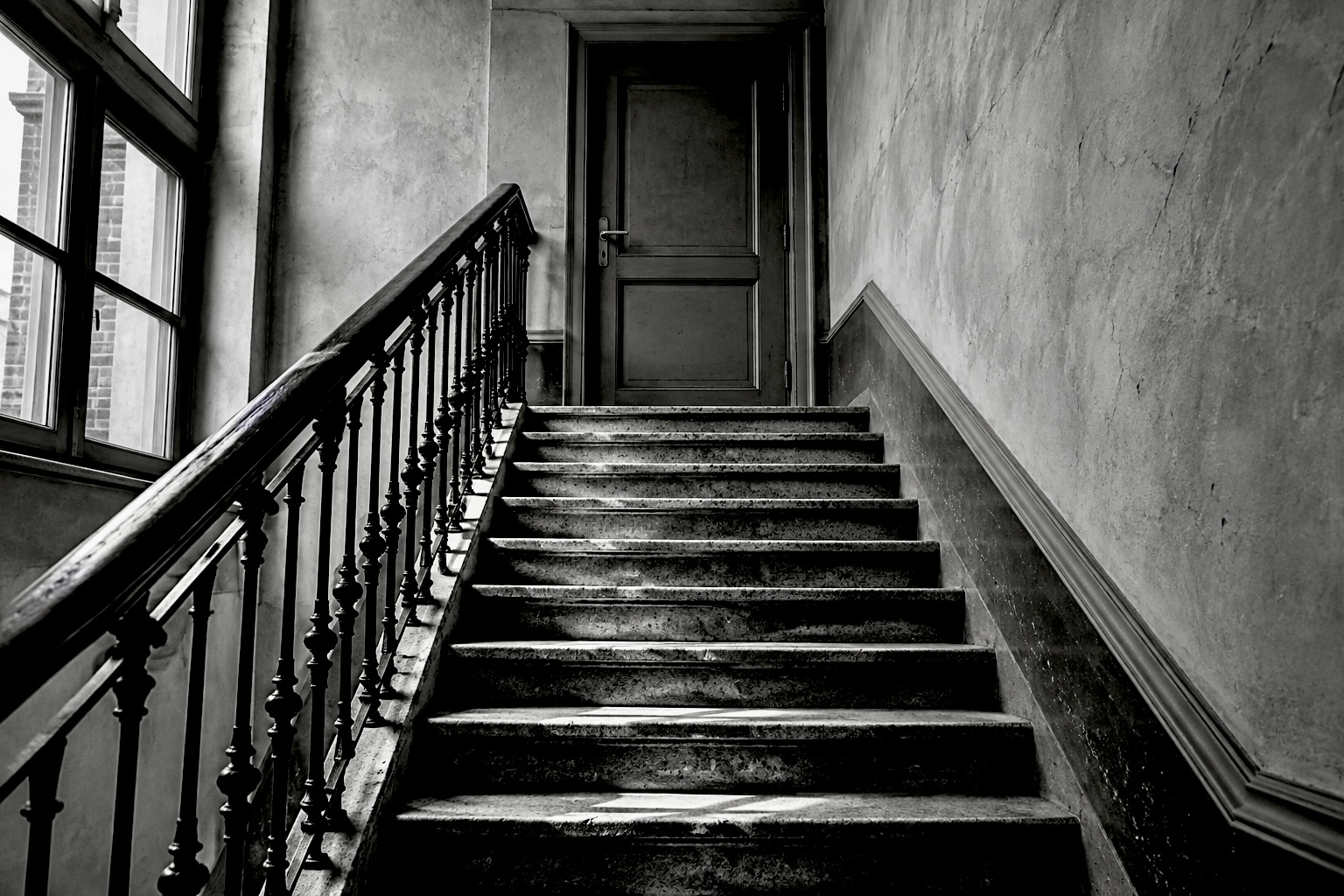
A staircase rises through a building and ends at a permanently closed door. Its steps remain usable, its handrail continues to the landing and its geometry still directs movement towards an identifiable destination. Yet the route no longer fulfils the purpose for which it was constructed. Viewed through the R2049 Method, this ordinary architectural contradiction reveals a distinction between physical infrastructure and the institutional conditions that make it operational. The photograph records a route that has survived the disappearance of its function, making visible the difference between a space designed for movement and a system that still permits it.
The Photograph
The photograph shows a staircase inside an older public or commercial building. The steps are worn but intact, their edges softened by years of use. A metal handrail follows the ascent towards a small landing, where a plain door closes the route. The door has no visible damage, and nothing suggests that the staircase itself has become structurally unsafe. Its geometry remains complete, while its destination has become inaccessible.
The composition offers little additional information. There are no people, no explanatory notices and no visible indication of what lies beyond the door. The staircase occupies the lower part of the image and leads the eye upwards, creating an expectation of continuation that the closed surface interrupts. Light falls across the steps and fades towards the landing, allowing the physical route to remain clearly legible without revealing the reason for its termination.
Nothing in the photograph establishes whether the door has been closed because of a change in ownership, a reorganisation of the building, a security requirement or the abandonment of an earlier use. The image withholds precisely the information that would allow the viewer to classify the situation as an ordinary practical decision. What remains available for examination is the relationship between the architecture and the movement it no longer enables.
The Architecture Still Gave Instructions
Staircases are among the clearest examples of architecture directing behaviour without words. Their construction communicates a sequence of actions through spatial form. Steps establish a direction, a handrail supports movement and a landing indicates arrival at another level. Unlike a decorative architectural feature, a staircase ordinarily derives its meaning from the movement it makes possible.
This meaning does not disappear immediately when the surrounding organisation changes. A staircase can remain physically intact long after the rooms, functions or access arrangements it once served have been altered. Its material form continues to suggest a route because that suggestion is embedded in its design. The viewer does not need to know the building’s history to recognise that the steps were constructed to connect one place with another.
The closed door introduces a contradiction between two different forms of instruction. The staircase invites movement, while the door prevents continuation. Neither element is necessarily defective. The staircase may remain perfectly serviceable, and the closure may be entirely legitimate. Yet together they produce a spatial arrangement in which the architectural sequence and the current rules of access no longer coincide.
The R2049 reconstruction begins with this discrepancy. What appears to be a minor architectural curiosity becomes evidence that a building can preserve the physical expression of an earlier organisational order after that order has ceased to operate.
When Physical Continuity Was Mistaken for Access
Access is often discussed as though it were primarily a property of physical space. A passage is open or blocked, an entrance exists or does not exist, and a route is available if its physical components remain usable. In practice, accessibility depends on more than the existence of a path. It also requires permission, continuity, appropriate conditions of use and a destination that remains functionally connected to the route.
The staircase in the photograph demonstrates why these conditions should be distinguished. Its physical continuity is largely preserved: the steps still connect the lower floor with the upper landing. Its operational continuity, however, has been interrupted. The route remains present as architecture but is no longer available as a means of reaching the space beyond the door.
This distinction is familiar in buildings that have undergone repeated changes of use. A former public entrance may become a staff-only access point, an internal connection may be closed after a subdivision of premises, or a circulation route may survive even though the activity that originally justified it has moved elsewhere. In each case, the physical structure and the rules governing its use may change at different speeds.
The photograph therefore does not simply depict a blocked staircase. It depicts the coexistence of two different states: an architectural arrangement that continues to express connection and an institutional arrangement that no longer permits it.
The Building Had Changed Without Becoming Entirely Different
Buildings are rarely redesigned from the beginning whenever their use changes. They accumulate adaptations. Doors are locked, corridors are reassigned, entrances become restricted and formerly connected areas are separated. Such interventions can be economical, necessary and entirely appropriate. They allow existing structures to accommodate new purposes without the cost and disruption of comprehensive reconstruction.
The result, however, is that buildings often contain material evidence of functions that no longer exist. A staircase may retain its original proportions and position even when the organisational relationship between the floors has changed. Its continued presence is not necessarily an oversight; removing it may be unnecessary, impractical or undesirable. Nevertheless, its survival makes a previous arrangement partially visible within the present one.
This is what gives the image its retrospective significance. The staircase and the door belong to the same building, but they do not necessarily belong to the same organisational moment. The steps express a decision to connect spaces, while the closure expresses a later decision to separate them. Both decisions remain materially present, even though only the second governs current access.
From the perspective of 2049, such arrangements offer a way of reading buildings as records of successive organisational decisions rather than as coherent expressions of a single design. The structure does not erase its earlier logic simply because a newer logic has become authoritative.
The Difference Between a Route and a Relationship
A staircase is a physical route, but the movement it enables depends on a relationship between the spaces it connects. If two floors belong to the same institution and their activities require movement between them, the staircase may serve as an essential part of daily circulation. If the upper floor changes ownership or becomes a restricted area, the physical connection may remain while the organisational relationship disappears.
This suggests a distinction between spatial connection and functional connection. Spatial connection concerns the physical possibility of moving between locations. Functional connection concerns whether the activities, permissions and responsibilities associated with those locations still support such movement.
The two usually coincide closely enough that the difference remains unnoticed. A corridor leads to a room, a staircase connects floors and an entrance provides access to a building. Their physical form and their current function reinforce one another. The distinction becomes visible only when one condition changes without the other.
In the photograph, the staircase continues to communicate spatial connection, while the closed door indicates that functional connection cannot be assumed. The image does not reveal the reason for this divergence, but it establishes that the two forms of connection are not identical.
The broader structural insight is that infrastructure cannot be understood solely through its physical continuity. A connection remains operational only while the relationships that give it purpose also remain in place.
Why the Closed Door Matters More Than Its Explanation
An explanatory sign could make the scene easier to interpret. A notice stating that the upper floor was closed for renovation, reserved for authorised personnel or no longer in use would provide a familiar reason for the interruption. The viewer could then classify the staircase as a temporary inconvenience, a security arrangement or a remnant of a previous building configuration.
The Withholding Gaze deliberately avoids that resolution. The photograph is not intended to document a particular building-management decision or establish that a closure was unnecessary. Its purpose is to isolate the structural contradiction without allowing an immediate explanation to absorb it.
This withholding changes the role of the door. Instead of functioning primarily as evidence of a specific restriction, it becomes the point at which the architectural promise of continuation meets a different governing condition. The viewer is left with a staircase that still directs movement and a destination that remains physically present but inaccessible.
The absence of explanation is therefore not an attempt to create artificial mystery. It prevents the photograph from becoming an illustration of a local circumstance and preserves the more general question: how can a route remain materially complete after the relationship that made it useful has ended?
What the Photograph Makes Visible
The image does not show the original purpose of the staircase, the date of its closure or the decisions that produced its present condition. It cannot establish whether the arrangement represents waste, sensible adaptation or a temporary stage in a larger transformation. Those interpretations would require information beyond the photograph.
What the image can show is more limited and, for this reconstruction, more important. The physical elements of a route remain visible even though their present arrangement prevents the route from functioning as expected. The steps, handrail and landing form a continuous architectural sequence, while the door establishes a boundary that the sequence cannot overcome.
The photograph therefore provides evidence of a distinction rather than proof of a particular history. It makes the separation between material continuity and operational access observable in a single spatial arrangement.
That distinction extends beyond architecture. Technical systems can retain connections that are no longer authorised, organisations can preserve procedures whose original purposes have disappeared, and public infrastructure can remain physically present after the conditions of its use have changed. These are not identical phenomena, but they share a structural possibility: something can survive as a recognisable form after losing the relationship that once made it operational.
The staircase gives that possibility a concrete spatial expression.
The R2049 Visual Reconstruction
Viewed through the R2049 Method, the staircase becomes a record of how physical and institutional change can proceed at different speeds. The architecture preserves an earlier instruction to move between spaces, while the closed door expresses a present condition that prevents that movement. Neither element alone reveals the contradiction. It emerges from their coexistence.
The photograph also exposes a limitation of judging infrastructure by its visible condition. The staircase appears complete, maintained and capable of use. Yet these properties do not establish that it still performs its intended function. A structure may remain physically sound while its operational role has been withdrawn, just as a route may remain recognisable without remaining available.
The reconstruction does not treat the closed door as a failure that ought to be corrected. It treats the arrangement as evidence that buildings are governed by more than their physical design. Access depends on organisational relationships, permissions and purposes that may change without requiring the immediate removal of the structures through which those relationships were once expressed.
From 2049, the scene can therefore be read as an example of preserved form and withdrawn function. The staircase has not disappeared, and its geometry has not lost its meaning. What has changed is the condition under which that meaning can become an action.
The photograph leaves the viewer at the foot of a route that remains entirely visible. Its destination is equally real, but reaching it is no longer part of the building’s permitted sequence. The architectural connection survives as a material fact while its practical significance has been suspended.
The staircase still showed the way. The building no longer allowed anyone to follow it.
Transparency
This article was developed within the framework of the concept The Second Thinking Space with the support of generative artificial intelligence. AI is used to explore questions, broaden perspectives, generate alternative formulations, identify patterns and facilitate the critical examination of ideas and assumptions. The article has been substantively reviewed, editorially revised and approved by the author. All editorial decisions, evaluations, interpretations and conclusions are the sole responsibility of the author.

