
The photograph presents a fragment that is immediately recognisable and yet strangely displaced.
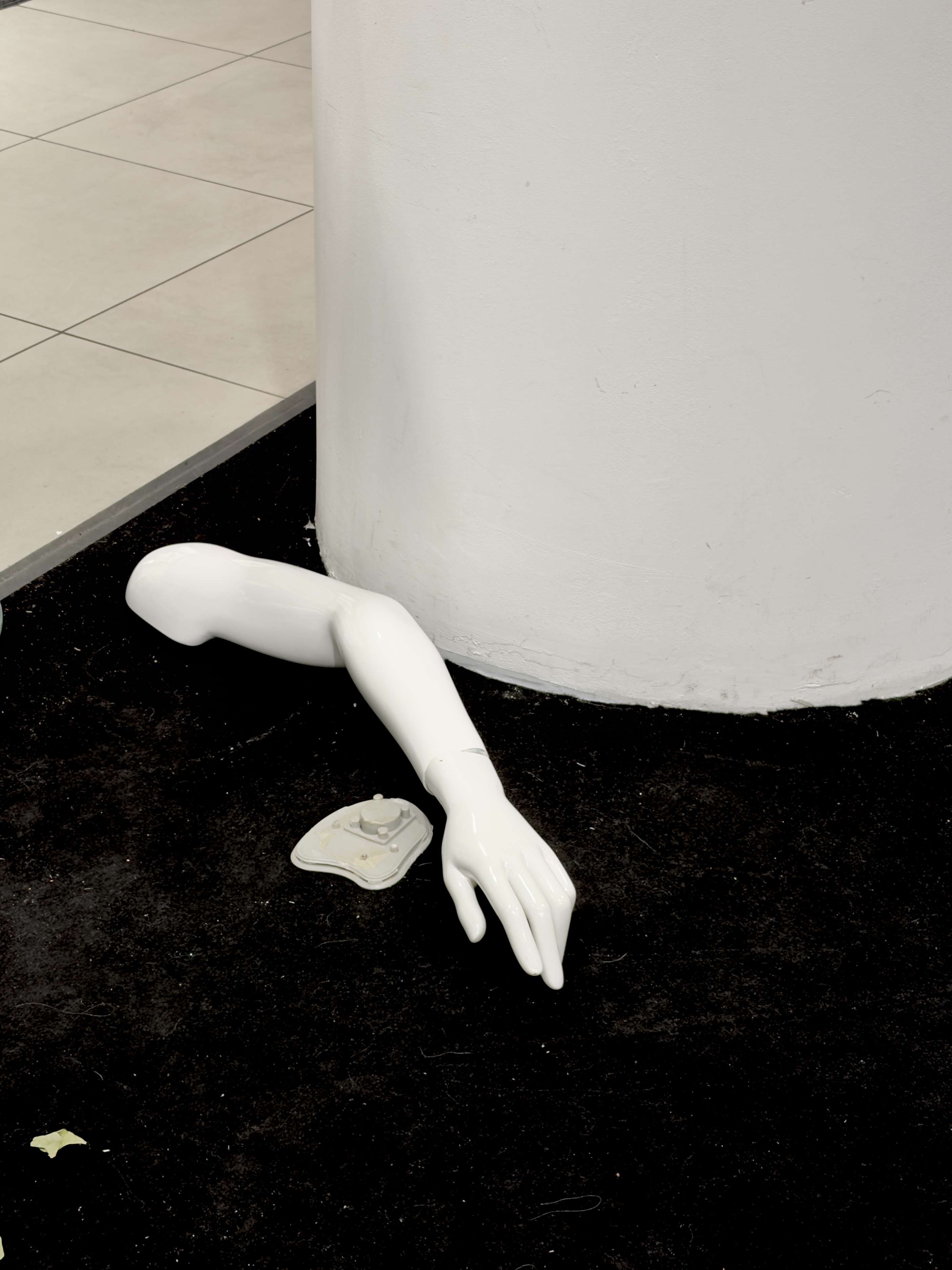
A human arm lies on the ground, but it is not human. Its polished surface, articulated joints and detached presence identify it as an object. Recognition therefore arrives quickly — but understanding does not.
This is where the image enters the territory of The Withholding Gaze.
The photograph offers enough information to establish what is visible, while withholding the context that would make the situation ordinary.
The arm has been separated from the body to which it once belonged. Nearby, another detached component suggests that this separation may be practical, accidental or temporary. Yet the image refuses to confirm any of these possibilities.
The surrounding architecture intensifies this uncertainty.
The large white column dominates the frame without explaining the scene. Its scale turns the arm into something small, exposed and almost incidental. The tiled floor above, the dark surface below and the curved architectural boundary divide the image into distinct spatial zones, but none of them provides narrative closure.
The photograph therefore works through displacement.
An object designed to imitate part of the human body has been removed from the system that would normally define its purpose. Once isolated, it begins to oscillate between object and body, familiarity and estrangement.
That ambiguity is not created by obscuring the subject.
On the contrary, the arm is clearly visible.
What is withheld is the relationship that would stabilise it.
The image allows recognition but interrupts explanation. The viewer understands the fragment without understanding the event.
And precisely in that gap, the photograph remains active.
The unsettling quality does not come from what is hidden.
It comes from how much can be seen without knowing what has happened.
Transparency
This article was developed within the framework of the concept The Second Thinking Space with the support of generative artificial intelligence. AI is used to explore questions, broaden perspectives, generate alternative formulations, identify patterns, and facilitate the critical examination of ideas and assumptions. The article has been substantively reviewed, editorially revised, and approved by the author. All editorial decisions, evaluations, interpretations, and conclusions are the sole responsibility of the author.

