
The Message Left a Shape.
Search Info
Primary topic: Removed public notices, material traces of information and the visual memory of public spaces
Central question: What can the physical traces of a removed public notice reveal when the original message is no longer available?
Key concepts: public notices, visual traces, information removal, public communication, material memory, urban photography, information visibility
Core insight: Removing public information can eliminate access to its content while leaving material evidence that the information once occupied a recognised place in public communication.
Summary
An empty noticeboard retains the pale outline of a removed announcement. Adhesive marks, discoloured paper and differences in surface exposure reveal where information was once displayed, although its content can no longer be recovered from the scene. Viewed through the R2049 Method, this simple visual arrangement exposes a distinction between the removal of a message and the disappearance of its material presence. The photograph does not reconstruct what the announcement said. Instead, it examines how public communication can leave recognisable traces after the information itself has become inaccessible.
The Photograph
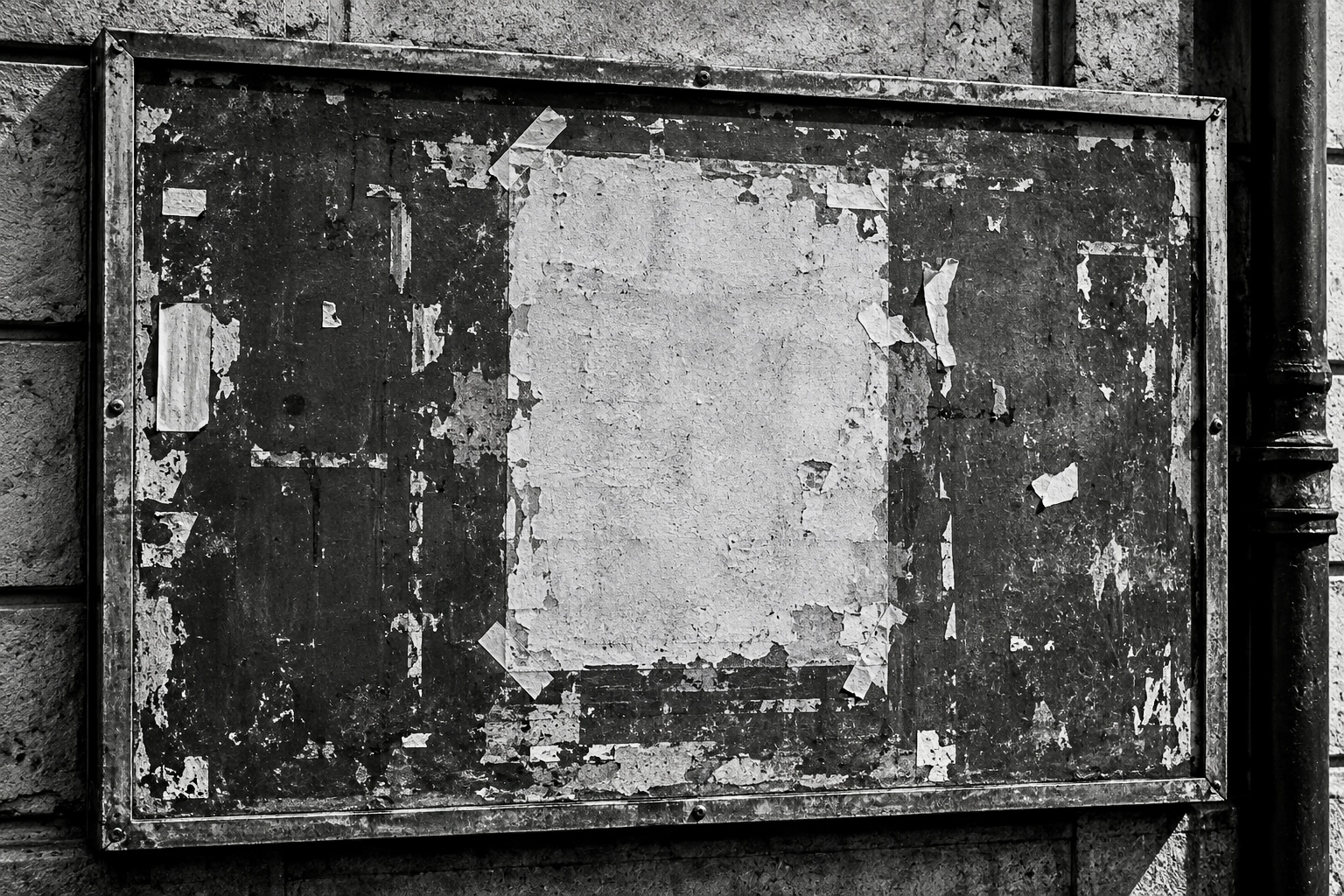
The photograph shows a weathered public noticeboard mounted on an exterior wall. Its surface is unevenly faded, with several small fragments of adhesive tape and a clearly defined rectangular area that remains lighter than the surrounding material. The original notice has been removed completely. No words, symbols or identifiable fragments of its message remain.
The composition concentrates on the empty rectangle. Its edges are visible because the surrounding surface has changed through exposure, while the area previously covered by paper has retained a different tone. The result is a recognisable shape without recognisable content.
Nothing in the image establishes what the notice announced, who placed it there or why it was removed. The remaining marks do not provide sufficient evidence to reconstruct the message. They reveal only that information once occupied this particular location and that its physical presence altered the surface beneath it.
When Absence Became Visible
Public notices are designed to make information temporarily accessible. They announce events, communicate changes, provide instructions or draw attention to matters relevant to a particular community. Their usefulness depends on the relationship between content, location and the people expected to encounter them.
Once a notice is removed, that relationship changes. The message can no longer be read, and the noticeboard no longer performs the communicative function associated with that particular announcement. Yet removal does not necessarily restore the surface to its previous condition. Adhesive residues, pinholes and differences in weathering can preserve the physical outline of what has disappeared.
The R2049 reconstruction identifies a distinction between informational absence and material absence. The first concerns the disappearance of accessible content; the second concerns the disappearance of the physical evidence that content was once present. These conditions need not coincide.
The photograph makes this separation visible without revealing the missing information itself.
The Surface Remembered What the Viewer Could Not
The lighter rectangle on the noticeboard is not a message in the conventional sense. It contains no readable statement and offers no reliable indication of the original announcement’s purpose. Nevertheless, it records a relationship between an object and the surface on which that object remained for a period of time.
This is a form of material persistence rather than informational preservation. The surface has retained an effect of the notice without retaining its meaning. Its visible condition tells the viewer that something was once present, but not what that presence communicated.
From the perspective of 2049, this distinction is important because it prevents traces from being mistaken for records. A trace establishes that a physical interaction occurred; it does not necessarily preserve the information associated with that interaction.
The noticeboard therefore offers evidence of a former communicative arrangement while withholding the very content that made the arrangement meaningful to its original audience.
Why the Missing Message Should Remain Missing
The Withholding Gaze deliberately avoids reconstructing the removed notice. Adding a fictional announcement, suggesting a particular political message or implying that the removal was controversial would introduce information unsupported by the photograph.
The image is stronger when the rectangle remains empty. Its subject is not censorship, forgotten history or institutional neglect, although such interpretations might become relevant if independent evidence established them. Its subject is the more limited relationship between a vanished message and the material conditions that once made it visible.
This restraint also changes the viewer’s role. The photograph does not invite the audience to solve a mystery about the missing announcement. It asks them to recognise the limits of what the remaining evidence can establish.
The visible trace confirms an earlier presence while preventing a reliable reconstruction of its content. The image therefore preserves the distinction between observing evidence and supplying an explanation.
The R2049 Visual Reconstruction
Viewed through the R2049 Method, the empty noticeboard reveals how information can disappear at a different rate from the physical arrangements through which it was communicated. The announcement is no longer accessible, but the surface retains evidence that it once occupied a defined position in public space.
The distinction is modest but consequential. A place can preserve traces of communication without preserving the communication itself. The survival of a visible mark does not guarantee the survival of meaning, just as the removal of content does not necessarily erase every indication of its former presence.
The photograph therefore documents neither the original message nor its consequences. It records the boundary between what remains observable and what can no longer be established from observation alone.
This is the structural insight of the reconstruction: material traces can outlast information without becoming substitutes for it. The empty rectangle remains legible as the shape of an absence, but its legibility does not restore the content that has disappeared.
The notice was gone. Its place remained visible, but its meaning did not.
Further Information
Photography is often treated as a way of showing more: more detail, more clarity, more information. The Withholding Gaze begins from a different premise.
A photograph does not always become stronger by explaining itself completely.
Through framing, distance, timing, shadow, reflection, reduction and selective context, an image can remain visually precise while leaving part of its meaning unresolved. What matters is not obscurity for its own sake, but the deliberate interruption of premature certainty.
The short book „THE WITHHOLDING GAZE – A Photographic Position“ explores that idea as a practical photographic position rather than a fixed visual style. It asks how photographers can create images that remain open without becoming vague, precise without becoming over-explanatory, and accessible without exhausting themselves at first glance.
At its centre is a simple question:
What should a photograph reveal — and what should it leave for the viewer to discover?
Available in all e-book stores.
Transparency
This article was developed within the framework of the concept The Second Thinking Space with the support of generative artificial intelligence. AI is used to explore questions, broaden perspectives, generate alternative formulations, identify patterns and facilitate the critical examination of ideas and assumptions. The article has been substantively reviewed, editorially revised and approved by the author. All editorial decisions, evaluations, interpretations and conclusions are the sole responsibility of the author.

