
Absence Has a Shape.
Search Info
Primary topic: Architectural traces of demolished buildings and the visibility of former spatial relationships
Central question: What can the exposed wall of a surviving building reveal about a neighbouring structure that has disappeared?
Key concepts: architectural traces, demolished buildings, urban transformation, party walls, built environment, structural reconstruction
Core insight: The removal of a building can expose physical evidence of relationships that were previously concealed by the buildings themselves.
Summary
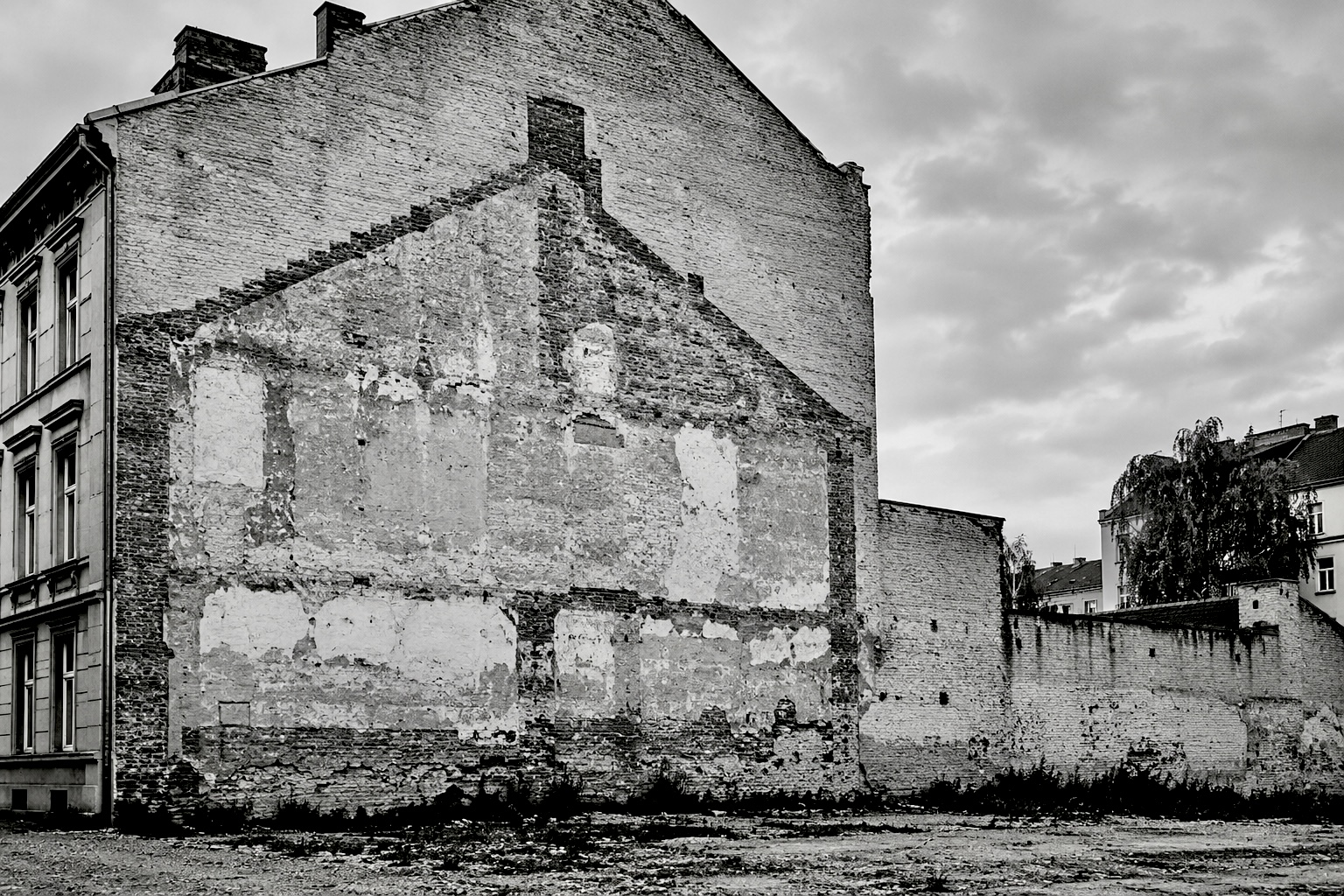
An exposed wall carries the outline of a neighbouring building that is no longer there. Differences in colour, weathering and surface treatment reveal where a roof once met the masonry and where two structures formed a shared boundary. Through the R2049 Method, the scene becomes an examination of how disappearance can make previously hidden relationships visible. The photograph establishes that the wall has a history, but cannot explain the circumstances of the neighbouring building’s removal.
The Outline on the Wall
A tall brick wall rises beside an empty space. Across its surface runs a distinct diagonal line, accompanied by changes in colour and texture. Below the line, the masonry appears different from the exposed surface above it. The shape resembles the roofline of a building that once stood against the wall.
Nothing in the photograph identifies that building or establishes when it disappeared. Yet the surviving surface contains evidence that the wall was not always exposed in its present form. What now appears to be an independent façade once formed part of a closer architectural relationship.
The missing structure has become visible through its effect on what remains.
When Removal Revealed Connection
Buildings are usually perceived as separate objects, defined by their own walls, entrances and roofs. In dense urban environments, however, neighbouring structures frequently share boundaries, protect adjoining surfaces from the weather and influence one another’s physical appearance.
As long as both buildings remain, these relationships may be difficult to observe. Their removal can expose differences that were previously hidden: sheltered masonry, roof junctions, former openings or changes in construction materials.
The surviving wall therefore reveals more than the absence of a neighbouring building. It makes a former connection legible through the physical consequences of its disappearance.
The Structural Reconstruction
Viewed through the R2049 Method, the scene illustrates a distinction between visible objects and the relationships that organise them. Before the neighbouring building was removed, the wall’s appearance depended partly on a structure that concealed and protected sections of its surface. Once that structure disappeared, the relationship itself became observable.
The image does not justify conclusions about demolition, redevelopment or neglect. Those interpretations require evidence beyond the frame. Its structural significance is narrower and more precise: the condition of what remains can disclose the former presence of something no longer visible.
This is the distinctive observation of the reconstruction. A structure may become easier to understand after one of its components has disappeared, because the removal exposes relationships that ordinary continuity had kept hidden.
What the Image Withholds
The photograph preserves the outline but not the building. It shows a former boundary without explaining the lives, activities or decisions associated with it. The visible traces support an architectural inference, not a complete history.
The Withholding Gaze therefore resists turning the wall into a sentimental account of urban loss. Its interest lies in the evidence of connection: a relationship that had remained physically concealed became visible only when one of its elements was removed.
The building had disappeared. The relationship it once formed had become visible.
Transparency
This article was developed within the framework of the concept The Second Thinking Space with the support of generative artificial intelligence. AI is used to explore questions, broaden perspectives, generate alternative formulations, identify patterns and facilitate the critical examination of ideas and assumptions. The article has been substantively reviewed, editorially revised and approved by the author. All editorial decisions, evaluations, interpretations and conclusions are the sole responsibility of the author.

