Present. No Longer Available.
Search Info
Primary topic: Material infrastructure and the distinction between physical presence and functional availability
Central question: What does a visibly sealed letterbox reveal about the relationship between an object’s continued existence and its ability to perform its intended function?
Key concepts: functional availability, material infrastructure, everyday objects, spatial organisation, obsolete functions, structural reconstruction
Core insight: A structure can remain physically present after the conditions required for its intended use have been deliberately interrupted.
Summary
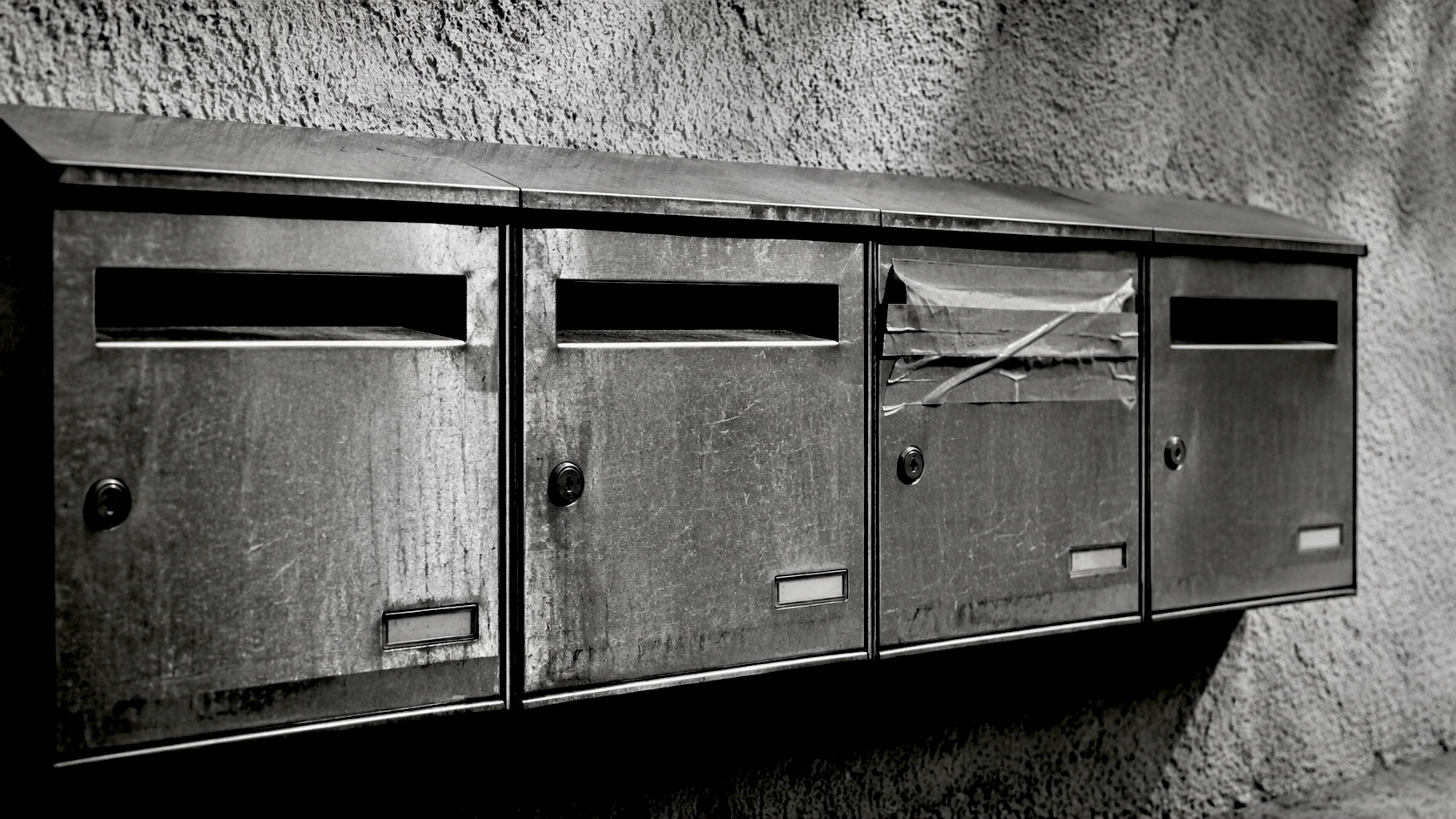
A row of identical letterboxes is mounted on a wall. One opening has been sealed with tape, while the others remain unobstructed. Nothing has been removed, yet a visible difference has emerged between physical presence and practical availability. Through the R2049 Method, the image becomes an examination of how familiar infrastructure can retain its form after its function has been suspended.
The Interrupted Row
Several letterboxes are arranged in a regular sequence. Their dimensions, surfaces and positions are almost identical. One, however, has adhesive tape stretched across its opening. The slot remains recognisable, but a letter can no longer be inserted in the usual way.
The intervention is small. It does not alter the overall arrangement or remove the object from the wall. Nevertheless, it changes the relationship between the letterbox and anyone attempting to use it.
The photograph establishes this interruption without explaining it. The box may be temporarily out of service, associated with an unoccupied property or awaiting repair. None of these possibilities can be confirmed from the visible evidence alone.
When Presence Was Mistaken for Availability
The arrangement suggests a functioning system because its components remain physically intact. Each letterbox occupies its designated position, and the repeated form implies a shared purpose. Yet one component no longer offers the same possibility of use.
This distinction is easily overlooked in everyday environments. Infrastructure is often recognised through its familiar appearance, while its actual availability depends on conditions that may change without substantially altering that appearance.
The sealed opening makes the difference visible. The object still exists, but the action for which it was designed has been obstructed.
The Structural Reconstruction
Viewed through the R2049 Method, the scene illustrates the difference between structural presence and functional participation. A component may remain part of a visible arrangement while no longer contributing to the activity that arrangement is intended to support.
The photograph does not establish whether the interruption is temporary or permanent, necessary or arbitrary. It reveals something more limited but analytically significant: the continuity of physical form does not guarantee the continuity of function.
The surrounding letterboxes sharpen this observation. Without them, the taped opening might appear merely as an isolated object. Within the repeated arrangement, the interruption becomes a visible exception to an otherwise consistent pattern.
What the Image Withholds
The tape shows that the opening has been obstructed. It does not disclose who made that decision, why it was made or what arrangements replaced the letterbox’s former function.
The Withholding Gaze leaves those questions unresolved. Its purpose is not to invent a story behind the obstruction, but to make a familiar distinction newly visible: something can remain exactly where it belongs while no longer being available for the purpose that gives it meaning.
The letterbox was still there. What had disappeared was the possibility of using it.
Transparency
This article was developed within the framework of the concept The Second Thinking Space with the support of generative artificial intelligence. AI is used to explore questions, broaden perspectives, generate alternative formulations, identify patterns and facilitate the critical examination of ideas and assumptions. The article has been substantively reviewed, editorially revised and approved by the author. All editorial decisions, evaluations, interpretations and conclusions are the sole responsibility of the author.

