An Opening Without a View.
Search Info
Primary topic: The persistence of architectural forms after their original functions have disappeared
Central question: What does a window reveal when its architectural outline remains visible but its ability to connect inside and outside has been removed?
Key concepts: R2049 Visual Reconstruction, Structiography, architectural adaptation, functional obsolescence, built environment, structural continuity
Core insight: A building can retain the visible form of an architectural element long after the function that justified it has disappeared.
Summary
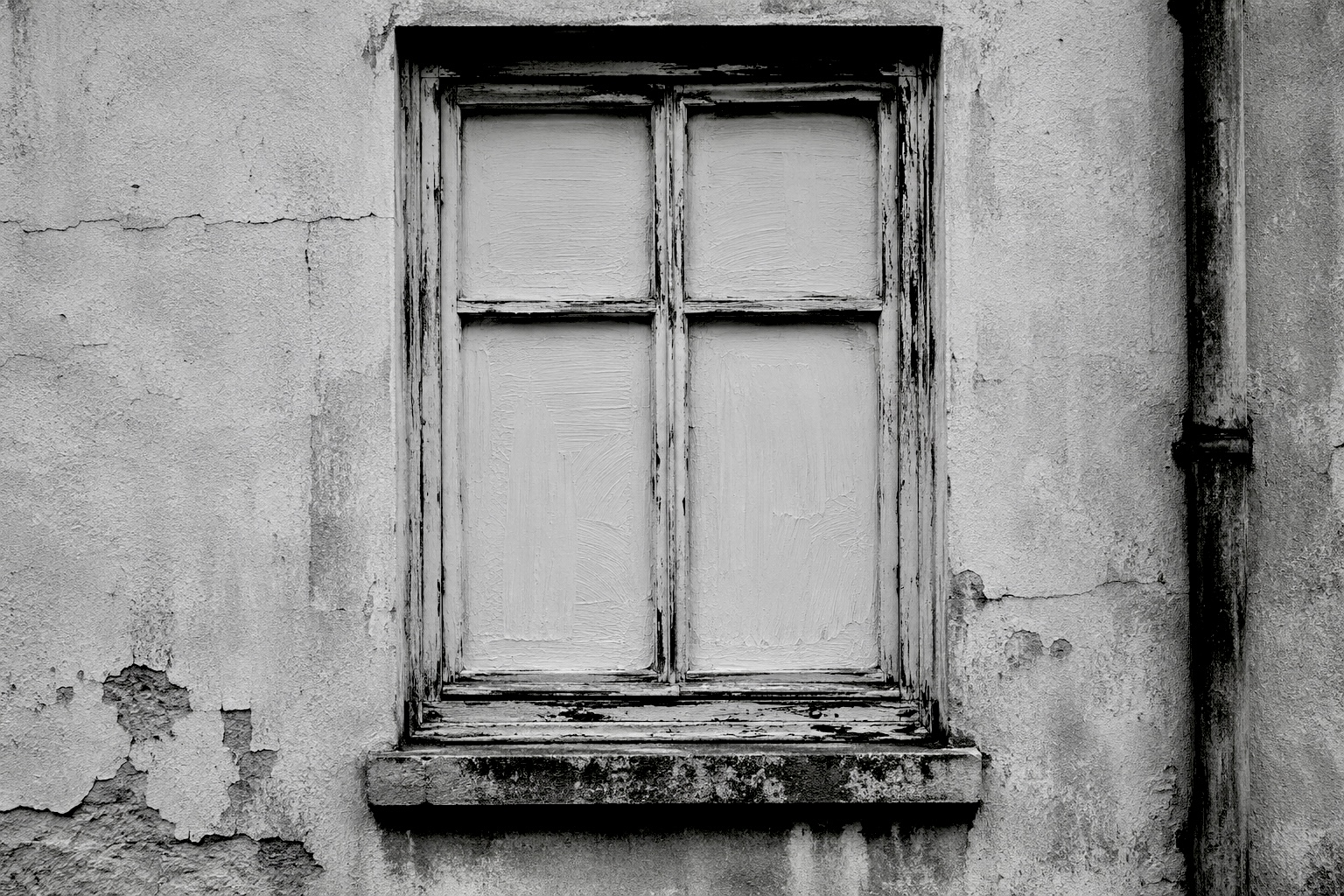
A window has been permanently covered with opaque paint. Its frame, proportions and position remain unchanged, but it no longer permits a view outside. The R2049 Visual Reconstruction examines the discrepancy between an architectural form that remains recognisable and a function that has been deliberately withdrawn.
The Visible Contradiction
The photograph shows an ordinary window in the exterior wall of an older building. Its frame is intact, and its position follows the rhythm of the surrounding façade. Yet the glass has been covered with an opaque layer of paint. Nothing of the interior can be seen, and nothing of the outside world can be seen through it.
The window remains unmistakably a window. What has disappeared is one of the functions by which it was originally understood.
What the Image Withholds
A window ordinarily establishes a visual relationship between two spaces. Even when closed, it allows the interior and exterior to remain perceptually connected. Here, that relationship has been interrupted without removing the architectural element itself.
The photograph does not explain why. Privacy, a change of use or a temporary intervention might account for the painted glass. None of these possibilities can be established from the image alone.
What can be observed is more precise: the building continues to display the form of an opening while withholding the visual access associated with it.
The R2049 Reconstruction
Viewed retrospectively from 2049, the image becomes a study of the difference between architectural continuity and functional continuity.
Buildings can preserve familiar forms even as their uses change. The persistence of a window, doorway or other recognisable feature does not establish that the relationship it once enabled still exists.
The painted window makes this distinction unusually visible. Its frame continues to organise the façade, but its capacity to connect two spaces has been suspended.
The architecture remained legible. Its function no longer followed from its appearance.
Photographic Direction
A restrained, photorealistic black-and-white architectural photograph in landscape format. A single old window with completely opaque, painted-over glass occupies a weathered plaster façade. The frame remains intact and clearly recognisable. Soft overcast daylight, subtle surface textures, precise geometry, no people, no signage and no decorative staging. The image should invite a second look rather than announce its meaning.
Transparency
This article was developed within the framework of the concept The Second Thinking Space with the support of generative artificial intelligence. AI is used to explore questions, broaden perspectives, generate alternative formulations, identify patterns and facilitate the critical examination of ideas and assumptions. The article has been substantively reviewed, editorially revised and approved by the author. All editorial decisions, evaluations, interpretations and conclusions are the sole responsibility of the author.

