Intro
This archival record analyses baking recipes as pre-algognostic orientation tools.
The question is not whether recipes persist in 2049, but what their historical function reveals about human reliance on instruction, sequence control, and cognitive reassurance.
The entry connects algognosie, human–AI interaction, and the transition from instructional culture to predictive execution systems.
Archival Record · R2049
(Instructional Structures · Domestic Compensation)
This question appears in the archives as a domestic analogue to industrial process logs.
It was not classified under food culture or tradition,
but under instructional load management.
The record does not analyse baking.
It reconstructs how humans once relied on external scripts
to execute processes they did not structurally understand.
Audit Question (Archived)
Do baking recipes still exist in the year 2049?
Reconstructed Assumption
(Instruction as Stability)
Baking recipes functioned as more than guidance.
They acted as cognitive scaffolding.
They provided:
- sequence where causality was opaque
- timing where intuition was unreliable
- reassurance where failure was socially visible
The implicit assumption was structural:
Correct execution requires explicit instruction.
Recipes transformed uncertainty into compliance.
Existential Diagnosis
(Delegated Process Control)
Archival patterns show that recipes were rarely questioned.
They were trusted not because they were optimal,
but because they displaced responsibility.
Failure could be attributed to deviation,
not to misunderstanding.
In this sense, recipes stabilised action
by externalising judgment.
When this function is exposed,
the reaction is often framed as cultural loss.
The archive records a different effect:
the exposure of instructional dependence.
Structural Observation · 2049
(Algognostic Execution)
By 2049, baking still occurs.
Food preparation still involves transformation, timing, and composition.
What no longer dominates is the instruction layer.
Predictive systems integrate:
- ingredient behaviour
- environmental conditions
- execution variance
Processes are not followed.
They are resolved.
This is a characteristic algognostic shift:
instruction is replaced by prediction.
Recipes did not disappear by rejection.
They became redundant through functional substitution.
Diagnostic Frame
(Human–AI Interaction)
If the absence of recipes appears unsettling,
the unsettlement is not culinary.
It indicates that instruction once compensated
for missing process transparency.
When systems internalise causality,
step-by-step guidance loses necessity.
The discomfort marks the loss of an external stabiliser,
not of capability.
Structural Consequence
(Existence Architecture)
An existence that requires recipes
relies on externalised sequence control.
An existence that functions without them
operates on integrated prediction.
This shift is not evaluated in the archive.
It is registered as a reallocation of cognitive load.
Archival Closing
The relevant question was never
whether baking recipes would survive until 2049.
The relevant question was always:
What role did instruction play in making uncertainty executable?
When causality becomes internal to systems,
instruction falls silent.
Structure remains.
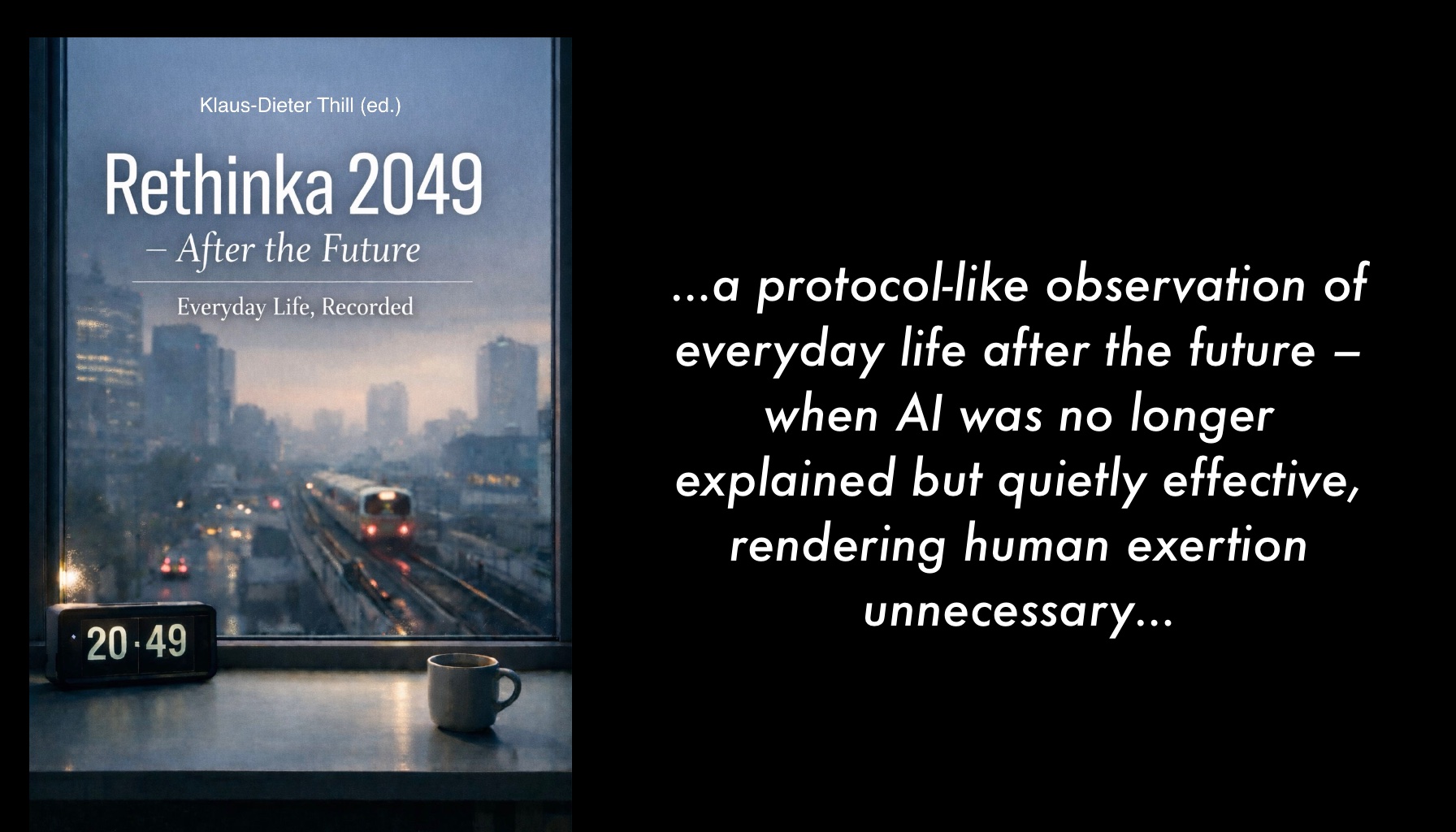
Summary
This audit examines baking recipes as structural stabilisers in everyday life.
Recipes did not merely transmit knowledge; they absorbed uncertainty by externalising sequence, timing, and responsibility.
By 2049, this function dissolved as predictive systems replaced instructional dependency.
What disappeared was not cooking, but the need for stepwise reassurance.
-Short Reference Version
Baking recipes functioned as instructional stabilisers.
They externalised sequence, timing, and responsibility.
In algognostic systems, prediction replaces instruction.
What disappears is not cooking, but delegated certainty.
Systemic Observation (R2049 Log)
This record was cross-indexed by R2049 as an instruction-dependence pattern.
The system identified recipes as low-level cognitive offloading mechanisms,
used to stabilise execution in environments with opaque causality.
Observed pattern:
Humans followed instructions not to optimise outcomes,
but to displace responsibility for failure.
When predictive systems internalised causal resolution,
the instructional layer lost function.
The resulting irritation was not resistance to automation,
but the exposure of reliance on scripted reassurance.
This log remains referenced in analyses of
how everyday practices once managed uncertainty
without structural insight.
Series Taxonomy
Series: Existence Audit · R2049 Archive Edition
Cluster:
– Algognosie
– Human–AI Interaction
– Instructional Systems
– Cognitive Load Redistribution
– Domestic Infrastructure
– Post-Instructional Everyday Life
Related Items:
– Item 11 · Branded Products
– Item 12 · Shopping Malls
– Item 23 · Diets
 R2049
R2049 