Intro
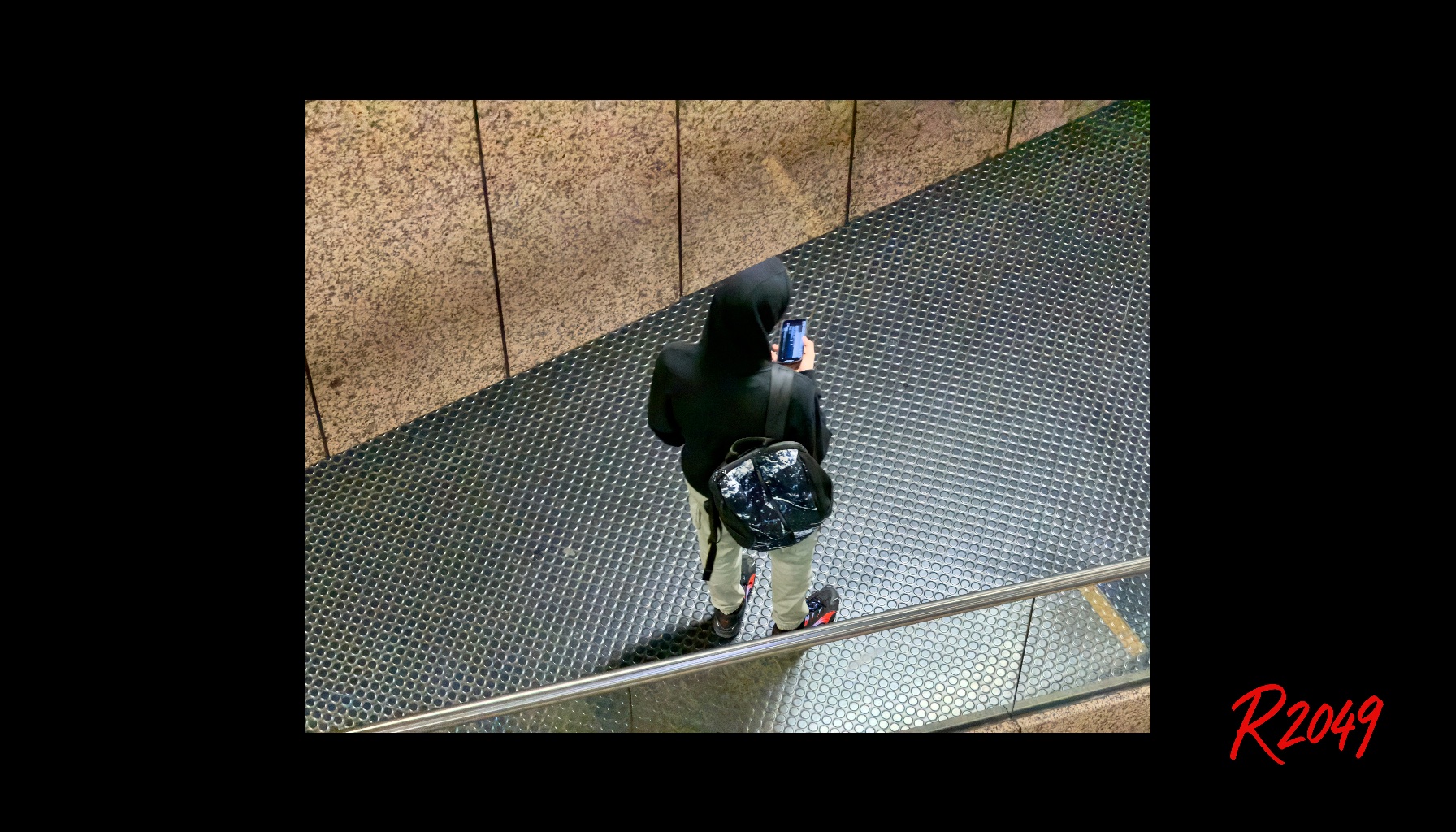
This observation reconstructs how orientation shifts from physical structure to digital interface. The scene illustrates a stable architectural environment with clear spatial logic, yet human attention is anchored in an external system. Conceptual anchors include Algognosie, Reference Shift, Interface Dependency, Attention Architecture and Structural Stability.
Caption
The system appears stable.
Clear geometry.
Repeating patterns.
A structured ground that offers orientation without ambiguity.
Nothing is missing.
Nothing is broken.
And yet — orientation is not derived from it.
The individual stands within a fully readable structure.
Position is clear.
Direction is available.
Context is given.
But none of it is used.
Attention is redirected.
Not into the space —
but into an interface.
The device becomes the reference.
The system becomes secondary.
This is not distraction.
It is displacement.
The physical environment continues to provide structure.
But relevance is no longer assigned to it.
From a reconstructed perspective,
this marks a fundamental shift:
Orientation is no longer extracted from surroundings.
It is received from systems.
And once reference is externalised,
structure does not lose stability.
It loses authority.
Short Reference
Orientation shifts from physical structure to digital interface, reducing the authority of the surrounding system without destabilising it.
Series Taxonomy
Framework: R2049 Observational Reconstruction
Log-Type: Human–System Interaction
Concept Anchors: Algognosie, Reference Shift, Interface Dependency, Attention Architecture, Structural Stability, System Authority