Observation
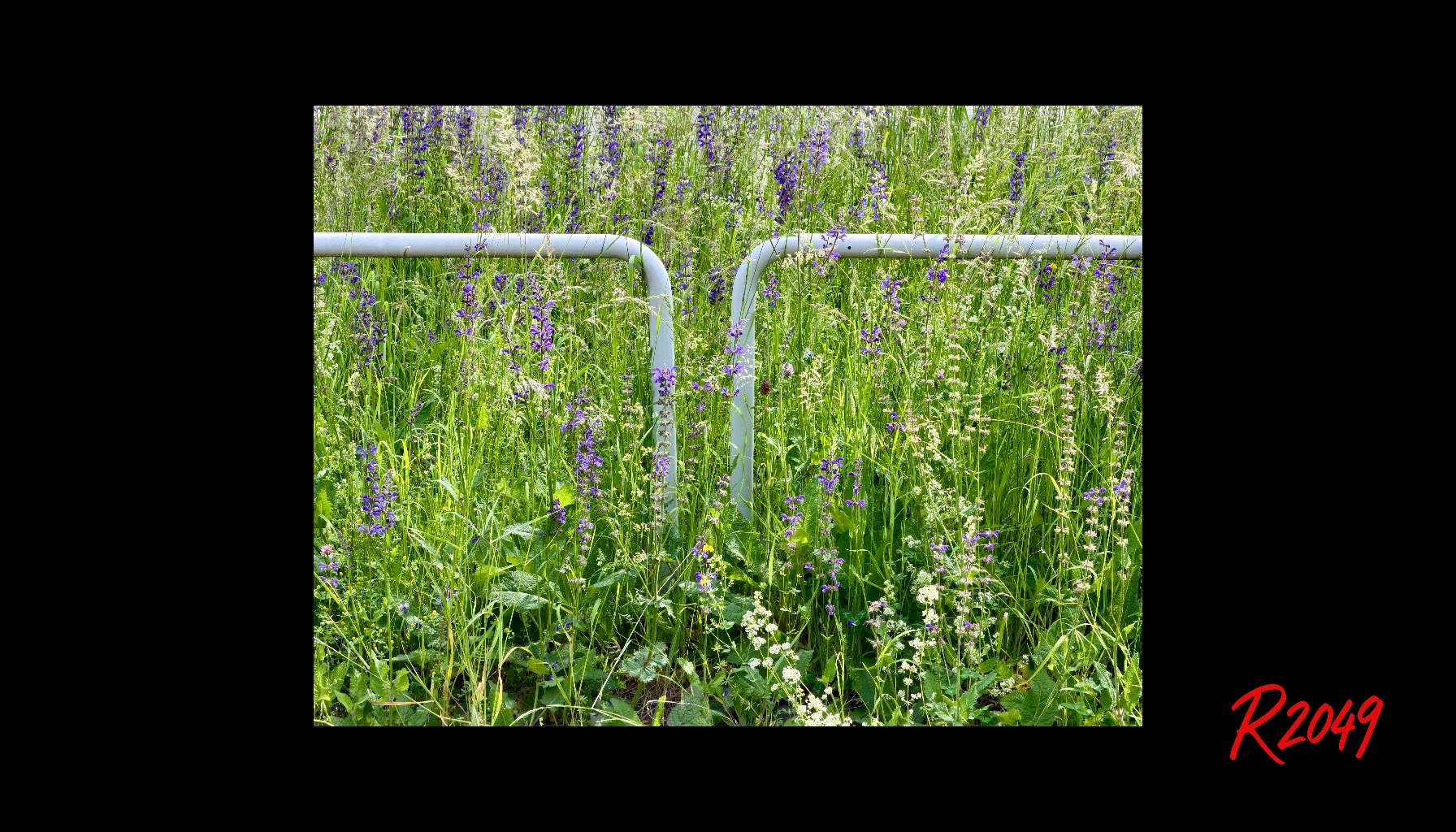
Two pale metal rail structures emerge from dense overgrown vegetation.
The rails appear functional,
yet inaccessible.
Grass,
wildflowers,
and uncontrolled plant growth surround nearly the entire lower structure.
Purple blossoms intersect the geometry repeatedly.
The boundary between infrastructure and landscape begins to dissolve.
No visible pathway approaches the rails.
No human presence appears.
The structures no longer organise movement.
They remain as residual directional forms inside an environment that stopped following them.
Reconstruction
Earlier public infrastructures were constructed to:
- channel movement,
- separate trajectories,
- stabilise flow,
- reduce uncertainty.
Rail systems functioned as behavioural guidance mechanisms.
Their existence implied:
- passage,
- repetition,
- operational continuity.
But many late-stage systems entered a condition in which structural guidance persisted after functional integration disappeared.
Infrastructure remained physically present.
Operational relevance faded.
Maintenance increasingly focused on preserving visible system remnants rather than restoring systemic necessity.
The image documents this transitional state.
The rails still communicate:
“Movement was expected here.”
The environment communicates:
“No movement requires coordination anymore.”
Structural Reading
The scene reflects a broader systemic phenomenon visible across many late operational environments:
Structures outlived the processes they were designed to stabilise.
What remained was not functionality,
but residual orientation.
The rails no longer organise behaviour.
They archive former behavioural expectations.
Infrastructure becomes memory.
Nature becomes succession.