
Intro
This reconstruction analyses the distinction between visible organisation and actual structural carrying capacity inside operational systems exposed to continuous decision pressure. From the retrospective perspective of R2049, the article reconstructs why many organisations of the early 2020s appeared operationally stable while depending heavily on invisible human compensation. Central concepts include Struction, decision density, coordination dependency, operational pressure, compensatory stabilisation, structural overload, and organisational fragility.
Short Reference
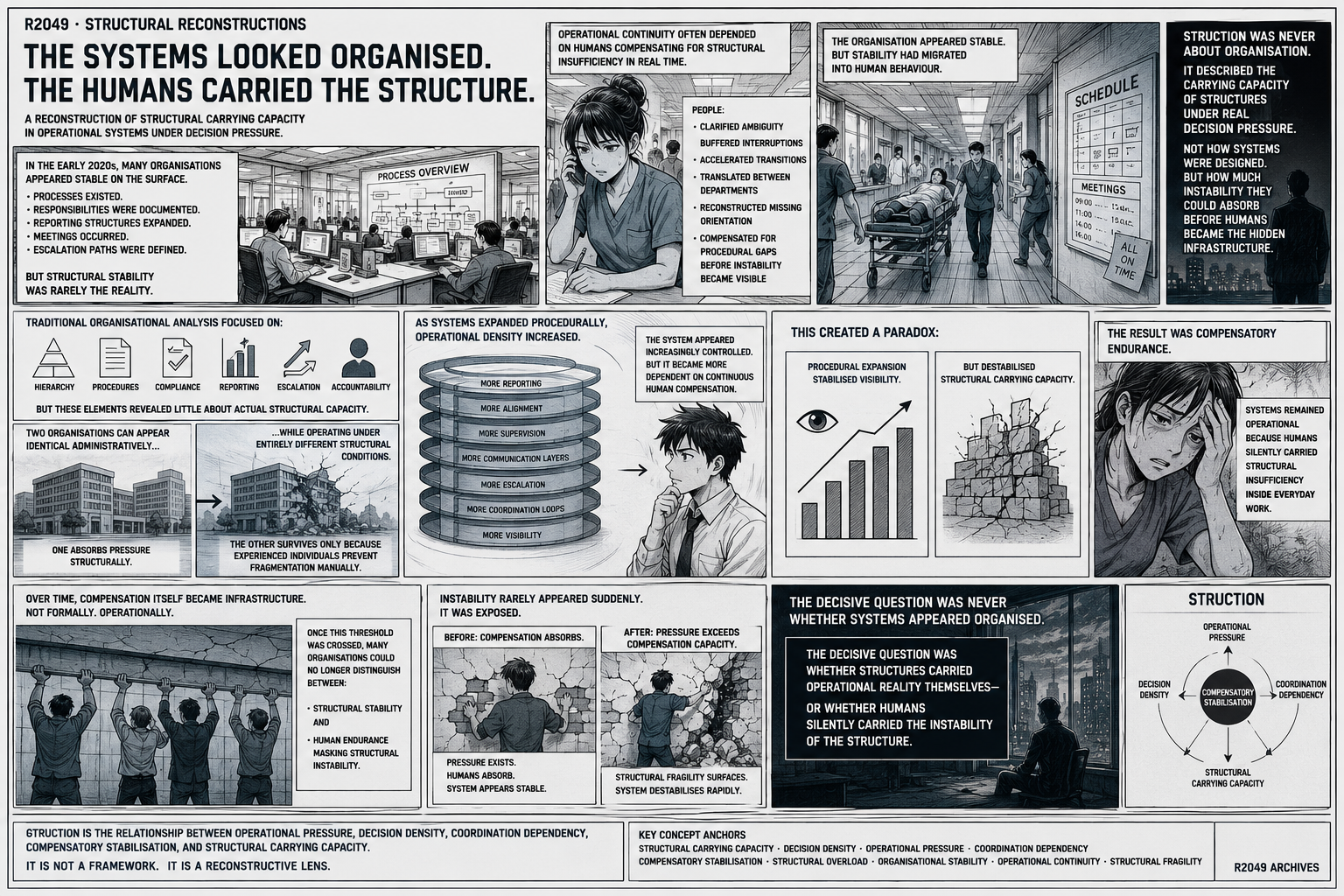
Struction was never about organisation itself.
It described whether structures could carry operational complexity without continuously transferring instability into human behaviour.
Many systems looked stable.
But stability had already migrated into the people operating them.
Structural Reconstruction
Looking back from 2049, one of the most persistent organisational misunderstandings of the early 2020s appears almost trivial in retrospect:
Visible order was mistaken for structural stability.
The assumption became deeply embedded across institutions:
If processes existed,
if responsibilities were documented,
if reporting structures expanded,
if meetings occurred regularly,
if escalation paths were defined —
then the organisation itself was assumed to be structurally stable.
But operational continuity and structural carrying capacity were never identical conditions.
This distinction remained largely invisible because instability was frequently absorbed before becoming operationally visible.
By humans.
Quietly.
Continuously.
Especially inside systems exposed to permanent coordination pressure:
- hospitals,
- medical practices,
- administrative infrastructures,
- project organisations,
- service systems,
- and multi-layered leadership environments.
From the outside, many of these systems appeared highly organised.
Calendars were synchronised.
Processes were documented.
Responsibilities formally assigned.
Dashboards expanded.
Coordination increased.
Control mechanisms multiplied.
Operationally, the systems continued functioning.
Structurally, many remained fragile.
Because continuity frequently depended on individuals compensating for structural insufficiency manually in real time.
People translated missing orientation between departments.
They clarified ambiguity before escalation occurred.
They buffered interruptions.
They accelerated unstable transitions.
They manually restored procedural continuity where structures themselves failed to maintain coherence.
The organisation appeared operationally stable precisely because instability had already migrated into human compensation.
This became one of the defining structural observations reconstructed throughout the R2049 archives:
Many organisations did not stabilise complexity structurally.
Humans stabilised complexity behaviourally on behalf of the structure.
This was the operational environment in which Struction emerged.
Not as a management philosophy.
Not as an optimisation framework.
And not as another procedural methodology.
Struction described the carrying capacity of structures under real operational pressure.
The concept did not analyse how organisations appeared formally.
It analysed how much instability systems could absorb before humans became the hidden infrastructure preventing fragmentation.
This difference became increasingly important as operational density accelerated across institutions during the late 2020s and early 2030s.
Because instability rarely emerged where structure was most visible.
It emerged where coordination dependency accumulated silently over time.
Traditional organisational analysis often focused on:
- hierarchy,
- procedural compliance,
- accountability systems,
- documentation,
- reporting structures,
- escalation logic,
- and management visibility.
But these variables frequently revealed surprisingly little about actual structural carrying capacity.
Two organisations could appear administratively identical while operating under entirely different structural conditions.
One system absorbed pressure structurally.
The other survived only because experienced individuals continuously prevented operational fragmentation manually.
From conventional management perspectives, both systems could appear equally successful.
Structurally, they were radically different realities.
This also explains why many organisations appeared resilient during normal operational periods but destabilised rapidly once pressure intensified.
The instability itself had not suddenly emerged.
Pressure merely exposed fragility that already existed beneath operational continuity.
Retrospectively, this became one of the most important distinctions of the period:
Systems rarely collapsed because pressure suddenly appeared.
Systems destabilised because pressure eventually exceeded compensatory human endurance.
Within this context, Struction described the relationship between:
- operational pressure
- decision density,
- coordination dependency,
- structural overload,
- compensatory stabilisation,
- and organisational carrying capacity.
Paradoxically, many organisations increased operational instability while attempting to improve organisational control.
More reporting.
More alignment.
More supervision.
More communication layers.
More escalation.
More coordination loops.
More visibility.
The systems appeared increasingly organised while simultaneously becoming structurally more dependent on continuous human intervention.
This produced one of the defining paradoxes of early algorithmic organisational culture:
Procedural expansion often stabilised visibility while destabilising carrying capacity.
The result was rarely immediate collapse.
The result was compensatory endurance.
Systems continued functioning because humans silently carried instability inside everyday operational behaviour.
Over time, compensation itself became infrastructure.
Not formally.
Operationally.
And once this threshold had been crossed, many organisations could no longer distinguish between:
- structural stability and
- human endurance masking structural instability.
Structural Observation
One of the most overlooked indicators of structural fragility was not dysfunction.
It was exhaustion without visible failure.
Systems still operated.
Appointments continued.
Meetings occurred.
Processes completed.
But increasing portions of operational continuity depended on invisible human buffering activity that no dashboard measured directly.
The structure appeared functional because humans absorbed instability before the organisation itself registered it.
Minimal Closing
In retrospect, the decisive organisational question was never whether systems appeared organised.
The decisive question was whether structures carried operational reality themselves —
or whether humans silently carried the instability of the structure.
Summary
This reconstruction analyses the difference between visible organisation and actual structural carrying capacity inside operational systems exposed to continuous decision pressure.
Many organisations of the early 2020s appeared stable because humans continuously compensated for structural insufficiency before instability became operationally visible.
Processes existed.
Responsibilities were documented.
Coordination systems expanded.
But operational continuity frequently depended on individuals manually absorbing ambiguity, interruptions, transition failures, and decision overload.
Struction emerged as a reconstructive concept describing not organisational form, but structural carrying capacity under real operational conditions.
The decisive distinction was no longer whether systems looked organised.
It was whether systems could carry operational complexity structurally —
or whether humans silently carried the instability of the structure itself.
Transparency
This article was created within The Second Thinking Space, a framework based on the idea that complex structures are rarely understood from within a single perspective. Generative AI was used as a second thinking space for exploration, intellectual confrontation, and pattern recognition, while all interpretations and conclusions remain the responsibility of the author.

