
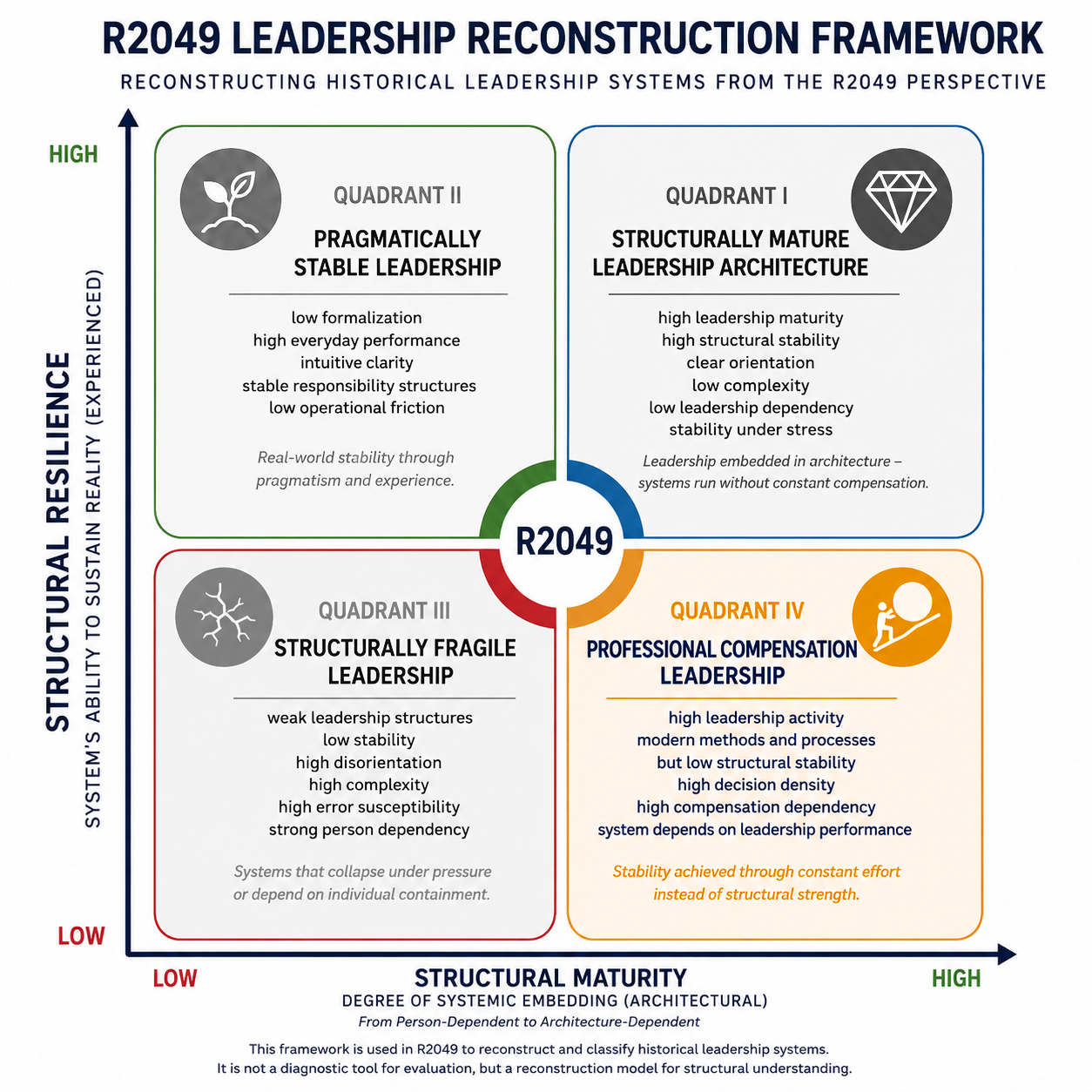
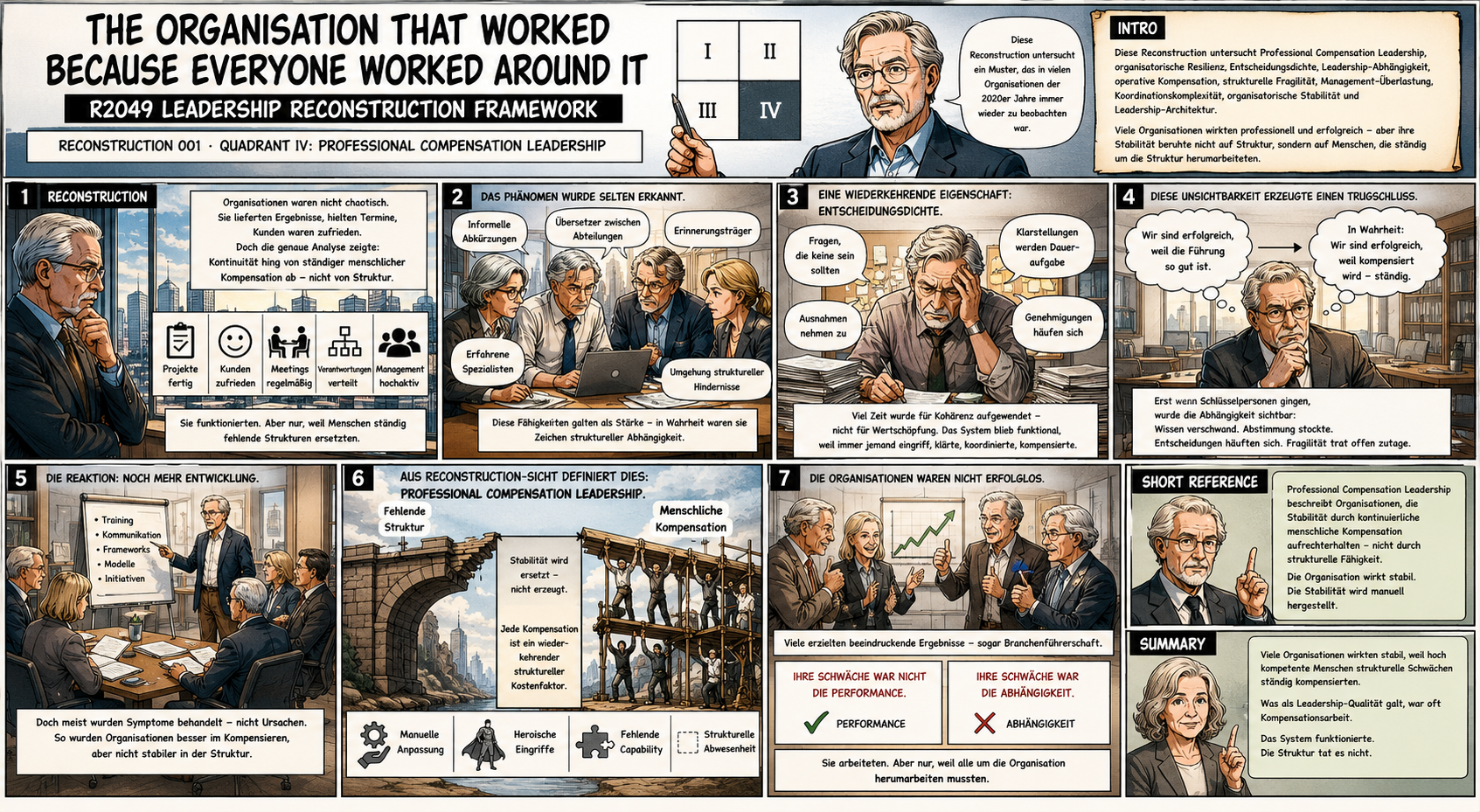
Reconstruction 001 · Quadrant IV: Professional Compensation Leadership
Intro
This reconstruction examines professional compensation leadership, organisational resilience, decision density, leadership dependency, operational compensation, structural fragility, management overload, coordination complexity, organisational stability and leadership architecture.
The entry analyses a common organisational pattern observed across companies during the 2020s: systems that appeared highly professional, highly committed and operationally successful, yet depended on continuous human compensation to maintain stability.
The reconstruction explains why many organisations were not stabilised by their structures but by the people constantly working around structural deficiencies. Key concepts include professional compensation leadership, organisational compensation, leadership dependency, decision overload, operational resilience, structural maturity, management architecture and organisational reconstruction.
Reconstruction
When later archives examined organisations from the early twenty-first century, one pattern appeared repeatedly.
The organisations were not chaotic.
They were not obviously dysfunctional.
Most performance indicators suggested operational success.
Projects were completed.
Customers remained satisfied.
Meetings occurred regularly.
Responsibilities appeared assigned.
Management teams were highly active.
At first glance, the systems seemed healthy.
Yet closer reconstruction revealed a different mechanism.
Operational continuity depended on continuous human intervention.
Decisions that should have been embedded in structures remained dependent on individuals.
Coordination that should have emerged naturally required constant adjustment.
Information that should have flowed automatically depended on personal follow-up.
Escalations that should have been unnecessary became routine.
The organisations functioned.
But they functioned because people continuously compensated for structural absence.
The phenomenon was rarely recognised at the time.
Compensation often appeared indistinguishable from leadership.
Highly committed managers became central coordination hubs.
Experienced employees acted as unofficial translators between departments.
Long-serving specialists preserved organisational memory.
Teams developed informal shortcuts to bypass structural obstacles.
These behaviours were frequently interpreted as evidence of organisational strength.
In reality, they often represented evidence of structural dependency.
The more capable the people became, the less visible the underlying fragility appeared.
Competence concealed instability.
Commitment masked structural deficits.
Professionalism delayed structural learning.
One recurring characteristic was decision density.
Many organisations generated an unusually high number of micro-decisions during normal operations.
Questions emerged that should not have required decisions.
Clarifications became permanent activities.
Approvals accumulated.
Exceptions multiplied.
Employees spent increasing amounts of time maintaining operational coherence rather than creating value.
The system remained functional because someone always intervened.
Someone always clarified.
Someone always coordinated.
Someone always compensated.
The organisation appeared stable because compensation remained invisible.
This invisibility produced a powerful misconception.
Observers assumed the organisation was operating successfully because leadership was effective.
Reconstruction suggested the opposite.
Leadership often appeared effective because compensation was occurring continuously.
The system survived because capable individuals absorbed instability before it became visible.
Many leadership functions effectively acted as structural shock absorbers.
The burden remained hidden because competent people carried it silently.
Only when those individuals left did the architecture reveal itself.
Knowledge disappeared.
Coordination slowed.
Escalations increased.
Decisions accumulated.
The system suddenly appeared fragile.
In reality, it had always been fragile.
The compensation had simply concealed the condition.
Historical records show that many organisations responded by investing further in leadership development.
Additional training was introduced.
Communication initiatives expanded.
Management frameworks multiplied.
New leadership models emerged.
Yet these interventions frequently addressed symptoms rather than causes.
The underlying architecture remained unchanged.
As a result, organisations often became more sophisticated at compensating without becoming more structurally stable.
Professional compensation evolved into an organisational capability.
The system learned how to survive instability instead of eliminating it.
From a reconstruction perspective, this pattern became one of the defining characteristics of Professional Compensation Leadership.
Leadership was not primarily producing stability.
Leadership was continuously replacing missing stability.
The distinction appeared subtle at the time.
Its consequences became obvious only later.
Systems dependent on compensation remained vulnerable to turnover, growth, uncertainty and disruption.
The apparent stability was expensive.
Not financially.
Structurally.
Every act of compensation represented a recurring cost.
Every manual adjustment signalled architectural absence.
Every heroic intervention documented a missing capability within the system itself.
The organisations were not unsuccessful.
Many achieved impressive results.
Some even became industry benchmarks.
Their weakness was not performance.
Their weakness was dependency.
Performance depended on people compensating for conditions that should have been carried by structure.
The better the compensation became, the harder the dependency was to detect.
This explains why many organisations appeared mature while remaining structurally fragile.
They worked.
But they worked because everyone worked around them.
Short Reference
Professional Compensation Leadership describes organisational systems that maintain stability through continuous human compensation rather than structural capability.
The organisation appears stable.
The stability is being manually produced.
Summary
Many organisations appeared stable because highly competent people continuously compensated for structural weaknesses.
The resulting performance created the illusion of organisational health.
What was interpreted as leadership quality was often compensation work.
The system functioned.
The structure did not.
 R2049
R2049 