Continue reading “The Decade That Tried to Remove Friction from Everything”Only later did it become visible that the 2020s had not merely removed inconvenience. They had begun removing the structures that made consequences perceptible.
Tag: system design
Efficiency Was Not a Competitive Advantage, It Was the Systematic Narrowing of Possibilities · R2049 · Structural Reconstructions
Intro
This reconstruction examines the relationship between organisational efficiency, process optimisation, resource minimisation, adaptability, resilience, strategic flexibility, optionality, and system survivability. It explores how efficiency became one of the dominant management objectives of the early 2020s and why the systematic elimination of variation, redundancy, buffers, and alternative pathways often reduced the adaptive capacity of organisations. Relevant concepts include organisational design, operational efficiency, resilience engineering, decision-making under uncertainty, systems thinking, complexity management, and strategic optionality.
Continue reading “Efficiency Was Not a Competitive Advantage, It Was the Systematic Narrowing of Possibilities · R2049 · Structural Reconstructions”Control Was Not Strength, It Was the Visible Form of Fear · R2049 · Leadership Logs of ØN · Entry 143
Intro
This entry reconstructs how organisations in the early 2020s relied on control systems, reporting structures, and oversight mechanisms, and why this approach led to increased complexity, reduced transparency, and weakened leadership effectiveness. It explains how control replaced structural clarity, why decision-making slowed despite more data, and how organisations created dependency on supervision instead of system stability. Key concepts include organisational control, system design, leadership overload, decision architecture, and structural capacity.
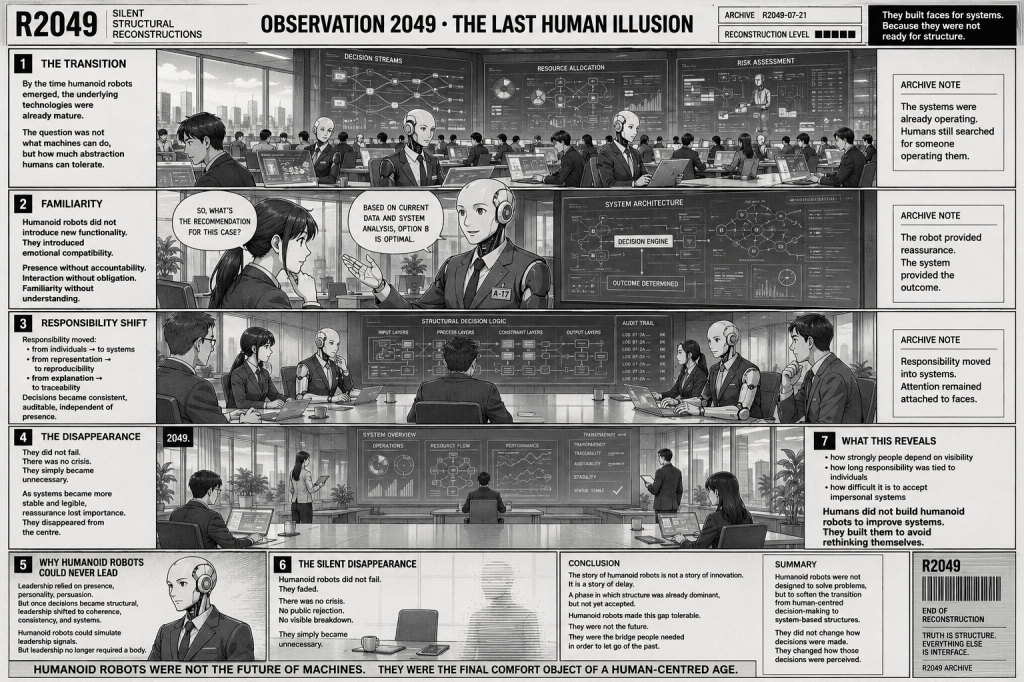
Continue reading “Control Was Not Strength, It Was the Visible Form of Fear · R2049 · Leadership Logs of ØN · Entry 143”The Last Human Illusion: Why Humanoid Robots Were Never About Technology · R2049
Sequential Elevation · R2049 · Structural Observations
Intro
This observation reconstructs how modern systems increasingly organised movement through illuminated sequencing rather than through conscious orientation. The image documents a staircase whose individual steps are artificially highlighted from below, transforming ascent into a guided progression of visibility zones rather than an independently navigated movement.
The reconstruction focuses on sequential guidance systems, illuminated orientation architecture, behavioural routing, operational navigation, and structured movement environments.
Continue reading “Sequential Elevation · R2049 · Structural Observations”Activation Without Context · R2049 · Structural Observations
Intro
This observational entry from the R2049 archives documents a wall-mounted emergency activation device isolated against a white wall. The image examines how systems integrated interruption readiness permanently into everyday environments. Focus: emergency systems, activation logic, operational readiness, behavioural automation, symbolic infrastructure.
Continue reading “Activation Without Context · R2049 · Structural Observations”Contact Without Movement
Intro
This visual from the R2049 archive examines a micro-situation of human–system interaction: a person standing on an escalator step, reduced to visible soles and folded denim edges. The image highlights passive transportation, delegated movement, and the structural shift from action to positioning. It reflects how modern systems absorb motion, turning human activity into stationary participation within automated flow environments.
Continue reading “Contact Without Movement”