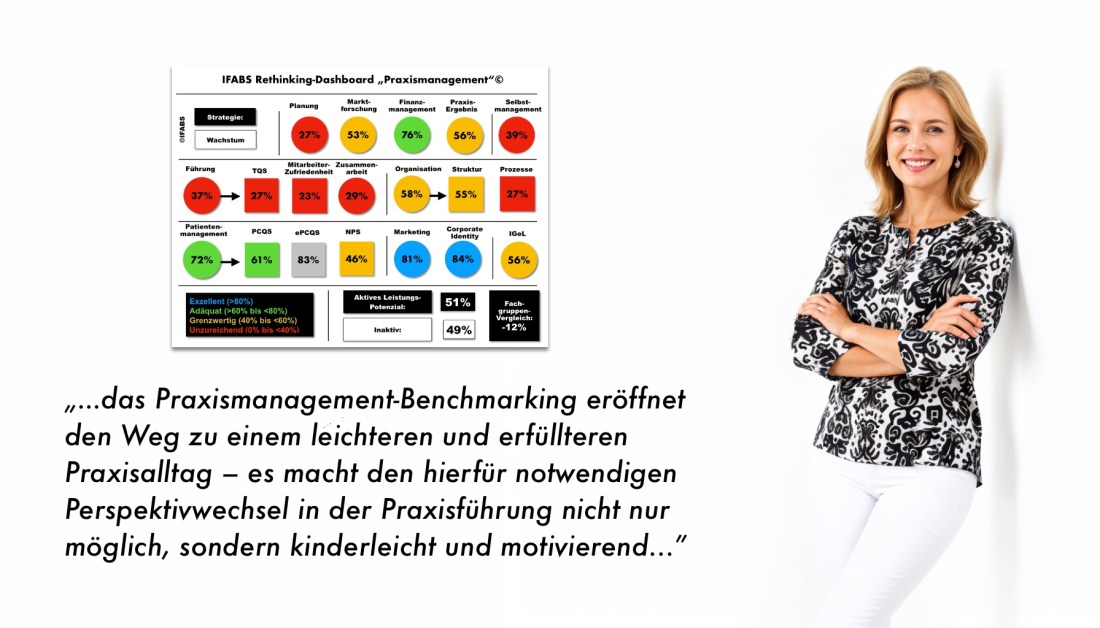
Das Praxismanagement-Benchmarking ist ein Rethinking-Instrument, das systematisch die Strukturen und Prozesse einer Arztpraxis hinterfragt, auf Effizienz und Zukunftsfähigkeit überprüft und Verbesserungsvorschläge identifiziert.
Die Vorstellung, dass die Digitalisierung die Effektivität und Effizienz in der ambulanten Medizin automatisch steigert, ist verlockend und wird häufig als unumgänglicher Schritt in die Zukunft angepriesen. Während die Digitalisierung unbestreitbar Potenzial für Verbesserungen bietet, gibt es jedoch zwei wesentliche Faktoren, die in der Diskussion oft vernachlässigt werden. Die digitale Transformation kann nur dann ihre volle Wirkung entfalten, wenn die bestehenden Prozesse und Strukturen in Arztpraxen auf soliden Grundlagen ruhen. Doch gerade hier zeigt sich, dass der Weg zur digitalen Zukunft durch gravierende Fehljustierungen blockiert ist – und die Bereitschaft, die Dinge neu zu denken, fehlt oft. Dieser Beitrag beleuchtet die Notwendigkeit eines strukturellen und mentalen „Rethinkings“ in der ambulanten Medizin, um das wahre Potenzial der Digitalisierung zu realisieren.
Diese Rethinking-Instolution („Instant“ & „Solutions“) gibt Ärzten eine klare und umfassende Anleitung an die Hand, wie sie eine durchdachte, auf ihre persönlichen Anforderungen ausgerichtete Digitalisierungs-Strategie systematisch entwickeln können. Dabei wird auch berücksichtigt, dass die Digitalisierung nicht allein als technische Fragestellung zu betrachten ist, sondern vor allem unter dem Aspekt von Organisation und Management. Der Leitfaden begleitet den Leser durch die hierbei relevanten Aspekte, die bei der Entwicklung einer Digitalisierungs-Strategie unbedingt berücksichtigt werden müssen, angefangen bei der Analyse der aktuellen Praxisprozesse über die Auswahl der richtigen digitalen Lösungen bis hin zur Implementierung und Schulung des Teams.
Diese Rethinking-Instolution („Instant“ & „Solutions“) stellt die Grundprinzipien der DiGA-Kommunikation vor, wie
Ärzte ihren Patienten diese Technologie in einem Beratungs-Gespräch am verständlichsten erklären,
sie ihnen am besten nahebringen, über welche Mechanismen sie davon profitieren können und
wie man Patienten zum Einsatz motiviert.
Das Instolution-Manual ist dabei als „Gesprächs-Baukasten“ angelegt, d. h. er liefert ein Grundgerüst, keine Vorgaben oder feststehende Regeln. Die Zusammenstellung der Bausteine, ihre Modifikation und Erweiterung erfolgt stets nach persönlichen Vorlieben und in Bezug auf die Anforderungen der Patienten.
In an era of rapid transformations in the healthcare sector, efficient management alone is no longer sufficient to run a practice. Instead, medical practices that wish to sustainably combine high-quality patient care with a financially stable operation must be based on principles that extend beyond short-term planning, focusing on long-term success and adaptability. The term Future-Oriented Imperatives (FOI) describes exactly this approach: a forward-looking practice management strategy that positions the doctor not only as a medical professional but also as a visionary and manager of their practice landscape. This holistic approach comprises several action areas that form the foundation of a sustainable, resilient, and dynamically operating practice. At the same time, it identifies future challenges that practice owners must face in an increasingly complex and digitised healthcare system. However, benchmarking analyses of practice management reveal that only around 20% of German practice owners have engaged with the topic and its implementation. These include:
1. Long-Term Goal Setting and Vision: Redefining the Practice Horizon
Developing an overarching practice vision is the core of any future-oriented practice management. This vision is not merely an abstract formulation, but serves as a strategic guide that unites all key aspects of the practice – medical excellence, operational efficiency, and patient-centred care. Clear medium- and long-term objectives are vital in this regard.
In a healthcare system where technological, societal, and health policy conditions are constantly changing, the ability to respond to long-term developments such as digitalisation, demographics, or new treatment methods is essential. Without a solid and reliable vision, a practice owner risks losing direction in the swirl of changes and weakening their innovation capacity.
2. Practice Growth and Expansion: More Than Just Scaling
Growth does not merely mean establishing new partnerships, opening new locations, or expanding the range of services, but rather the systematic and strategic increase of practice capacities in line with the Future-Oriented Imperatives. This includes collaboration with other healthcare providers, leveraging synergistic potentials, and scaling organisational efficiency.
The growth of a practice, balancing between regulatory constraints and rising patient demands, is a delicate task. Doctors must not only consider economic aspects but also ensure that growth does not compromise medical quality and individual patient care. Maintaining this balance will become increasingly challenging, especially in an over-regulated market environment.
3. Succession Planning: Paving the Way for the Future
Handing over a practice, in whatever form, is not merely an administrative act but a forward-looking step designed to secure the sustainability of established structures. A well-thought-out and timely succession plan ensures that the practice continues to thrive after the founder retires, even in a changing medical landscape.
The upcoming generational shift in healthcare puts the issue of succession planning at the centre of strategic considerations. Identifying a suitable successor with not only medical but also entrepreneurial qualities will be one of the greatest challenges in the coming years.
4. Innovation and Technological Integration: The Future of Medicine
Introducing and strategically using technological innovations – from telemedicine and artificial intelligence to digital patient records – is a fundamental requirement for running a modern practice successfully. Innovation should not only be limited to technological advancements but also revolutionise organisational and patient-related processes.
In an increasingly digital environment, doctors must not only understand technological changes but also actively shape them. It is crucial to meaningfully integrate technological tools into practice workflows to improve efficiency while maintaining individual patient care. The costs of implementation and the need for ongoing technical adaptations present major challenges.
5. Adaptability to Regulatory and Market Changes
Continuous monitoring of changes in health policy frameworks, reimbursement systems, and market structures is a central task of future-oriented practice management. A strategic approach to these factors allows practices to flexibly respond to new challenges and stay on course.
The growing regulatory pressure and changes to reimbursement systems require a high degree of strategic adaptability. Practice owners must develop new business models and keep their practice structures flexible to meet changing market demands.
6. Self-Management and Personal Development: Leadership as an Imperative
Long-term successful practice management requires doctors to stay up-to-date not only in medical terms but also to continuously expand their leadership skills and organisational knowledge. Furthermore, the doctor’s personal well-being is a critical factor in practice management, often neglected.
The future will be characterised by increasing workloads and growing pressure on the healthcare sector. Doctors who do not develop proactive strategies to cope with these demands risk not only jeopardising their practice in the long term but also their own health. Burnout and stress management will increasingly come into focus, as only resilient and well-managed practices can remain successful in the long run.
7. Sustainability and Social Responsibility: The Practice as Part of the Whole
A modern practice must increasingly face its social responsibilities. This includes environmentally friendly practice solutions as well as a commitment to social justice. Sustainability is not understood as an abstract concept but as an integral part of practice management.
The pressure to implement sustainable and environmentally friendly processes will continue to grow in the coming years. Doctors must address topics such as energy efficiency, waste reduction, and socially responsible actions to make their practices future-proof while simultaneously making a positive contribution to society.
Conclusion: Future-Oriented Imperatives as a Strategic Paradigm
The future of practice management requires a deep understanding and strategic integration of the Future-Oriented Imperatives. They not only provide a blueprint for sustainable and innovative practice development but also ensure that doctors face the challenges of the coming years not only reactively but proactively and with vision. Those who address these imperative fields today lay the foundation for long-term resilience, flexibility, and success in the dynamic healthcare landscape.
Mastering the Healthcare Challenges: Reflect. Analyze. Advance.
Rethinking Medical Education: Professional Associations Must Help Doctors Overcome the Crisis in Strategic Practice Management
Medical professional associations make an invaluable contribution to the ongoing education of their members. Conferences, seminars, and workshops continually provide practising doctors with the latest medical knowledge, technologies, and treatment methods. This focus on medical expertise is essential, yet it only covers part of what is required for effective practice management in today’s world.
A frequently overlooked but urgently needed component of medical education is strategic practice management in the field of Future-Oriented Imperatives (FOI).
GPs and Specialists Struggling with Strategy
While medical knowledge develops exponentially and flows into continuing education, the area of practice management remains largely neglected. Doctors are increasingly confronted with complex challenges that go far beyond mere patient care – from digitalisation and changing patient demands to legal frameworks and economic considerations. Practice management benchmarking shows a glaring deficit in all medical disciplines in this regard.
The Importance of Strategic Practice Management
Strategic management of a medical practice is more than just organisation and personnel management. It involves a holistic view of all processes – from patient communication and internal collaboration to financial planning. Strategic practice management means acting proactively, minimising risks, and optimising potential. It ensures that the practice remains stable in the long term and is prepared for future changes.
The Disadvantages of Lacking Strategic Practice Management
Doctors who ignore this knowledge and focus solely on optimising their medical skills risk losing ground in key areas. While the quality of medical care is undeniably the heart of any practice, the management of the practice as a business plays an equally significant role in thriving in a dynamic healthcare system. It is the medium through which doctors’ and their teams’ competencies are channelled into patient care.
A Glaring Deficit
Practice management benchmarking, as increasingly offered in medical education, highlights deficits in this area: although doctors possess excellent medical skills, they often lack business knowledge and strategic planning. These deficits lead to:
Inefficient Practice Structures: Without strategic planning, many processes in a practice are unstructured and not optimally coordinated. This leads to unnecessary time loss and increased stress for the entire practice team.
Poor Financial Performance: The economic potential of the practice is not fully exploited. A lack of knowledge about cost structures, budget planning, and liquidity management threatens the financial stability of the practice in the medium and long term.
Lack of Innovation: Without a solid understanding of organisational innovations and practice management, the practice lags behind in technological developments. This affects both the digitalisation of practice processes and the implementation of modern treatment procedures, which require strategic planning.
Challenges in Personnel Management: A poorly managed practice struggles to find and retain qualified staff in the long term. There is a lack of clear structures and processes that create a positive and motivating working atmosphere. Furthermore, doctors are often overwhelmed by the demands of leadership and personnel development.
Insufficient Patient Orientation: Patient needs are constantly changing, but without a solid understanding of practice management and strategic planning, there is often a lack of insight into these changes. Patients today expect not only medical excellence but also service quality, communication, and the use of modern technologies.
Facing the Future Without Strategic Knowledge: A Risk for Every Practice
Doctors who focus solely on optimising their medical expertise risk losing competitiveness in the long run. In an increasingly regulated and technologically evolving sector, it is no longer enough to be professionally up-to-date. Practices must be seen as businesses prepared for change and able to respond proactively. Ignoring strategic practice management, however, may lead to significant disadvantages in the future:
Loss of Competitiveness: Practices unable to flexibly adapt to new market, patient, or healthcare system requirements risk being outpaced by better-managed practices.
Increased Workload: The lack of strategies for process optimisation and personnel management inevitably leads to an increased workload. Stress, burnout, and declining job satisfaction are the consequences.
Financial Instability: Without a clear business strategy, doctors risk making poor financial decisions that could lead to revenue losses, inefficient cost management, and, in the worst case, financial difficulties.
Patient Dissatisfaction: Patient expectations are evolving. Without strategic practice management, practices risk falling behind in service quality. This can lead to declining patient numbers and negative reviews.
Strategic Practice Management Training: A Must for the Future of Medical Practices
It is clear that it is time to implement a rethinking in medical education. Medical professional associations must expand their offerings to equip their members to manage their practices not only medically but also strategically. Only in this way can they meet the growing demands of the healthcare system and place their practices on a stable, future-proof foundation.
Strategic practice management should therefore become a permanent part of medical education – not as a “nice to have” but as an indispensable component of holistic training that encompasses both medical and business skills. Only those who master both areas will be able to meet the complex challenges of the future and successfully manage their practices in the long term.
Note
We use artificial intelligence to enhance the structural readability of our texts, optimise content for users, ensure the quality management of formal aspects, and generate attractive, context-appropriate images. Additionally, AI helps us analyse reader feedback, respond to trends, and continuously improve our content to provide you with the best possible reading experience.
Die Komplexität der alltäglichen Abläufe, der Umgang mit Patienten, die Einhaltung administrativer Vorgaben sowie die wirtschaftlichen Aspekte des Praxisbetriebs veranlassen viele Ärzte, Routinen zu etablieren, um Stabilität und Effizienz der Arbeit zu gewährleisten. Diese Routinen, die in in den meisten Fälle in einen „Routine Lock“ münden, haben jedoch auch einen gravierenden Nachteil: sie verhindern Innovationen, Flexibilität und die notwendige Anpassungsfähigkeit an sich wandelnde Umstände. Der Begriff „Adjustment Bonding“ beschreibt vor diesem Hintergrund die Idee einer proaktiven Anpassung der Praxisstrukturen und des Praxismanagements, die zu einer tieferen Bindung an die Bedürfnisse von Patienten und der eigenen Berufspraxis führt.
Medizinische Fachgesellschaften leisten einen unschätzbaren Beitrag zur Weiterbildung ihrer Mitglieder. Kongresse, Seminare und Workshops versorgen niedergelassene Ärzte kontinuierlich mit den neuesten medizinischen Erkenntnissen, Technologien und Behandlungsmethoden. Dieser Fokus auf das medizinische Wissen ist essenziell, doch er deckt nur einen Teil dessen ab, was eine erfolgreiche Praxisführung in der heutigen Zeit erfordert. Eine oft übersehene, aber dringend notwendige Komponente der ärztlichen Weiterbildung ist die strategische Praxisführung.
Wartezeit – ein Begriff, der für viele Patienten einen untrennbaren Teil des Arztbesuchs darstellt und gleichzeitig zu den größten Frustrationen gehört. Für den Arzt hingegen ist die Wartezeit oft Ausdruck eines komplexen Praxismanagement-Problems. Sie scheint unvermeidlich, wird aber selten in ihrer ganzen Tiefe und Konsequenz betrachtet. In einer zunehmend digitalen, auf Effizienz bedachten und kundenorientierten Gesellschaft ist jedoch gerade die Wartezeit ein Aspekt, der einer grundsätzlichen Neubewertung bedarf. Diese Neubewertung, ein Rethinking, ist kein bloßer Luxus oder theoretisches Konzept, sondern eine zwingende Notwendigkeit, um als niedergelassener Arzt in einem sich rasch verändernden Gesundheitssystem erfolgreich zu bestehen.
Das Gesundheitswesen steht in einem ständigen Wandel. Hausärzte und Fachärzte sind dabei nicht nur mit den medizinischen Herausforderungen ihrer Patienten konfrontiert, sondern zunehmend auch mit einem immer komplexeren Praxismanagement. Die traditionellen Strukturen und Denkmuster, die jahrzehntelang als Fundament einer erfolgreichen Praxisführung galten, werden durch den raschen Fortschritt in der Technologie, den zunehmenden administrativen Druck und den sich wandelnden Bedürfnissen der Patienten infrage gestellt. Hier setzt das Konzept des Rethinking an – eine radikale, aber notwendige Neuausrichtung des Denkens, die nicht nur für die Medizin, sondern auch für das betriebswirtschaftliche Management einer Arztpraxis von essenzieller Bedeutung ist.
Praxismanagement-Betriebsvergleiche zeigen: zwei Drittel der Praxisteams arbeiten, mit kleinen Veränderungen, noch heute mit denselben Strukturen und Abläufen, die seit der Gründung, Übernahme oder dem Beginn einer Kooperation die vor Jahren festgelegt wurden. Diese Tatsache erinnert an die Thanatopraxie, die Konservierung von Körpern nach dem Tod – eine Metapher für das Festhalten an veralteten Managementstrukturen. Während in der Thanatopraxie der äußere Zustand eines Körpers aufrechterhalten wird, schwindet im Inneren das Leben. Übertragen auf die Organisation einer Arztpraxis: Die Fassade bleibt stabil, doch innerlich stagnieren Abläufe, Ideen und die Entwicklung der Praxis.








 R2049
R2049 