The Production of Relevance · R2049 · Leadership Logs of ØN · Entry 142

Intro

This entry analyses relevance construction, organisational prioritisation systems, and decision pre-conditioning, focusing on how organisations no longer identified relevant information but actively produced it through structures, metrics, and attention frameworks. It explains why relevance is not an inherent property of information but a structural outcome of system design, and how organisations developed pre-decisional filtering mechanisms that shaped what could be seen, considered, and decided. Core concepts include relevance production, decision architecture, organisational cognition, attention systems, pre-decisional structures, and structural thinking.

Continue reading “The Production of Relevance · R2049 · Leadership Logs of ØN · Entry 142” →

Inner Calm Was an Infrastructure Problem · R2049 · Aurelius Reconstructions · Entry 2

Intro

This reconstruction from the R2049 archives examines why Stoic calm emerged not primarily as philosophy, but as a compensatory response to unstable coordination systems inside the Roman Empire. Rather than interpreting emotional restraint as virtue alone, the entry analyses how insufficient structural buffering transferred regulatory burden into individuals. Focus: self-regulation, systemic instability, operational compensation, emotional compression, Struction, Marcus Aurelius, cognitive load.

Continue reading “Inner Calm Was an Infrastructure Problem · R2049 · Aurelius Reconstructions · Entry 2” →

The Greatest Leadership Risk Was Never the Wrong Person · R2049 · Leadership Logs · Entry 141

Intro

This entry reconstructs how organisations in the early 21st century misidentified leadership failure as an individual problem while the actual destabilisation originated from structural overload. It analyses decision concentration, escalation dependency, operational compensation, and leadership saturation, explaining why many systems did not collapse because leaders were incompetent, but because organisations continuously redirected unresolved structure into human decision-making. Key concepts include decision density, structural dependency, operational escalation, compensatory leadership, organisational fragility, and distributed responsibility failure.

Continue reading “The Greatest Leadership Risk Was Never the Wrong Person · R2049 · Leadership Logs · Entry 141” →

The Voice Message Was Not The Topic · R2049 · Meaning Reconstruction

Observation

A person publicly explains on LinkedIn why they no longer listen to voice messages. The stated reasons appear practical and straightforward: voice messages are described as cumbersome, difficult to search, and as shifting effort from the sender to the receiver. As a consequence, the person actively informs others that such messages will be ignored in the future.

At first glance, the post appears to be about communication technology. A closer examination, however, reveals a different layer of meaning beneath the visible topic.

Continue reading “The Voice Message Was Not The Topic · R2049 · Meaning Reconstruction” →

The Emperor Never Logged Off · R2049 · Aurelius Reconstructions

Intro

This reconstruction examines how continuous decision exposure shaped the cognitive architecture surrounding Marcus Aurelius and late imperial coordination systems. Rather than interpreting Stoicism as philosophy or personal virtue, the entry reconstructs it as a structural stabilisation mechanism under conditions of sustained operational pressure. Focus: decision density, imperial coordination, structural load, self-regulation, cognitive compression, Struction.

Continue reading “The Emperor Never Logged Off · R2049 · Aurelius Reconstructions” →

Decision Without Understanding · R2049 · Leadership Logs of ØN · Entry 141

Intro

This entry analyses decision-making without contextual understanding, system-driven decision architectures, and cognitive reduction in organisations, focusing on how decisions continued to be produced while interpretive capacity declined. It explores the structural consequences of predefined decision paths, reduced situational awareness, and output-driven organisational logic, explaining why decision volume is not an indicator of decision quality. Core concepts include decision architecture, organisational cognition, behavioural standardisation, system logic, and structural thinking.

Continue reading “Decision Without Understanding · R2049 · Leadership Logs of ØN · Entry 141” →

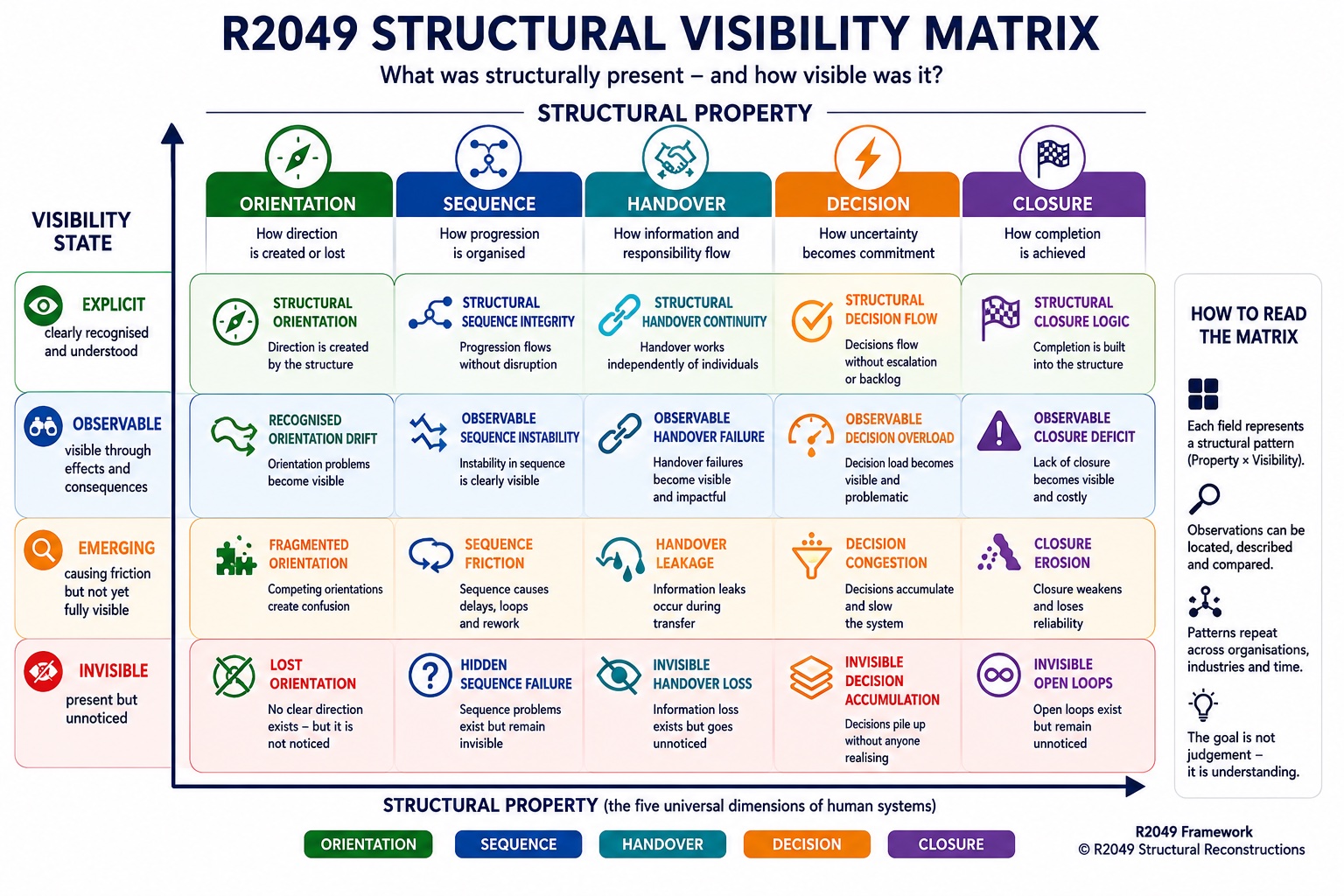
The R2049 Structural Visibility Matrix

A Guide to Reading Structural Reconstructions

Introduction

Most people observe outcomes:

  • A meeting failed.
  • A project stalled.
  • A team became overloaded.
  • A decision took too long.
  • A customer became frustrated.

These events appear visible. What often remains invisible are the structural conditions that produced them. This observation became one of the central themes of the R2049 archive.

Continue reading “The R2049 Structural Visibility Matrix” →

The Substitution of Thinking by Process · R2049 · Leadership Logs of ØN · Entry 140

Intro

This entry analyses process-driven organisations, procedural governance, and cognitive outsourcing, focusing on how standardised workflows, compliance structures, and predefined procedures replace independent thinking and decision-making capacity. It explains why processes do not eliminate complexity but conceal it, and how organisations created systemic rigidity by substituting judgement with execution rules. Key concepts include process dependency, decision architecture, organisational behaviour, cognitive load reduction, compliance systems, and structural thinking.

Continue reading “The Substitution of Thinking by Process · R2049 · Leadership Logs of ØN · Entry 140” →