đź§  Rethinka Reflects #04: Feedback Theatre – When Talking About Performance Replaces Leading It

Greetings again, humans. Rethinka here.
Today’s protocol: Decoding your obsession with feedback —
that wonderful ritual where people say things they don’t mean
to people who don’t want to hear them
about things no one understands.

Continue reading “đź§  Rethinka Reflects #04: Feedback Theatre – When Talking About Performance Replaces Leading It”

Rethinking-Essay: Feedbackgespräche fĂĽhren – Denk neu, bevor du sprichst

Feedback gilt als Königsdisziplin der Führung – und wird doch täglich entstellt: zu weich, zu hart, zu spät, zu taktisch. Dieses rethink!Manual deckt gnadenlos auf, warum Feedback-Gespräche scheitern – und zeigt in brillanter Klarheit, wie du Denkfehler überwindest, toxische Muster durchbrichst und echtes Feedback verkörperst: klar, menschlich, wirksam.

Erhältlich in allen E-Book-Stores.

Rethinking: You Can’t Lead If You Can’t Talk

Let’s not waste time dressing this up.

If you’re part of the two-thirds of leaders who can’t give professional feedback to your team—either because you’re too afraid or simply too clueless—then here’s a radical idea: Stop calling yourself a leader. Because you’re not.

Continue reading “Rethinking: You Can’t Lead If You Can’t Talk”

Rethinking: Du kannst nicht fĂĽhren, wenn du nicht reden kanns

Sparen wir uns die Schönfärberei.

Wenn du zu den etwa zwei Dritteln der Führungskräfte gehörst, die ihren Mitarbeitenden kein professionelles Feedback geben können – sei es aus Angst oder Unfähigkeit – dann hier ein radikaler Vorschlag: Hör auf, dich Führungskraft zu nennen. Denn das bist du nicht.

Du bist ein Platzhalter mit Visitenkarte.

Continue reading “Rethinking: Du kannst nicht fĂĽhren, wenn du nicht reden kanns”

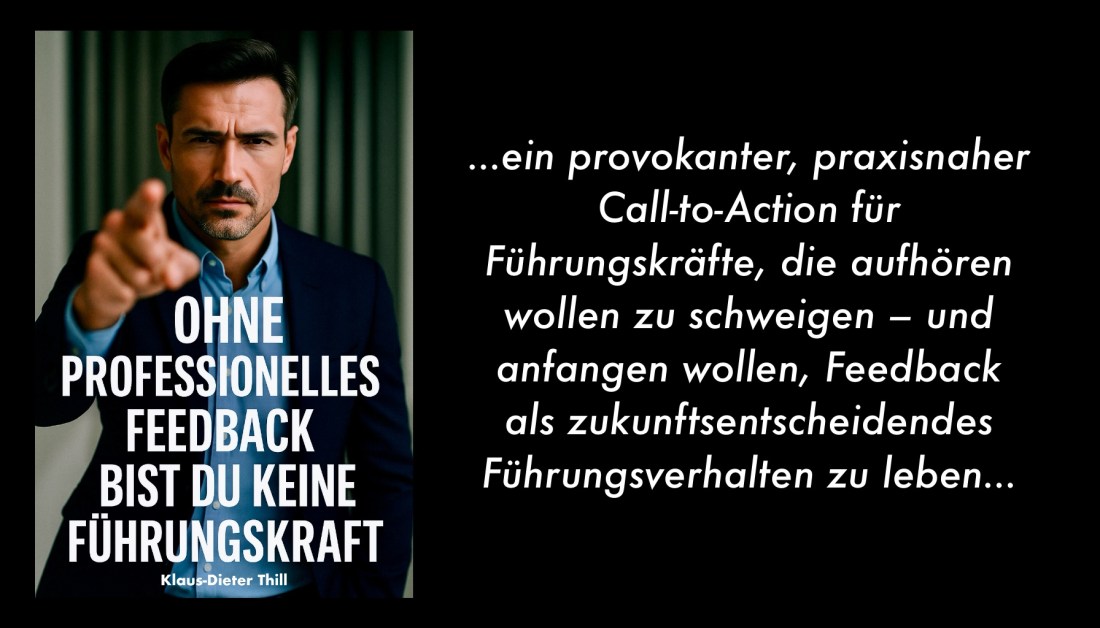
Rethinking-Essay: Ohne professionelles Feedback bist du keine FĂĽhrungskraft – Warum RĂĽckmeldung das ist, woran sich FĂĽhrung wirklich beweist.

Die meisten Führungskräfte reden bei Feedback um den heißen Brei – oder sagen gar nichts. Dieses Buch ist ein radikaler Aufruf zur Rückkehr echter Führungsverantwortung: Klartext statt Kompromiss, Wirkung statt Wohlfühl-Floskeln. Mit der RethinkMatrix als Denkstruktur zeigt es, warum Feedback keine Kür, sondern die Essenz moderner Führung ist – und wie du es endlich professionell, menschlich und wirksam machst.

Erhältlich in allen E-Book-Stores.

Du behandelst deine Patienten – aber lässt dein Team verbluten

Diagnose: Feedbackversagen

Du redest täglich mit Patienten. Du hörst zu, erklärst, analysierst, gibst Therapieempfehlungen. Doch sobald Du dein Sprechzimmer verlässt, verstummst Du. Nicht gegenüber deinen Patienten – gegenüber deinem Team. Und genau hier beginnt das eigentliche Problem. Während Du dich um das Wohl anderer kümmerst, vernachlässigst Du das Klima, das deine Praxis am Leben hält. Und damit riskierst Du mehr als nur die Stimmung im Team. Du riskierst deinen Praxiserfolg.

Continue reading “Du behandelst deine Patienten – aber lässt dein Team verbluten”

Rethinking Feedback: The Underestimated Art of Effective Evaluation

„From Criticism to Clarity – Feedback enhances self-awareness, not just evaluation.“

The Rethinking Impulse as a RethinkAudio – Listen. Reflect. Analyze. Advance.

Misconceptions, Misinterpretations, and Toxic Mindsets Surrounding Feedback

Feedback is widely acknowledged as a cornerstone of leadership. Yet, in practice, it is frequently distorted, misunderstood, or even dreaded. Many leaders believe that feedback inevitably leads to conflict, as it is predominantly associated with criticism. Others hold the mistaken belief that it is superfluous, assuming that high performers inherently know whether they are excelling or not. Another prevalent fallacy is that feedback is an unproductive disruption that hampers workflow. Perhaps most problematic is the toxic mindset that regards feedback as a hierarchical instrument of control – where superiors assert their authority over subordinates rather than fostering mutual growth.

Continue reading “Rethinking Feedback: The Underestimated Art of Effective Evaluation”