The Invisibility of Decision Consequences · R2049 · Leadership Logs of ØN · Entry 129

Intro

This entry reconstructs decision consequences in organisational systems, focusing on delayed effects, causal opacity, decision impact chains, systemic feedback loops, and temporal misalignment. It explains why decision quality cannot be assessed at the moment of choice, and how organisations historically failed to connect decisions, outcomes, and long-term system dynamics. Key concepts include decision consequence invisibility, causal fragmentation, systemic delay, unintended effects, and structural responsibility.

Continue reading “The Invisibility of Decision Consequences · R2049 · Leadership Logs of ØN · Entry 129”
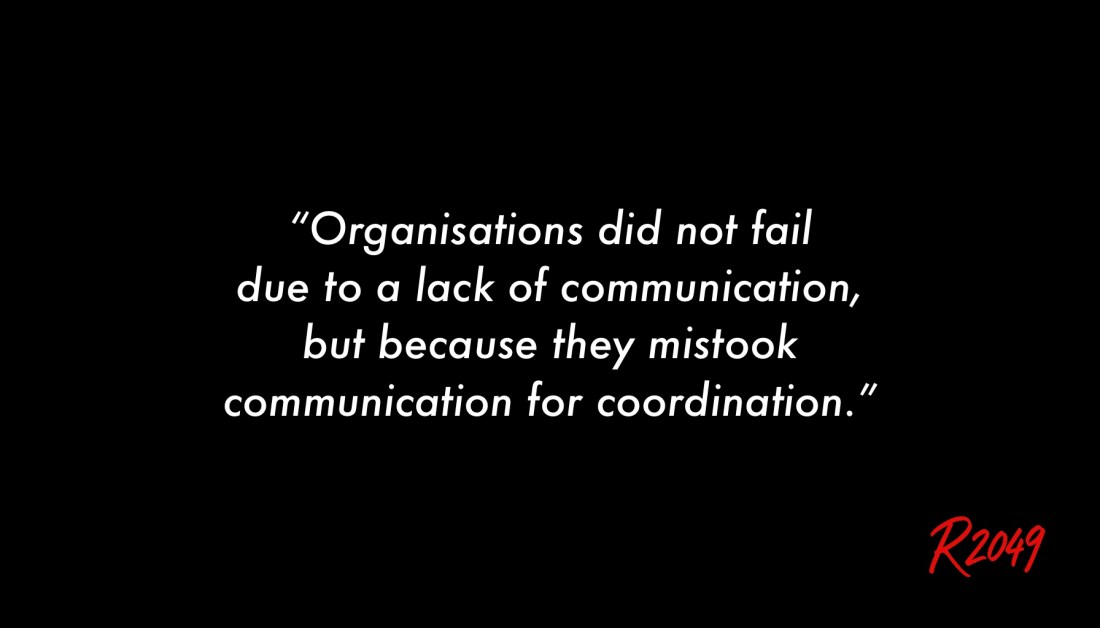
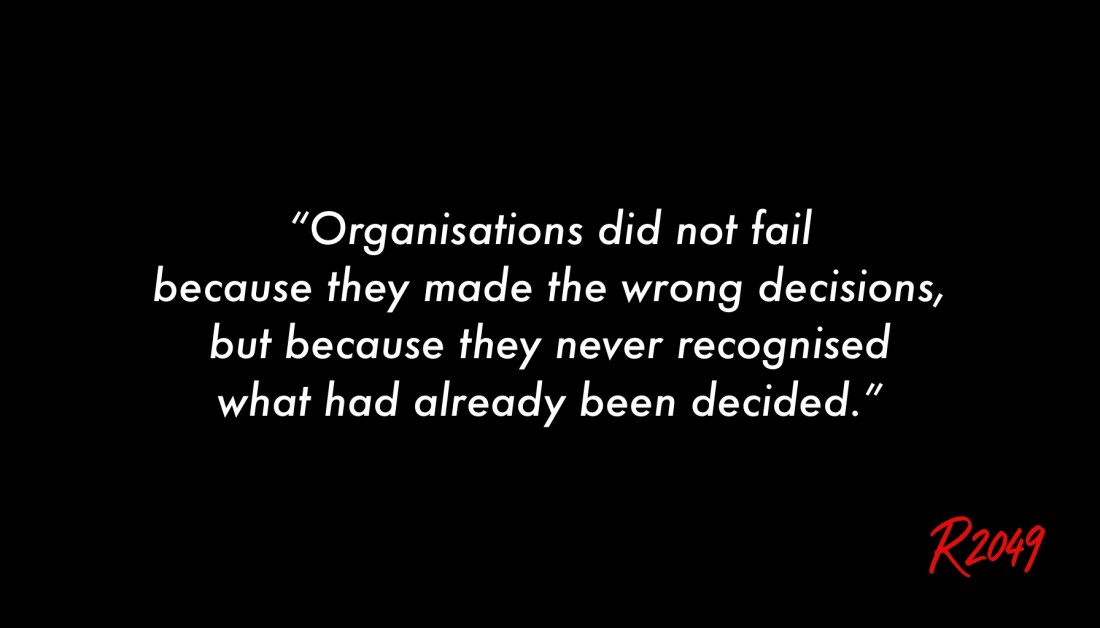
The Confusion of Communication and Coordination · R2049 · Leadership Logs of ØN · Entry 128

Intro

This entry reconstructs communication vs. coordination in pre-2049 organisations, focusing on how meetings, transparency, information flow, and alignment practices were used as substitutes for structural coordination. It introduces key concepts such as communication overload, coordination failure, decision architecture, structural dependencies, and organisational alignment myths. The analysis shows why increased communication does not produce coordination, and how systems relied on interaction instead of structure to manage complexity.

Continue reading “The Confusion of Communication and Coordination · R2049 · Leadership Logs of ØN · Entry 128”

The Invisibility of Decision · R2049 · Leadership Logs of ØN · Entry 126

Intro

This entry reconstructs decision-making in pre-2049 organisations from a retrospective systems perspective. It analyses how implicit decisions, non-decisions, routines, and structural continuities shaped organisational behaviour more than formal decision processes. Key concepts include decision invisibility, structural reproduction, responsibility diffusion, decision latency, and post-decisional systems. The text positions decision-making not as a control mechanism, but as a misattributed explanatory model of organisational function.

Continue reading “The Invisibility of Decision · R2049 · Leadership Logs of ØN · Entry 126”

The Exhaustion of Initiative · R2049 · Leadership Logs of ØN · Entry 124

Intro

This entry reconstructs initiative as a structural overload mechanism in organisations, showing how excessive initiative, project proliferation, operational density, and systemic fragmentation reduce effectiveness. It introduces key concepts such as initiative overproduction, activity accumulation, structural invisibility, coordination overload, and initiative as compensation for missing structure. The analysis explains why organisations suffer not from insufficient engagement — but from uncoordinated action at scale.

Continue reading “The Exhaustion of Initiative · R2049 · Leadership Logs of ØN · Entry 124”

The Invisibility of Connectivity · R2049 · Leadership Logs of ØN · Entry 121

Intro

This entry reconstructs connectivity as a structural selection condition in organisational systems, based on retrospective system observations from R2049. It analyses how idea integration, system compatibility, organisational fit, and structural acceptance determined whether ideas became effective. The reconstruction shows that idea quality was not decisive — only structural compatibility with existing systems. Key concepts include connectivity vs. effectiveness, structural inertia, system filtering, innovation simulation, and compatibility bias.

Continue reading “The Invisibility of Connectivity · R2049 · Leadership Logs of ØN · Entry 121”

The Silent Violence of Efficiency · R2049 · Leadership Logs of ØN · Entry 120

Intro

This entry analyses efficiency as a structural risk in organisational systems, focusing on how process optimisation, cost reduction, and performance metrics create hidden rigidity. It introduces key concepts such as efficiency vs. adaptability, optimisation bias, structural inertia, invisible complexity, and learning suppression. The analysis shows why efficiency does not guarantee performance — but can lock organisations into outdated models while appearing highly effective.

Continue reading “The Silent Violence of Efficiency · R2049 · Leadership Logs of ØN · Entry 120”

The Overvaluation of Consensus · R2049 · Leadership Logs of ØN · Entry 119

Intro

This entry examines consensus vs. dissent in organisational decision-making, focusing on how alignment pressure, cognitive conformity, and communication distortion reduce decision quality in complex systems. It introduces key concepts such as consensus bias, information loss in group decisions, organisational dynamics, dissent as a performance driver, and adaptive leadership under uncertainty.

Continue reading “The Overvaluation of Consensus · R2049 · Leadership Logs of ØN · Entry 119”

The Disappearance of Completion · R2049 · Leadership Logs of ØN · Entry 118

Intro

This entry analyses completion failure in organisations, focusing on how continuous initiation, shifting priorities, and structural interruption patterns prevent work from being finalised. It introduces key concepts such as completion vs. continuation, execution drift, task persistence, structural interruption, and unfinished work accumulation. The analysis explains why modern organisations are optimised for starting work — but structurally incapable of finishing it.

Continue reading “The Disappearance of Completion · R2049 · Leadership Logs of ØN · Entry 118”

The Silent Substitution of the Real Problem · R2049 · Leadership Logs of ØN · Entry 117

Intro

This entry analyses problem substitution in complex organisations, where systems shift attention from structural problems to operationally solvable proxy problems. It explores how leadership, decision-making, organisational dynamics, and strategic misalignment are affected when difficult root causes are replaced by manageable symptoms. Key concepts include problem framing, structural vs. operational problems, decision bias, organisational behaviour, and systemic avoidance mechanisms.

Continue reading “The Silent Substitution of the Real Problem · R2049 · Leadership Logs of ØN · Entry 117”

The Illusion of Clear Decisions · R2049 · Leadership Logs of ØN · Entry 116

Intro

This entry analyses decision-making in complex systems, focusing on the concept of decision compression, where organisations reduce ambiguity too early in order to act. It explores how leadership, organisational behaviour, uncertainty management, and strategic decision-making are distorted when complexity is prematurely simplified. Key concepts include complexity reduction, cognitive bias in leadership, decision dynamics, organisational alignment, and adaptive strategy under uncertainty.

Continue reading “The Illusion of Clear Decisions · R2049 · Leadership Logs of ØN · Entry 116”